
Towards the end of 2000, we were given the chance to appreciate, at the Lía Bermúdez Art Center in Maracaibo, Doménica Aglialoro’s installation Ecce Mulier. This show, curated by Ricardo Bello, had already been presented in 1999 at the Celarg Foundation’s RG Hall in Caracas, and at the Ateneo de Valencia, in Valencia, Spain in early 2000. It was conceived to be shown along with Nela Ochoa’s installation (or group of installations) ADN 8A.
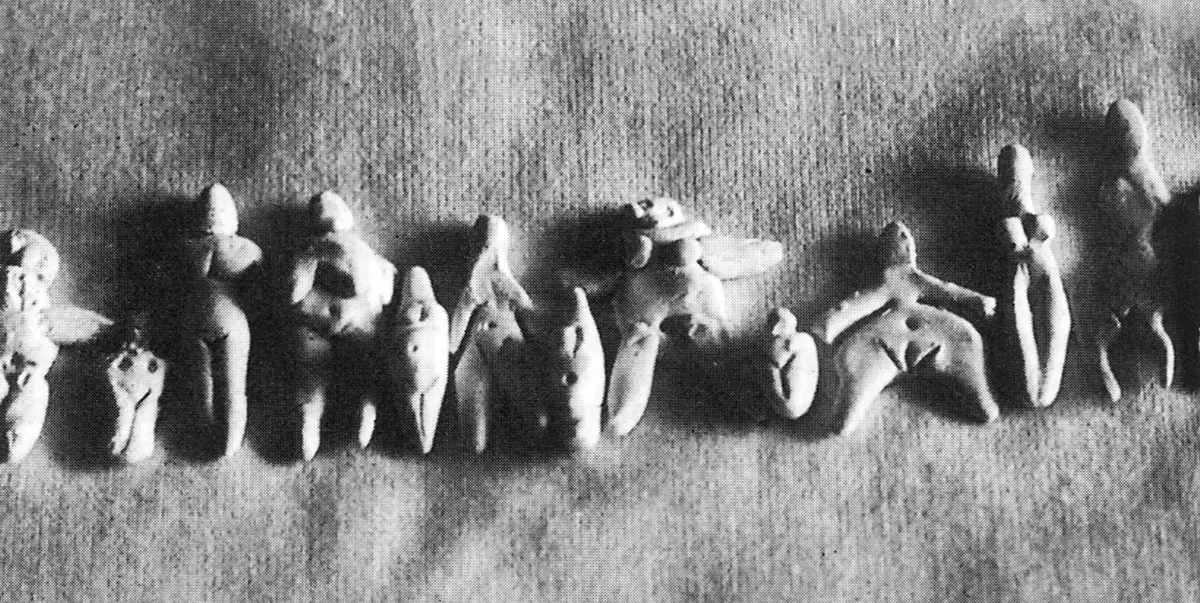
Doménica Aglialoro is a Caracas-born artist. She studied art in her native city and in Italy, and her career has developed in both places. Her artistic beginnings were linked to the graphic arts and, above all, to the fire-related arts; however, the experimental, extremely free bent her work has acquired in the last years has contributed to her being awarded several important prizes in Venezuela. Ecce Mulier is conceived as a 12-station suite in which the artist works with fabric, twine, and potter’s clay. At first glance, these works are moving, due to their simplicity and the plastic “sincerity” with which the materials have been worked and the pieces organized. In most of them, the white, clean fabric is a veil that both hides and subtly reveals something; twine presented as an evident, badly made seam, comments on traditional women’s work; clay, in the small molded figures, suggests the feminine hand that amasses and organizes, as if preparing and elaborate dish, in an intimate act.
Aglialoro’s themes allude directly to female sexuality and to the female imaginary associated to a woman’s intimacy, desires, and passions. It is in that sense that the form of the vulva appears repeatedly in many of her works, where a vertical orifice across the fabric can be bordered by, or embroidered with, clay thorns, letting loose innumerable connotations. Male sex as an object of desire and disappointment is similarly treated as a plastic object. In Ábaco (Abacus), for instance, the artist reconstructs that ancient mathematical instrument with beads that, upon close inspection, turn out to be diminutive clay penises.
Aglialoro’s work is imprinted with depth tending towards the archetypal, towards the most profound atmospheres of feeling. Thus, nothing in it can be gleaned from pure rationality. These works are somewhat mysterious; in them, the organic, corporeal matter is the evidence of an existence distilling into the soul.
It is impossible to find in these works any reference to the dominant trends in Venezuela’s contemporary art scene. Aglialoro labors in solitude in her exploration of the elements connecting body, passion, and death.
KATHERINE CHACÓN