
In his works loaded with a carnivalesque festivity that dispels any dramatic notion of the assumptions of identity, Douglas Pérez aims to tackle the issue of Cubanness by questioning stereotypes. As an inheritor of the Latin American discourse of decolonization, he “enjoys” history and returns it to us changed: His way of telling us that there is a possibility of becoming better human beings. The “price” to pay for aspiring to utopia is solved through a sense of humor.
The Good Painting and the Bad Idea (El buen cuadro y la mala idea), his most recent exhibition at La Casona, looks steadfastly at the clichés on identity, departing from stories in which negroes suggest the timeless presence of backwardness, poverty, precariousness, and mutilation—the contextual characteristics of the damage done by colonization. According to the artist, the show’s title, with its explicit double sense, responds to an effort to vindicate the painting, which has devaluated due to the imprint that the art market has had in Cuba. In his opinion, the language of installation or environments, inherited from the 1980s, not only has a functionality; it is necessary to recuperate the possibilities of the pictorial language as a system capable of influencing the collective conscience by providing reflections that go beyond the contemplative.
In this show, Pérez is interested in “talking about the levels of criteria and the need for our art in this day and age… to exploit tempera, a technique that has apparently fallen from grace with formal judgments … to use the colonial house [where the show was held as a coherent space, accessible to the issue of painting, as a transmitter of content, and by being a place that’s decrepit in architectural terms and as such evokes melancholy.”
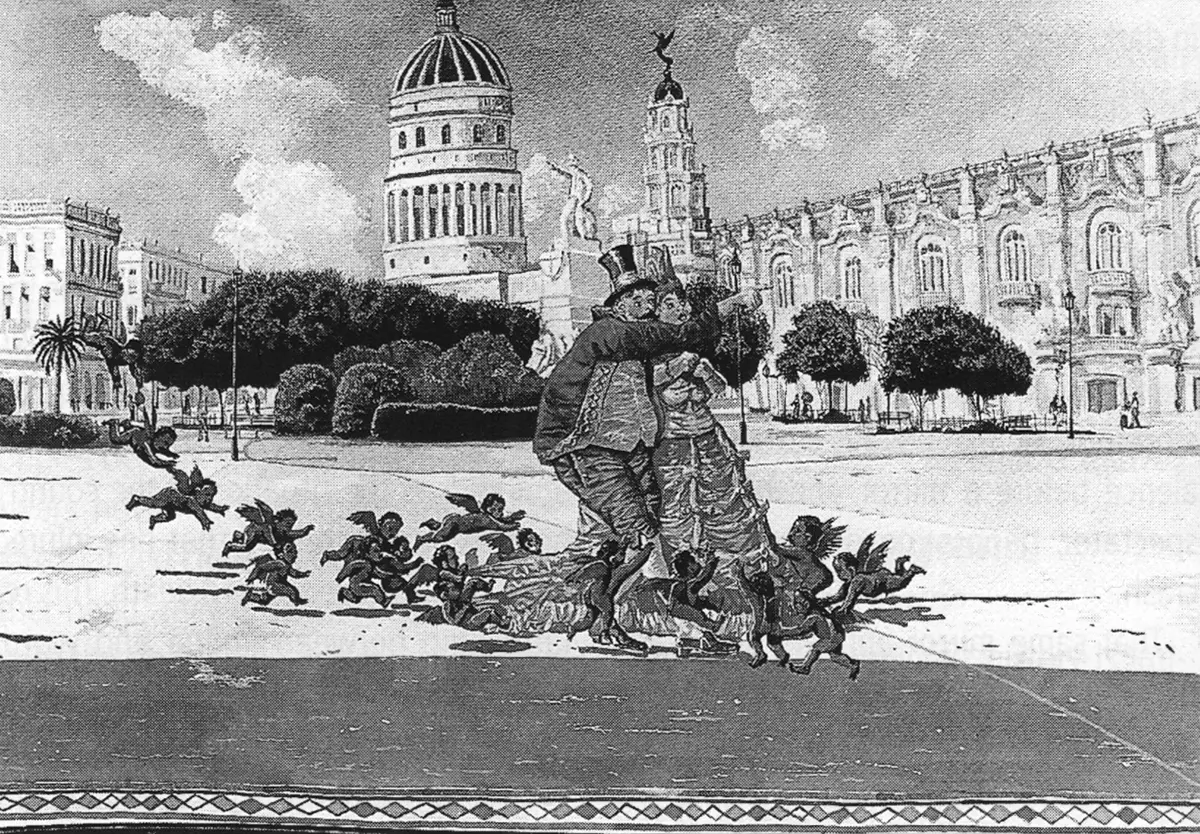
The show was composed entirely of tempera and oil paintings. With the former, he made fortuitous reference to the 19th-century lithographs of Eduardo Laplante—one of the earliest foreign (in this case, French) artists who took an interest in our lands. Laplante forms part of a group of foreign artists who during that time arrived in Cuba lured by the tobacco industry. The artists developed their original style on the tobacco’s packaging. That’s why Douglas uses tempera—to imitate the lithographs, maintaining their border ornamentation (borla) in a fashion similar to the packs of cigarettes. The “joke” is that his scenes work as a weekly sequence of a typical tourist visit that unfolds ironically in diurnal and nocturnal versions: the criolla aristocracy, the tourist, the black man, the beggar, the calash driver. All of these scenes share a univocal space where the concept of Cubanness is trapicheado (traded illicitly), seduced, mixed, degraded, and cooked in a sordid atmosphere.
Influenced by Laplante’s engravings, Douglas takes the sugar mill as an allegory, a sort of essence or abbreviation of the island’s idiosyncrasy. That’s where we can find the origin of many elements in our lexicography—customs, traditions, ways of understanding sexuality, of projecting ourselves before life in Cuba. From the sugar mill the artist has extracted the supposed keys to our psychology, on which the Negro is placed as the embodiment of Cuba’s negative traits: among them, the choteo (self-deprecating mockery, also called the “criollo disgrace” by Fernando Ortíz), the festive temperament, the voluptuousness, the unruliness, the want for quick success, the vanity—all mixed in the petri dish of an emerging psycho-social structure, where the fringes join the ranks of power through class, resulting in a hybrid of “cyclopean resistance..”
The fact that Cuba today is developing an apprehensive tourist industry that takes into account the restoration of the capital city’s architecture, taking care to maintain the marvelous remains of the colonial period, among which the tourists stroll leisurely or are driven around atop carriages, as in the olden times—all helps the artist to poke fun at the ongoing marketing scheme. And in the midst of these circumstances appear the jinetera (the local prostitute), the gallego (the Spaniard who settled on the island), the street vendor, the swindler, the pimp, the malojero (the seller of herbs)—indissoluble elements of Cuban reality. The stories told make us laugh at our own weaknesses.
Douglas has frequently been called a racist, due mostly to his “perverse” allusion to the world of blacks, who are commonly associated with acts of violence and social unruliness. But the truth is that the artist uses blacks to recall the past and the multiple deficiencies that colonization left behind. In his canvases, it’s not unusual to see the artist identifying himself with migrations looking for a sense of belonging or a change toward a different state of affairs. Due to its colonial history, Africa is the continent the artist refers to constantly. He feels provoked by the way its inhabitants, uprooted from their land, found in the island a place where there wasn’t a well-defined psychosocial structure, which allowed them to adapt themselves by partially incorporating their customs and traditions amidst the symbiosis with the rest of the racial elements that intervened in the shaping of our nationality.
Douglas makes an effort to rescue the qualities found within the academic tradition, which in the country has found itself eroded during the last decade. For such purpose, he uses Esteban Chartrand’s landscapes and the Basque painter Víctor Patricio de Landaluze’s folkloric scenes, where the guajiro, the negro, and the mulatta appear. We find an excellent technique in tune with relentless conceptual research, both gained largely from his stay at the Instituto Superior de Arte en Cuba. He’s part of a group of creators who in the 1990’s decided to make academia their trade, with the intention of vindicating its values, especially those of painting.
El buen cuadro y la mala idea hides a philosophy of precariousness that takes advantage of identity clichés in order to meditate about them while at the same assuming the concept of nationality without those prejudices, euphemisms, or veils that elicit Maniquean reactions and prevent sheer enjoyment, even if it carries a little photo implicitly in it.
AMALINA BOMNIN