
The Mexican Problem is a contentious title for a contentious exhibition. Both the title and the work on display are intended to push people’s buttons, to upend political correctness, to be offensive, if necessary, just to get people thinking about some of the complex issues regarding U.S./Mexican relations. The first question to ask is, what is the Mexican problem? From the U.S. perspective, it might refer to the influx of illegal Mexican immigrants into California and Texas. From the Mexican perspective, it might relate to the cultural colonialism imposed upon its citizenry by the U.S. media. Or, from a purely economic perspective, it could refer to the NAFTA treaty and the controversies surrounding it since its inception.
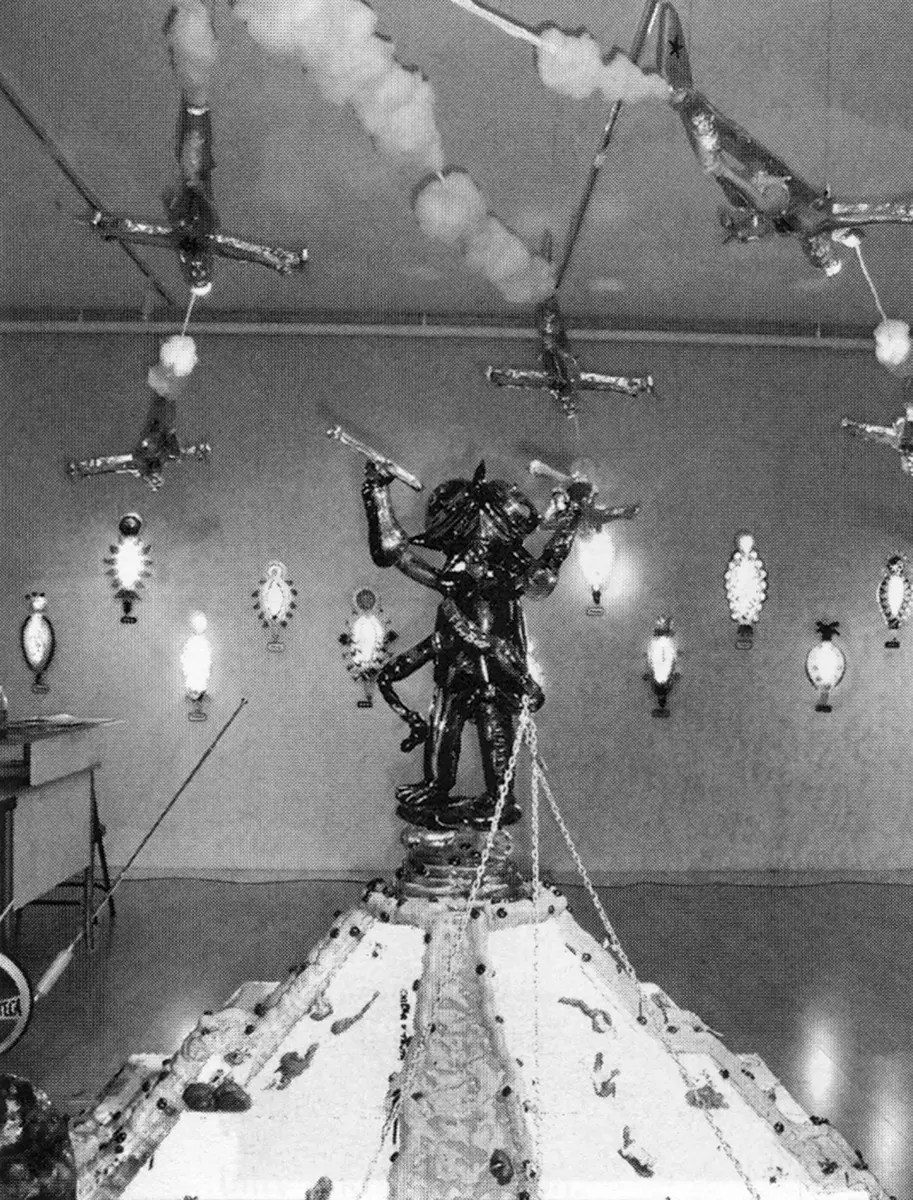
For Jamex and Einar de la Torre, two brothers who work collaboratively on their sculptural installations, it refers to the stark dualities that exist in border towns, in this case, in the San Diego/Tijuana region. The brothers divide their time between their home in Ensenada, Mexico, and their studio in San Diego. This experience of living on both sides of the border has had a significant influence on their work, and the main theme encountered in The Mexican Problem is the unavoidable culture clash that arises from the U.S. and Mexico’s close proximity to one another. But while these nations and their respective towns of San Diego and Tijuana sustain dramatic contrasts, they necessarily exert a profound socio-economic influence upon one another. The resulting hybridized cultures that have emerged within these “in-between” areas are often wonderfully inventive yet oxymoronic, and De la Torre brothers critique such cultures with due wit and irony.
Working in the rasquache method which refers to the process of making something out of found materials and detritus, the brothers have mined their immediate surroundings for kitschy paraphernalia that they combine with exquisite, hand-blown glass pieces in excessive, neo-baroque installations. Their work simultaneously embodies a garish, populist Mexican aesthetic as well as the crass commercialization of American life and the Mexican lust for it. Acquisition of material goods, expressed here in the form of a frenzied accumulation of TV sets and satellite dishes, comes to represent a third-world yearning for the fulfillment of the American dream.
But the De la Torres brothers are careful not to impose their own codes of taste upon the populist vein sampled here. The term rasquache can also mean a disregard for the privileged class system that determines “good taste.” The artists purposefully subvert any elitist paradigms that hold fine art above the realm of popular culture by debasing any and every subject matter that comes under their scrutiny. Nothing is too sacred not to be treated with equal doses of profanity and kitsch: colorful, blown glass vulvas shaped like the image of the Virgin of Guadalupe cover one wall of this room-sized installation; plaster Jesus effigies spray-painted green to look like U.S. bomber planes fly towards the vulvas in the form of a targeted military assault; figures from Aztec mythology are trivialized, commercialized, turned into logos to sell mass-product, as in the image of one Olmec head decorating a satellite dish for the popular station Aztec TV.
The Mexican Problem presents a series of bedazzling scenarios in which mythological heroes interact with political leaders and martyrs and share screen time with soap opera stars, interweaving everything into a cohesive, multi-layered narrative that is charged with political commentary. El Fly Boy, an insect-like sovereign presides over the whole circus-like affair like some sort of despicable master of ceremonies. Standing on top of an excrement-covered pyramid, he holds the reigns of three pigs that take on the roles of capitalism, religion, and the Mexican political party PAN. Does El Fly Boy represent the newly elected Presidente Fox? George W.? Whatever his identity, he benefits from a democratic system sullied by political corruption and capitalist greed. And in situating the viewer right smack in the middle of this all-encompassing installation, the De la Torres reminds us that, whichever side of the border we live on, we are all bound together within this new global economy.
BERIN GOLONU