
Ernesto Neto’s O Casamento (The Wedding) is more than just an art show. It’s the creation of a space where the artist celebrates his marriage to Lili and his union with Lito, their gestating child. These works exhibited at the Museu de Arte Moderna are simultaneously the witnesses and the traces of the act, and of the moment in which it occurred. In each of these pieces, sculpture-installations to be seen and also physically occupied and inhabited, Neto reaffirms his interest in the interstices, the contact zones, the de-formations that result from the encounter of two bodies or two surfaces.
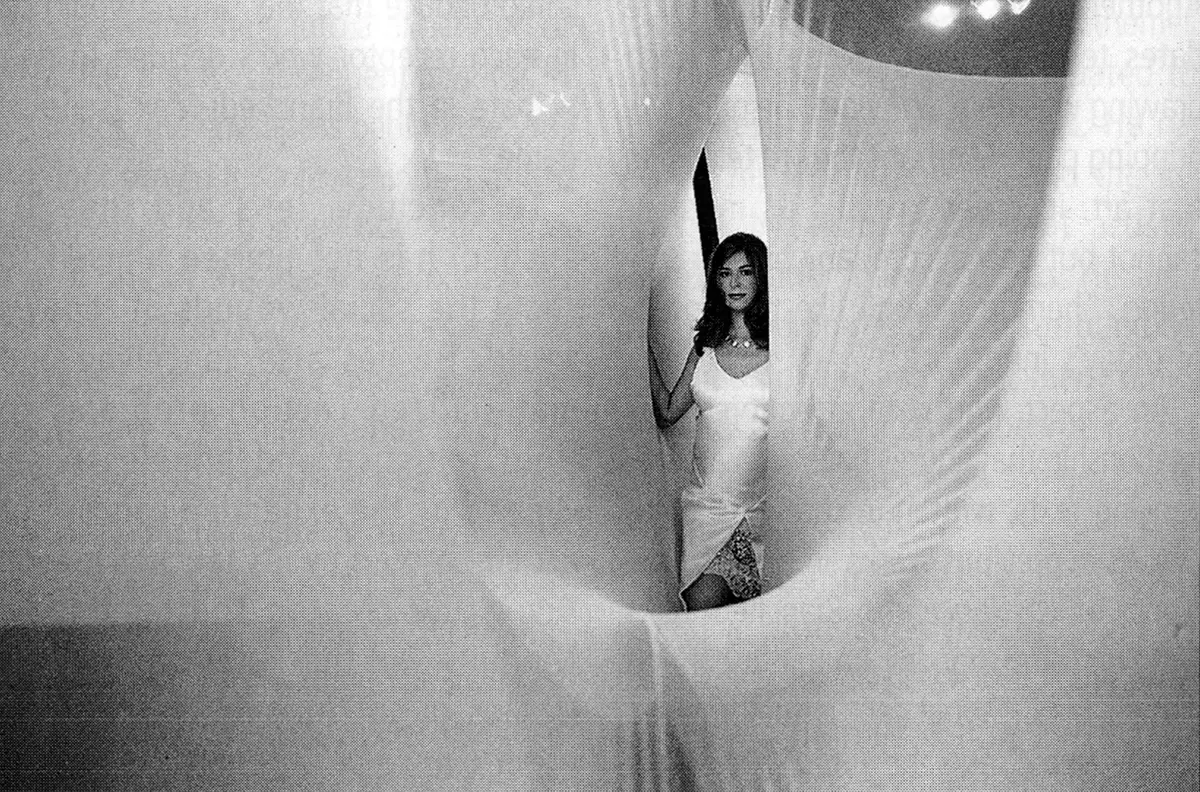
Descaminhos de Lili (Lili’s Paths) is a tunnel made of the same almost-white fabric with which Neto builds his Naves (Ships) and his sculptures. Lili walked through this tunnel, entering each one of its bifurcations until she found her flower bouquet, on the night of the ceremony. Following now in her footsteps, entering with bare feet the narrow passages of that bridge tunnel, we feel how the movement of our arms in search of balance actually widens the path, and how our weight stabilizes the structure on the ground. The bottom seam that closes this malleable solid can serve as our guide in walking through the tunnel, working as a balance beam we force down to the ground step by step, without altogether eliminating the vertigo.
Útero capela (Uterus Chapel) is another of Neto’s inhabitable sculptures, and it is here that the bride and groom were married. From the outside, this piece appears as an organic solid, and from its insides, we get a diluted view of the space it doesn’t enclose: the museum and the art it contains, the video projected on a wall as a register of the ceremony-performance, and the exterior landscape revealed by a window. We get this view through an almost transparent film that defines and limits this habitat as a membrane. Útero capela proposes a space that is both internal and external, not only because of the permeability and transparency of its borders. Both spatial realities intertwine in the curves that bring intimations of the external space to the structure’s center, as parenthesis allowing the insertion of the outside into the inside; as a Klein bottle which, by the coincidence of the bottom and the neck, transforms inside and outside into a continuum.
In Corpos corpos corpos (Bodies Bodies Bodies), Neto builds a huge collective mattress. Lili reclined here at the end of the ceremony, at a moment when the performance alluded to a goddess of fertility. The relief in this ample, solid piece molds and adjusts its shape to the laying bodies. In this case, the transformations we impose on matter are more lasting than those produced in Descaminhos. The piece does not return to its original shape when we leave it; on the contrary, the imprints of our bodies stay and are incorporated into the work, in the exact position in which the body received us. The imprint will not change until a new body occupies the space, like an Archimedes bathtub possessing memory.
The same obsession with limits, contours, and borders, and the same interest in the malleability and permeability of materials, spaces, and bodies, are reflected in the artist’s decision to transform his marriage into a performance and an exhibition. With this gesture, Neto expands the contact surface between the museum and other institutions, between performance and ritual, between the imaginary and the real, stretching to its limits the membrane that separates the work of art from daily life.
In joining two separate subjects, matrimony brings bodies together, giving greater plasticity to their rigid contours. This is the behavior of Neto’s pieces, which envelop the body, guide it, and give it comfort. We walk through these works and join them by giving them shape in ways that they themselves determine. Impregnation is the moment of synthesis for this approximation of bodies, fluids, and genes. If a couple is not just the sum of two individuals but what results from the transformation of their encounter, maybe it is in the genetic combination originating a child where the idea of resultants, so dear to Neto (the very name of the artist’s son, Lito, is the result of the fusion of Lili and Neto), reaches concretion. Surely the gestating period is the lasting moment in which the interpenetrability of bodies reaches its limit, joining them in an indivisible totality, a single entity—expanded, widened, with something inside from the outside.
CARLA ZACCAGNINI