
Hugo Palma Ibarra’s (Nicaragua, 1942) life has been marked by two dissimilar but equally enriching art scenes, Italy and Nicaragua. In Italy, the artist learned from the great masters of Western painting; in his native Nicaragua, from the hard realities of life, the wounded landscape, the light that diffuses form, and from those optimistic human beings who sing the beautiful country of their hearts. Palma-Ibarra expresses the anxiety of one who creates a grid within the pictorial space in order to give life to anonymous objects and characters, while at the same time sectioning the other space, that of Being, to meet its loneliness. Preludios (Preludes) was the title of this show comprised of small-format paintings that, like self-enclosed jewels, were offered to the public as an autonomous preamble of what was to come. Preludes as announcements of larger works to be developed at a later time.
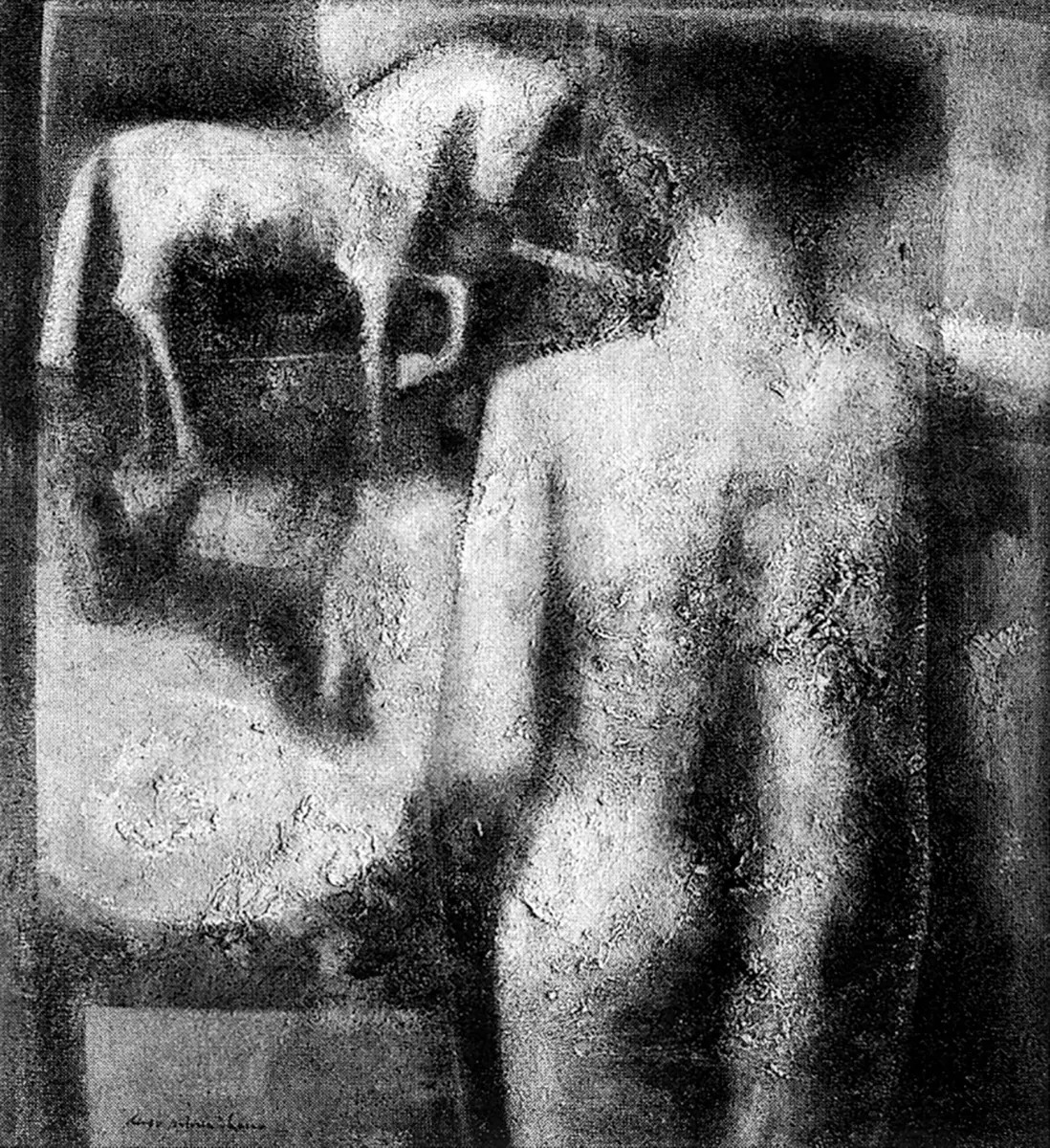
Horses, nude figures, and bells are some of the dissociated images populating this Nicaraguan artist’s repertoire. The dissociation of the pictorial frames of reference is here a recurring device, an active visual universe interacting along a structure of vertical and horizontal planes superimposing on each other, and enclosing independent images. Thus, a turning nude figure in close-up enters into a dialogue with a horse in the background, without a crossing of affection, in works such as last year’s En el camino (On the Road). The richness of these multiple planes, and of matter and visual textures, creates an elegant equilibrium between theme and means of expression on the works’ surfaces. In the manner of the still life, Palma-Ibarra’s works erase gestural disorder and move into the fragmentation of visual discourse, leaving to the viewer its reconstruction as a moral act. This is the representation of intimate thoughts expressed in secret signs, to be discovered slowly.
Palma-Ibarra has created his own vocabulary based on personal study and analysis of the great moments in the history of figurative painting. But his colors come directly from the ochre-colored land of his birth, with its muted chromatism. Yellows play into various golden tones, diverse reds, translucent whites, and browns: a palette of unending possibilities. Color, planes, and forms join in the exploration of pure perceptions, without recurring to sleight-of-hand or painterly acrobatics. The artist, a quiet and calm man, works his canvases with the patience of a monk intent on cultivating his internal world in order to help others.
The artist renounces the violence of the brushstroke, adopting instead a meditative, harmonious composition developed from fragmentation. It doesn’t matter that a circle representing a ball shares the pictorial space with a faceless female figure, or that two more female bodies, suggested by their contours and implying loneliness, are placed next, as in the Apariciones (Apparitions) series. The violence of these almost mutilated bodies, variations on the theme of loneliness, needs to be simulated. But here painting is not only a theme; it’s art. The artist controls and maximizes his media, putting them to work toward a specific goal: turning painting into a real possibility of freedom.
The Preludios series signals the presence of a true artist, one whose two-dimensional work creates a language that brings him closer to himself and to the viewer. He continues to privilege the essence of what it is to be human, and in this humanist search enters a real sensorial universe of singular dimensions.
BÉLGICA RODRÍGUEZ