
“The house a symbol of the link between our imaginary world and reality. That house’s objects as expressions of solidarity, affection, and cohabitation.” This is a constant found in Ismael Mundaray’s (Venezuela, 1952) painting. In Travesía (Voyage), the show of his latest works at the Galería Felix, he uses the house as an imaginary space containing the objects of domestic life. Shoes, dishes, a bed, and a pitcher, all talk visually of a human presence but in absentia, an invisible presence existing only in the vital breath. In other words, it can be felt and sensed, yet is not present, perhaps it’s part of the ghosts accompanying us. The great empty spaces explain this absence artistically and thematically.
When he paints in a series, the artist consolidates his usual topics, which have man and his environment as their backbone. It’s his voyage from the indigenous villages where inhabitants dwell in the communal house, to the urban house where man lives surrounded by objects so as not to be alone and represent himself in object forms, in many cases banal. Consequently, his painting is a metaphor for a “place” loaded simultaneously with presence and absence, mysterious feelings, and signs with no literary load. All this serves as an excuse for the artist to install himself in the painting, where color and light have a functional character. The pictorial material defines the structure of the canvas’ surface in large planes of colored light and shadow in which the solitary objects are inserted.
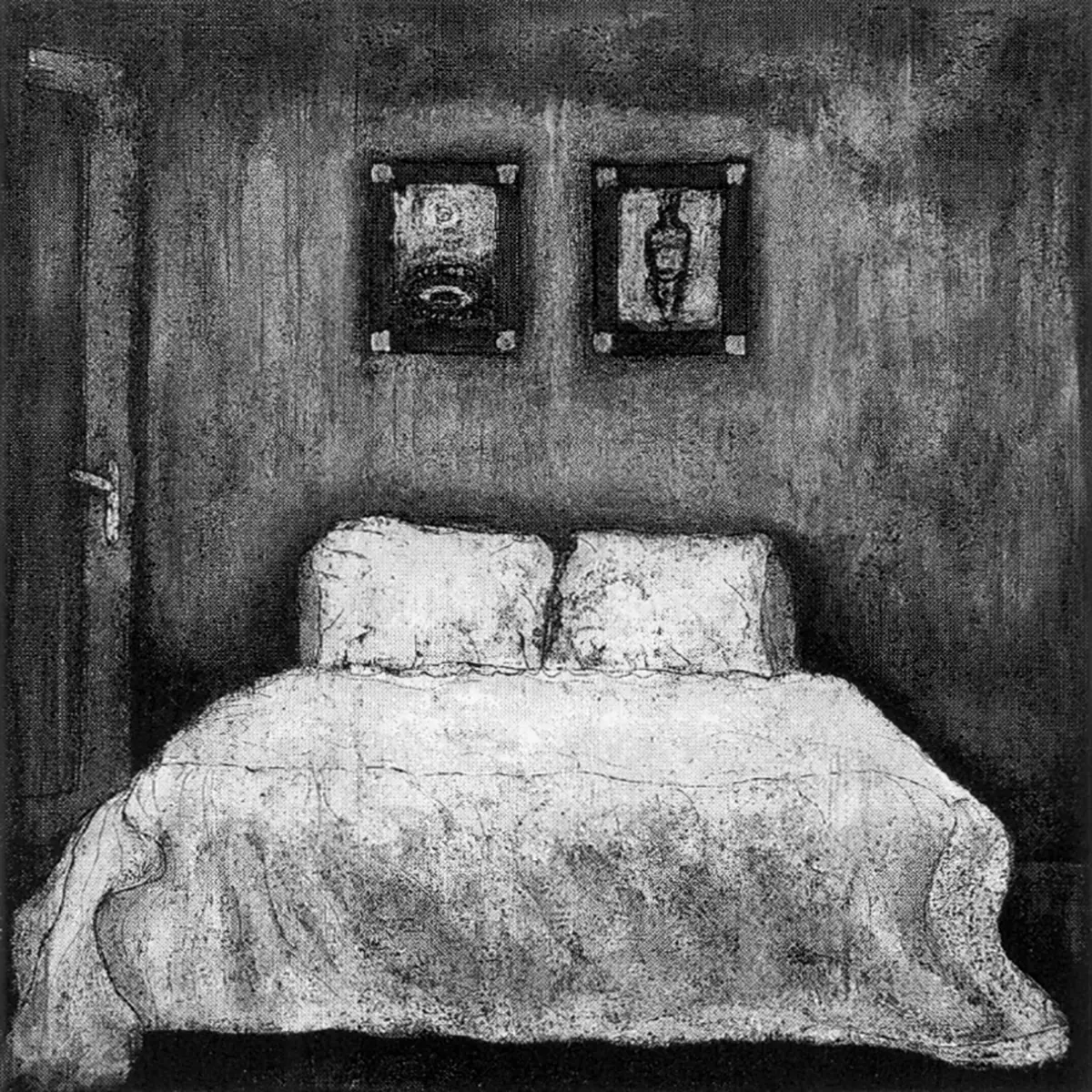
Painting in itself has a particular importance in the series Travesía (Le lit). A large bed covered with a yellow-ochre color is presented foreshortened in a solid first plane. The bed is at the same time a symbol of absence and the household object waiting to fulfill a function. As with the objects in all the other paintings, the bed is the environment; it’s what’s there, what remains. With a figurative repertoire essentialized in the shape of the objects and an abstraction configured in space as an active entity, Mundaray renounces an essentially minimalist vocabulary to enter the rich possibilities of the artistic dialogue between the former and the latter. There resides the modification of the ordinary, elevated to the sublime as part of a conceptual proposal. It contains the surprise of the creative journey to the unknown, toward those tangible atmospheres where the register of his reading only needs a minimum of resources to make an event out of the pictorial discourse.
With patience and will, in his paintings Ismael Mundaray reflects on his fellow man. He proposes a journey in which nothing is simple or left to chance. On the contrary, the calculation is part of a creative attitude in which the formal is a vehicle to express a theme and vice versa, and in the end, the only thing that matters is to make art. His studies in geodesic engineering have not been in vain, nor has his dedication to drawing as a means to master the pictorial space. The same can be said for his long study trips made to the realities of man and his material and metaphysical traits. All this has been of use at the moment of proposing a new series, which has its origin in the previous one. Travesía is a consequence of Orinoco, and this of Wabanoko, Casas Con Corrientes De Aire (Houses with Currents of Air), and Shabonos. With the scientific sharpness of an anthropologist, he’s gone back and forth in the universe of Venezuelan indigenous cultures and their habitat, and with the intuition of modern man, he’s busied himself in developed societies. All the series form a long line ending in Travesía, which took him to the Orinoco River, in Venezuela, and the Seine, in Paris. To say, “The journey is me,” in the artist implies the possession of a topic that has to do much with him and his peers as well. The journey is a showcase of eloquent and mute witnesses of past, present, and future lives. It’s the continuation of man through those witnesses, or "the representation of the basic things surrounding me, a chair, a shirt, a dress, and some shoes. It’s my pictorial journey from the delta of the Orinoco River to the intimate universe of objects. But the house is my inspiration’s central object, in this series and the previous ones as well."
Mundaray moves from his local space to the metaphorical space of the spirit and the soul. There, curiosity and hard work yield the artist’s solid calm as a result, which doesn’t obey the imagination’s transitory whims. Imagination is the source of creativity, but only when it has sided with the command of artistic media and clarity of objectives. That way, he has the last word.
BÉLGICA RODRÍGUEZ