
The centenary of Ismael Nery (1900-1934) was remembered last year with a retrospective held at the Centro Cultural del Banco del Brasil in Rio de Janeiro and at the Museo de Arte Brasileño, in São Paulo. This show exhibited in Brazil’s two main cities, demonstrated the importance of his work and his uniqueness in Brazilian art of the twentieth century. The legacy of this artist was unique because of the profile of his work, which mainly focused on the human being, his processes of subjectivity that are permanently worked, and which transcend the limits of the time in which he lived. Nery’s work reveals a full state of currentness, expressing the dramas and conflicts present today.
At the moment in which the recognition of a multidisciplinary approach to the study of art is gaining strength, it is important to underscore the fact that Nery’s work is enriched under the light of psychoanalytical interpretation. The explanation of the process of symbolization with the theses of Freud and Jung allows us to redirect the dimension of his legacy on Brazilian culture.
In the context of Brazil’s artistic modernization beginning in the ‘20s,1 keeping the city of São Paulo as the first scene, and later Rio de Janeiro as well, Ismael Nery was among those who opened a dialogue with the artistic vanguard, formally absorbing elements of expressionism, cubism, metaphysics, and surrealism. His work, aside from the strong human content, does not incorporate into its aesthetic project the question of cultural identity, key to the modernist debate of the moment in Brazil. This made it possible for the artist to be seen as “the only avant-garde painter” working in Rio de Janeiro in the ‘20s.2
At 33 years of age (he passed away seven months before turning 34), Nery left behind a dense and cohesive work. Drawer and painter, he was also a poet and philosopher, creating in his aesthetic praxis a theory that he called “essentialism.” He also created fashion design, architectural projects, and scenographies for the theater. Friends who lived with him say that he had a fascinating personality, attracting a group of intellectuals around him, such as the poet Murilo Mendes, the painter Guignard, and the critics Antonio Bento and Mário Pedrosa, among others.
In his short life, he never sold a piece and he held few shows. His work was exhibited beginning in 1965 when five of his pieces made up the show Surrealism and Fantastic Art at the São Paulo Biennial. Shortly thereafter, he held a show at Rio de Janeiro’s Petite Galerie. After that, he began to grow into one of the most highly valued artists in Brazil’s art market and he won recognition as one of the most important Brazilian artists who had turned to the avant-garde. Nearly two years earlier, one of Nery’s pieces brought in $220,000 in an auction held in Rio de Janeiro.
Denise Mattar, the curator of the centenary exhibition both in Rio and in São Paulo, gathered one hundred works of the artist, including 43 oils: nearly half of what he painted in his short life!
There has not been an exhibition of Ismael Nery’s work in Brazil in sixteen years, and since all the pieces come from private collections, the public was given the rare opportunity to come into contact with the artist’s production.
The curator states that Ismael Nery was an enigmatic man and that his personality cannot be dissociated from his work. She also points out that Nery did not face art as a job, but rather as a way of expressing ideas, and he stood out from the intellectual reality of his day. He was a fervent Catholic at a time when intellectualism was adopting left-wing positions. He sought an international language when Brazil’s modernist movement was working on questions of cultural identity. He was a mysterious person on the Brazilian art scene and, according to the curator, his premature death turned him into a myth. This fact led her to title the show Ismael Nery: 100 Years The Poetics of a Myth.
From the Latin American perspective, it could be considered that that mythic dimension is more or less similar to that of Frida Kahlo in the Mexican context.
Nery’s position is, without a doubt, unique in Brazilian art. No other artistic personality of Brazilian modernism has cultivated in his aesthetic project that approach between artistic renovation and mysticism, an aspect that is very present in the European avant-gardes. From that perspective, and as regards Latin America, Nery should be studied in comparison with Xul Solar and Torres-García.
The Brazilian artist developed a philosophy that he called "essentialism,"3 according to which "man does nothing that does not at least have the great value of an experience. Essentialist man is . . the man who, having exhausted the experiences that life has to offer, tries to extract a philosophy grounded in the results of his choices. Life for the essentialist is a construction that begins with birth and ends with death. Every man possesses a determined coefficient of energy and time that cannot be squandered without a final loss. This is why we must give the greatest efficiency possible to the actions of our lives. Essentialism came to the conclusion that life is nothing more than a supplier of constructive elements and it presents itself to us without any type of pessimism or optimism, since its reactions are always proportionate to our actions, and the balance of life is indestructible...We wish to have harmonic Knowledge."
His thought presents a foundation on a theological order at the same time as ideas marked by the socialist left appear. A possibility of making Catholicism compatible with Marxist thought occurs in Nery’s philosophy, similar to what we see in another important name in Latin American intellectual reality: José Carlos Mariátegui.
Training and Contact with avant-garde Languages
Regarding his training, it is worth pointing out that he studied at the School of Fine Arts of Rio de Janeiro, and in 1920 he traveled to France, to study at the Académie Julian in Paris. In this period, however, he must have had access to the languages of the renovating movements, for it is after this moment that his work presents some expressionist and cubist lines. Designs strongly characterized by Art Deco are also observed at the beginning of his career. In 1927, he traveled once again to France, where he met Chagall and André Breton, among other celebrities of the cultural circle. He was impressed by the work of the aforementioned painter and this impact would mark his work. The artist then absorbed aspects of surrealism.
This is why, for a long time in Brazil, he came to be considered the only artist of surrealist modernity.
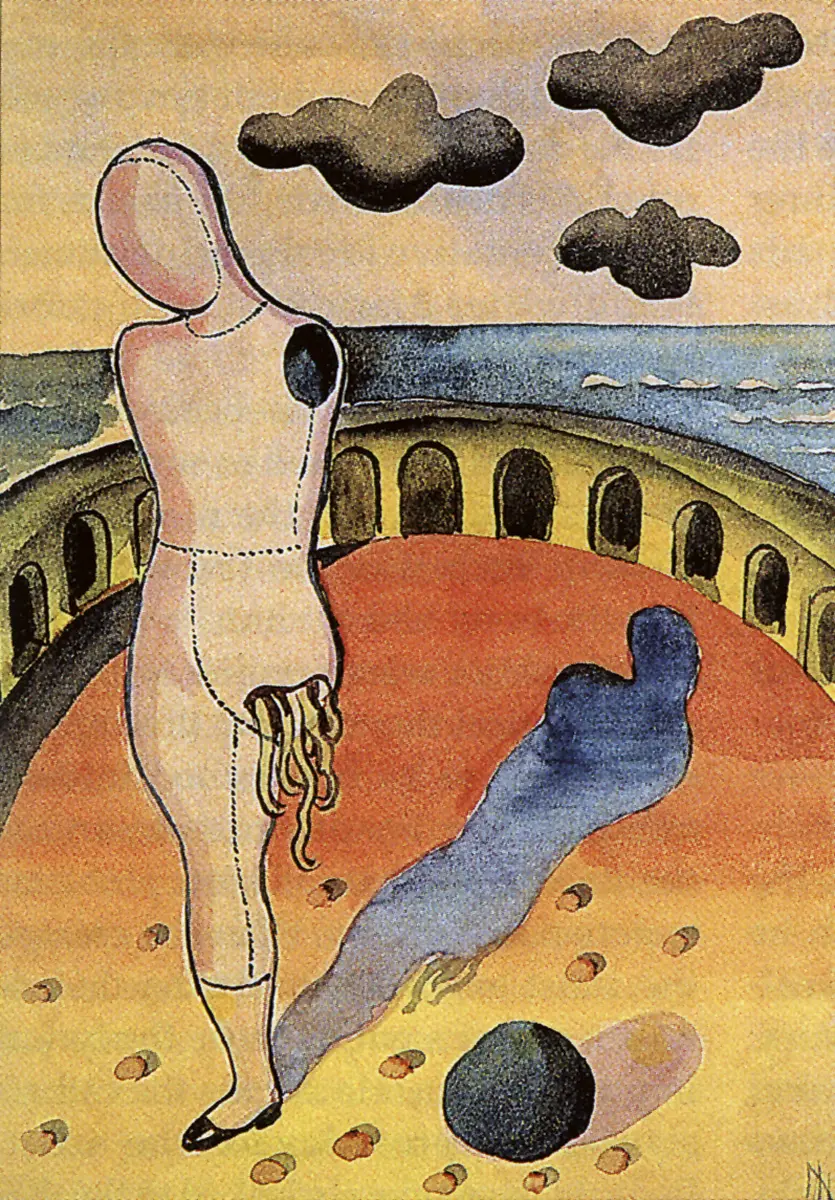
In spite of the fact that he had used the designation of surrealist for some of his works—he called two of his pieces, one from 1928 and the other from 1929, Surrealist Composition—we find in his work a strong symbolic richness that certainly comes from the philosophical theses with which he was struggling. The theme of surrealism as a dream is absent from his work. Nonetheless, there is a metaphysical dimension that, at some points, draws him near to a De Chirico, for example.
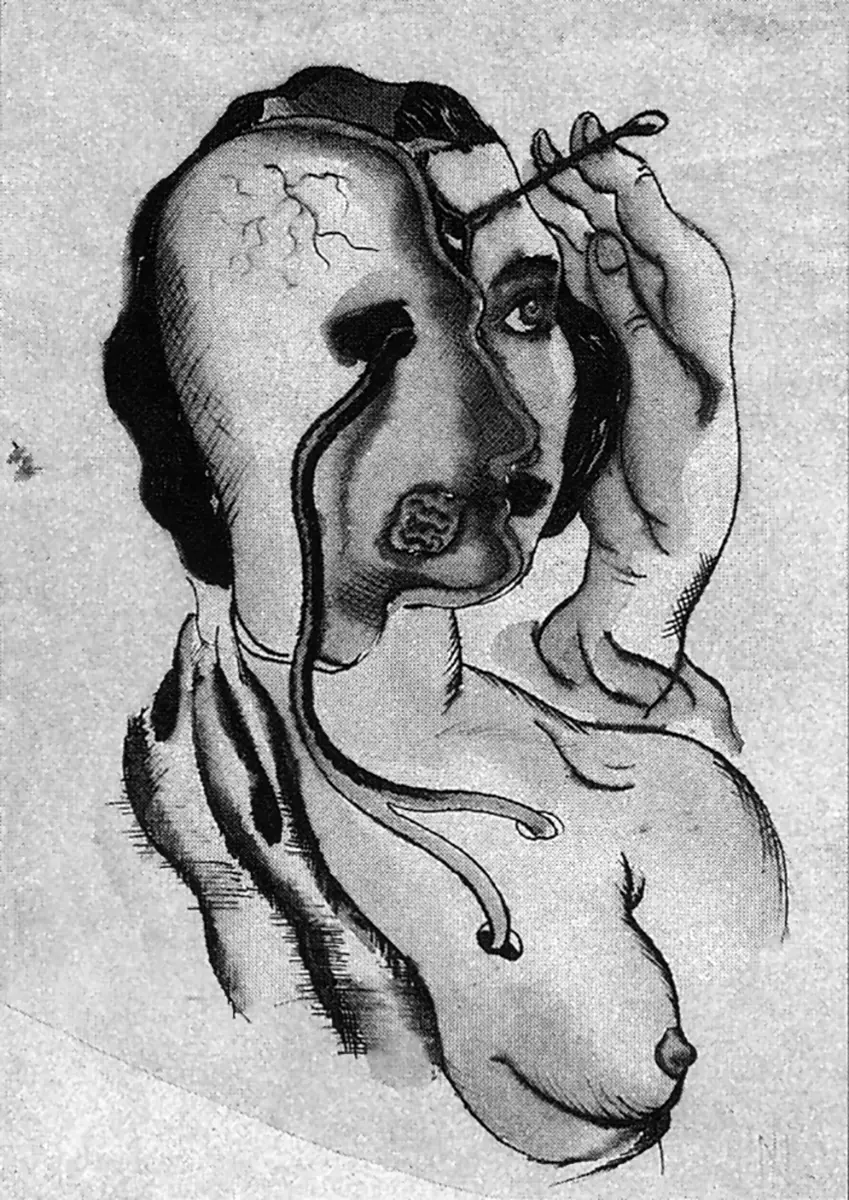
Before the representative group of works gathered for this centennial show, Nery’s aesthetic can be perceived with greater complexity since both his aesthetic and his ethical data are strongly insinuated in his work (his theology, his essentialist philosophy).
On the other hand, the montage of the exhibition, where the works were placed next to pieces of poems, clearly showed that, having also devoted himself to poetry in the last two years of his life, both contexts must be studied in their interrelation. His creation process can best be understood by comparatively observing the two fields of his poetics.
The Human Being as Central Theme
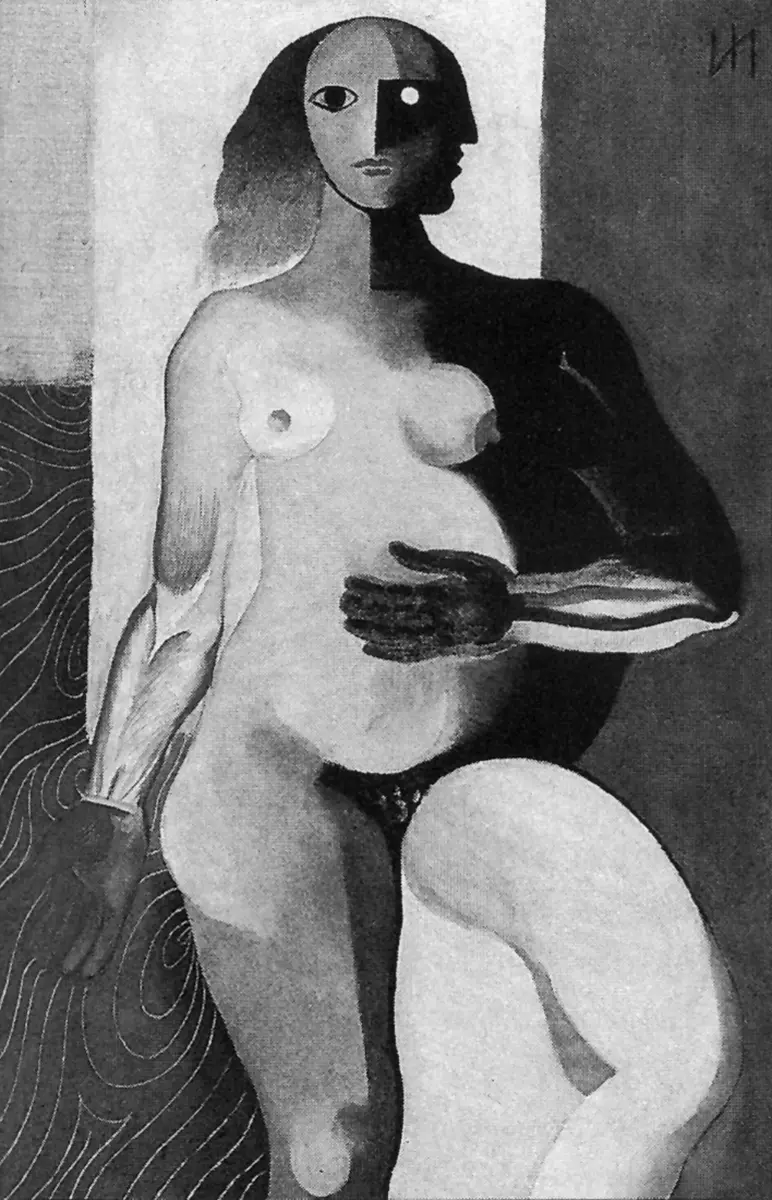
The central theme in Nery’s work is the human being. In a human being where the I and the other are confused, the male I and the female I are superimposed. When his work absorbs aesthetic elements of expressionism, cubism, metaphysics, and surrealism, the key content of his work is not altered.
Already in 1928, the Brazilian critic Mário de Andrade considered the artist to be a creator who “almost lives a mystic obsession, concerned with the realization of a human ideal type."4
He observed that standing before his pictures, “one gets the impression that the problems expressed in one are developed and finished in others.” For this critic, the search for a representative ideal type of human being unites Nery to investigators like Modigliani.
Another critic, Mário Pedrosa, later recalled that Nery used to say that the body was the form, the mold of the soul.5 Such was the sacred nature that the body had for him.
Both critics were familiar with psychoanalytical theories and this dimension seems to be understood in their interpretation.. For de Andrade, art has the ability to exorcize all inner problems experienced by man. When he creates, the artist expresses what the unconscious screams out, whence the lyrical impulse is born. He admits the catharsis that art provides for the artist. Pedrosa, more closely linked to the thesis of the psychology of form, understood that the emotional tensions and changes of the artist’s unconscious were expressed in his creative intuition.
The human question translated into the problem of the I and the other, present in many aspects of Nery’s work, could be understood through psychoanalytical interpretation.
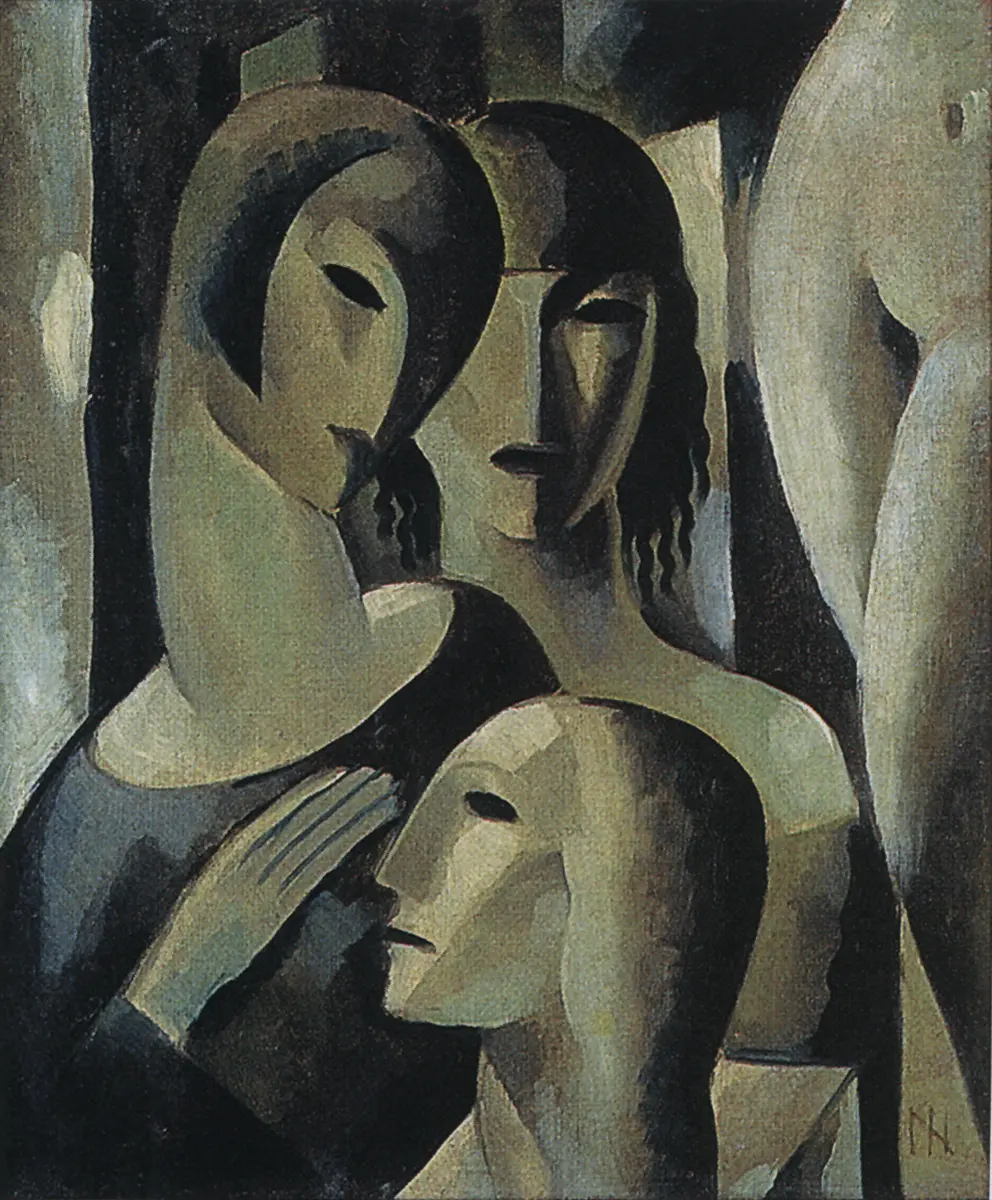
In many of Nery’s pieces, two figures appear, one overcoming the other, suggesting the male and female elements in interaction (or tension) in the personality of the individual (Figure, Surrealist Faces).
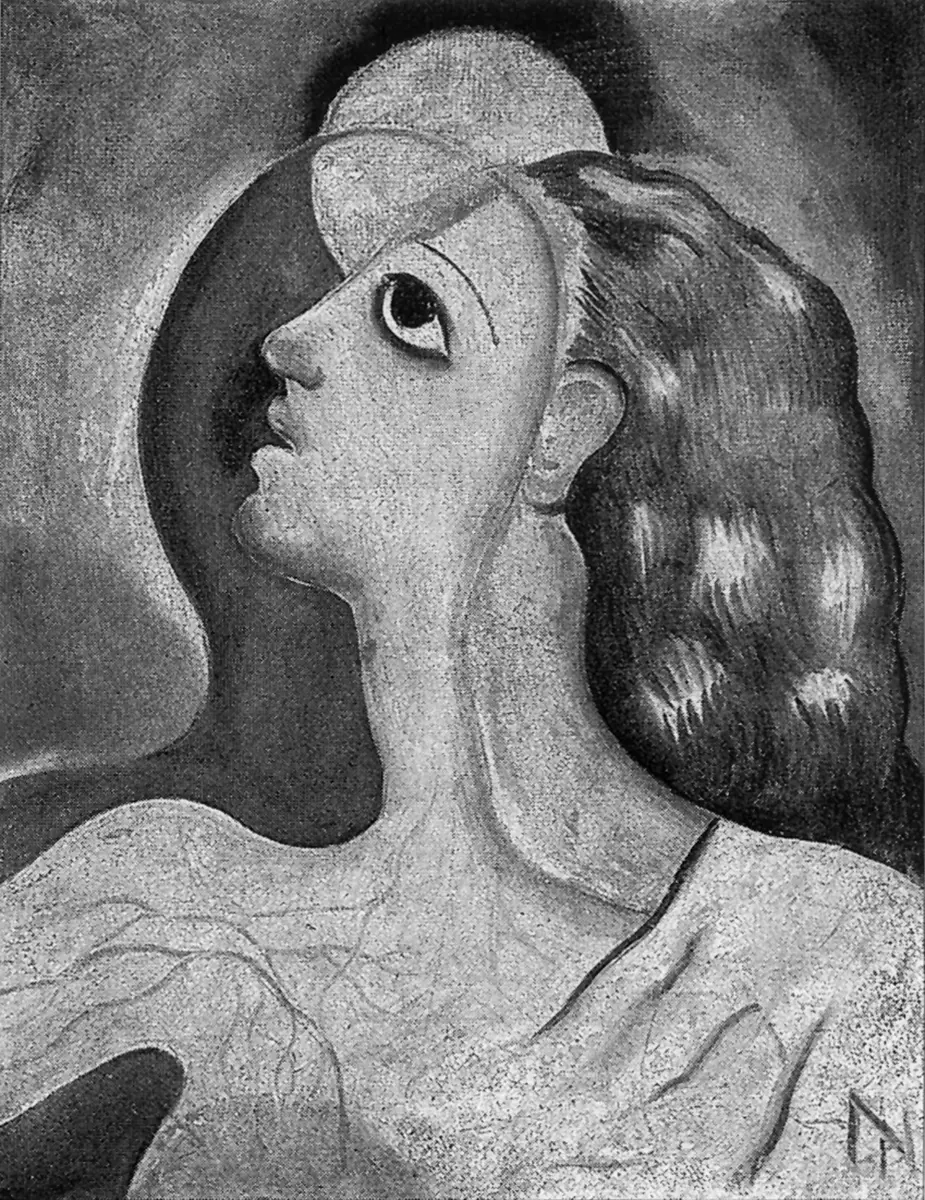
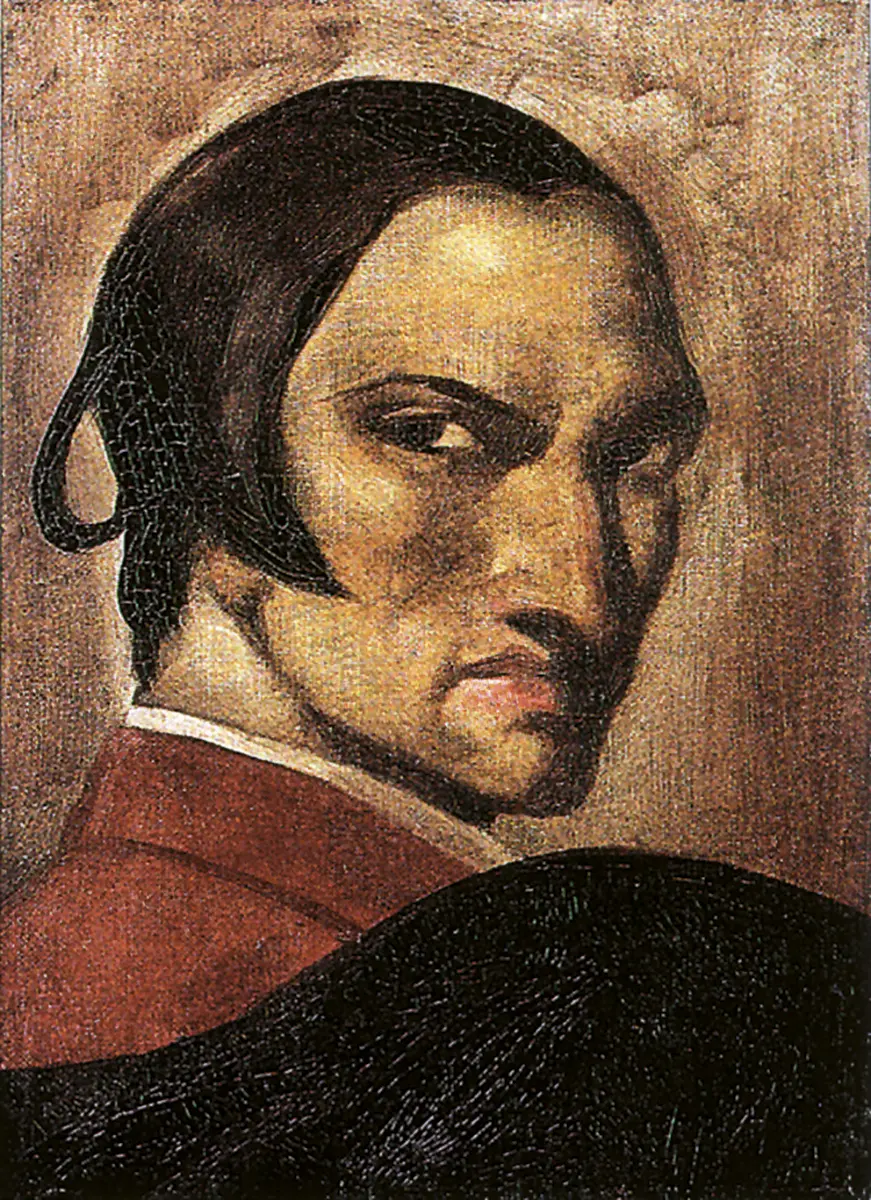
Self-portrait is also a theme that is worked by the artist, as a show of the different facets of his personality. As the critic Affonso Romano de Sant’Anna has observed, the self-portrait is painting in first person, the mask of the author (Autorretrato-Torero, Hombre Cubista [Self-portrait-bullfighter, Cubist man]). Self-portraits are not simple. There is an interesting symptom that may be observed psychoanalytically: the male artist also paints himself as a female in some canvases. There is a male I and a female I, there is an original couple that appears in the majority of his compositions.
The psychoanalyst and art collector Chaim José Hamer states that, as he began to acquire contact with Nery’s work, he was able to see in a significant part of it a “Freud as a plastic artist," meaning that he saw before him "phylogenesis, ontogeny, combined figure, fetal development, trauma from birth, narcissism, depression, Oedipus complex, a life instinct, and a death instinct, among other points of emotional tension."6
In the retrospective, we find a work titled Trauma de Nacimiento (Trauma from birth), where an adult head rests on the pelvic bones of a woman, and a hand grabs the umbilical cord. The head is that of a man and the eyes of his face have no iris. It is as if the man were looking inside, toward the present, the psychoanalyst observes, and he cites a fragment of a poem by the artist in order to take up the question of birth:
"For me, I have not yet finished being born. I have tiny hands, or hands yet unborn. I should be borne in pieces by all the mothers of the universe, From Eve to the last woman."
Love is also a theme present in his plastic work as well as his poetry, seen from the perspective of eroticism—the Nude is a frequent theme in his plastic work—of complementariness, of the genesis of the human being: Figura (Figure), Deseo de Amor (Desire for love), Pareja (Couple).
Death is another frequent theme in his plastic art and in his poetry. The artist, from fifteen years of age, had the premonition that he would die at age 33, and in fact that is what happened.
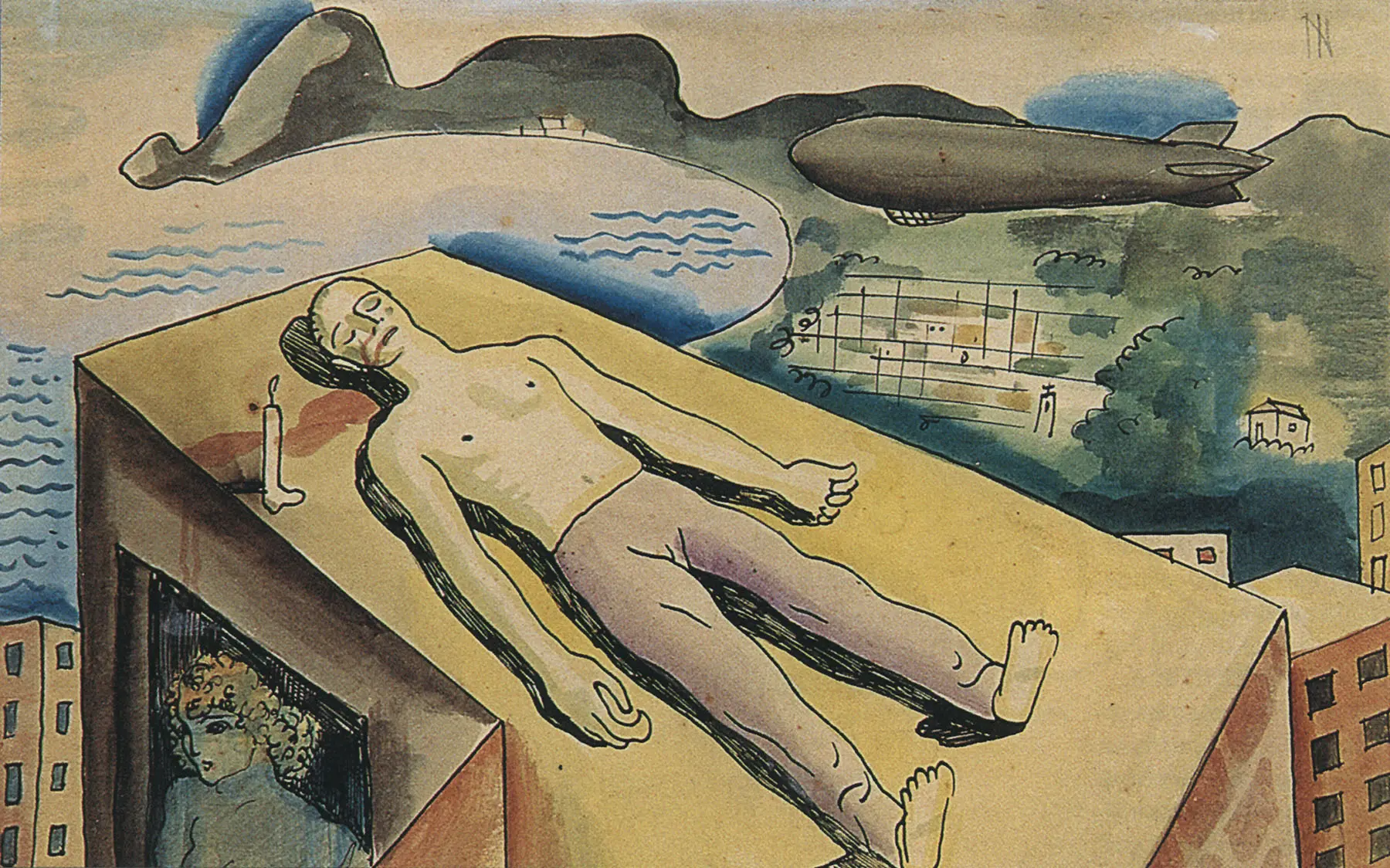
The watercolor Muerte de Ismael Nery (Ismael Nery’s Death) is visionary. The dead man lies on a house, in the middle of the landscape of Rio de Janeiro. The drawing Vida y Muerte (Life and Death) takes up this problem: the face (self-portrait?) has one of its halves represented as a skull and, again, a petrified eye stands out in the physiognomy.
NOTES
1. Modernization began with the so-called Week of Modern Art in 1922, when the break from academic art, the need for aesthetic actualization, and the freedom of inquiry were proclaimed.
2. Antonio Bento, Dimensõe da Arte (Rio de Janeiro: MEC, Serviço de Documentação), 1964.
3. Cited in Murilo Mendes, Poema Post-essentialist, published in A Ordem April 1965, and in the exhibition catalog Ismael Nery:100 Años, A Poética de Um Mito, p.83.
4.“Ismael Nery,” Diário Nacional, April 10, 1928.
5.“Ismael Nery: um encontro na geração," Correio da Manhã, December 4, 1966.
6.Ismael Nery e a Psicanálise, in the catalog cited above, p. 67.
LISBETH REBOLLO GONÇALVES
Professor at the University of São Paulo, Brazil. Member of the AICA and President of the Asociación Brasileña de Críticos de Arte.