
Espacio Mínimo closed its doors in Murcia and celebrated the opening of its new gallery in Madrid (near the National Museum Centro de Arte Reina Sofía) with a show of Liliana Porter’s works. The decision to move the gallery, made by its director, José Martínez Calvo, confirms how difficult it is for a gallery of this kind (one willing to run artistic risks) to survive in Spain’s provincial capitals. In its Murcia period, Espacio Mínimo gained national prestige and contributed to the promotion of important artists, such as photographer José Manuel Ballester and painter Enrique Marty. One hopes the move to Madrid will help the gallery’s activities find greater resonance.
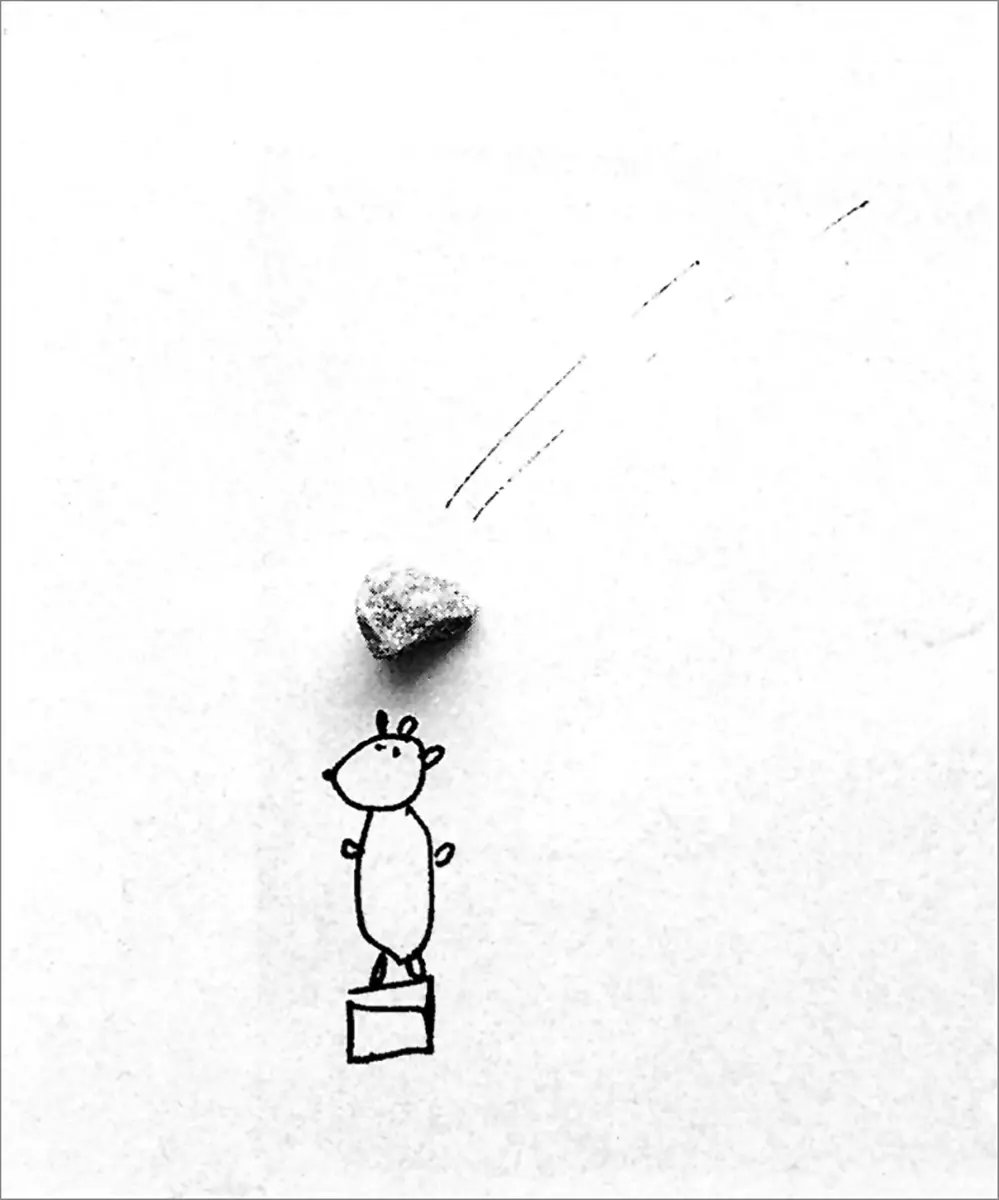
This is Liliana Porter’s (Buenos Aires,1941) first Madrid appearance. It includes a small sample of her photographs, a good number of her drawings and collages, editions of her graphic pieces, and her last video, Solo de tambor (Drum Solo). A sizable portion of the pieces on paper shown here is based on Porter’s work at the Civitella Ranieri Center, where the artist began using school notebook sheets as support—a choice well-suited for the aura of innocence and discovery that permeates her work. With a childlike hand, Porter linedraws on these pages small animals that seem newborn, wide-eyed, amazed at the world; vulnerable creatures facing all sorts of danger. These works are clean, done with a mastery of compositional simplicity, white spaces, of emptiness where the characters face life alone.
In the very small first-floor hall, Porter’s second video is shown on a television screen. Her first video, For You, premiered at the Ruth Benzacar Gallery in Arco 99. Solo de Tambor, the new production, was presented in March of last year at the same Argentinean gallery and, like its predecessor, is built around short scenes—some lasting only seconds dramatizing situations encountered by Porter's habitual dolls and by some china figurines. These brilliant short scenes display primary sentiments—love, fear, the need for company— and a sense of “white” humor only occasionally turning into its “black,” more macabre counterpart. In the video’s Finale, all the protagonists come out for a salute, which somehow gives unity to the sequence of images and turns the toys into actors, presented here as conscious players who have just represented a role. As in Porter’s previous video work, music by Sylvia Meyer plays a major part.
In these times of theoretical complexity, postmodern philosophy, and art committed to the most disparate causes, naiveté is fled from as though it were the plague. Porter’s creations have been subjected to thoughtful interpretation by critics, but these readings sometimes feel like an attempt to rationalize their naive appearance. Porter’s intelligence is obvious, as are her references to art history and contemporary culture. The same goes for the interplay of reality and fiction in her work, her peculiar narrative strategies (minimal and yet extraordinarily eloquent), her surprising ability to generate a dialogue between figures that seem to emerge from different planets, and her suggestion of movement (in the videos) through broken shifts. There is plenty of intellectual and conceptual work behind her achievements. But we shouldn’t leave aside the tremendous tenderness permeating these melancholy encounters, the vulnerability of her characters, Porter’s vindication of the imaginary, and a child’s ability to make the inanimate come alive. These are the major characteristics of Liliana Porter’s universe. A universe which, being known to each of us, is accessible and opens with ease. An ease is achieved only with difficulty. A knowing and wise naiveté.
ELENA VOZMEDIANO