
At first glance, Hall 6 of the Alejandro Otero Museum, the site of Mariana Bunimov’s first solo, resembles a disorganized room. Objects such as photographs and drawings lay on the floor or hang from the walls without following any apparent criteria. The voluntary precariousness of the assemblage is reinforced through the use of pins, tacks, tape, and nails to support the artwork. There aren’t any text labels to guide our reading. By placing itself on the margins of the formal and technical principles that dominate conventional museographic discourse, this show invites us to enter an intimate environment where childhood fetishes—stuffed animals and plastic dolls, pages from books, and school notebooks—mix with elements of domestic life, such as napkins, toilet paper, and canvas bags.
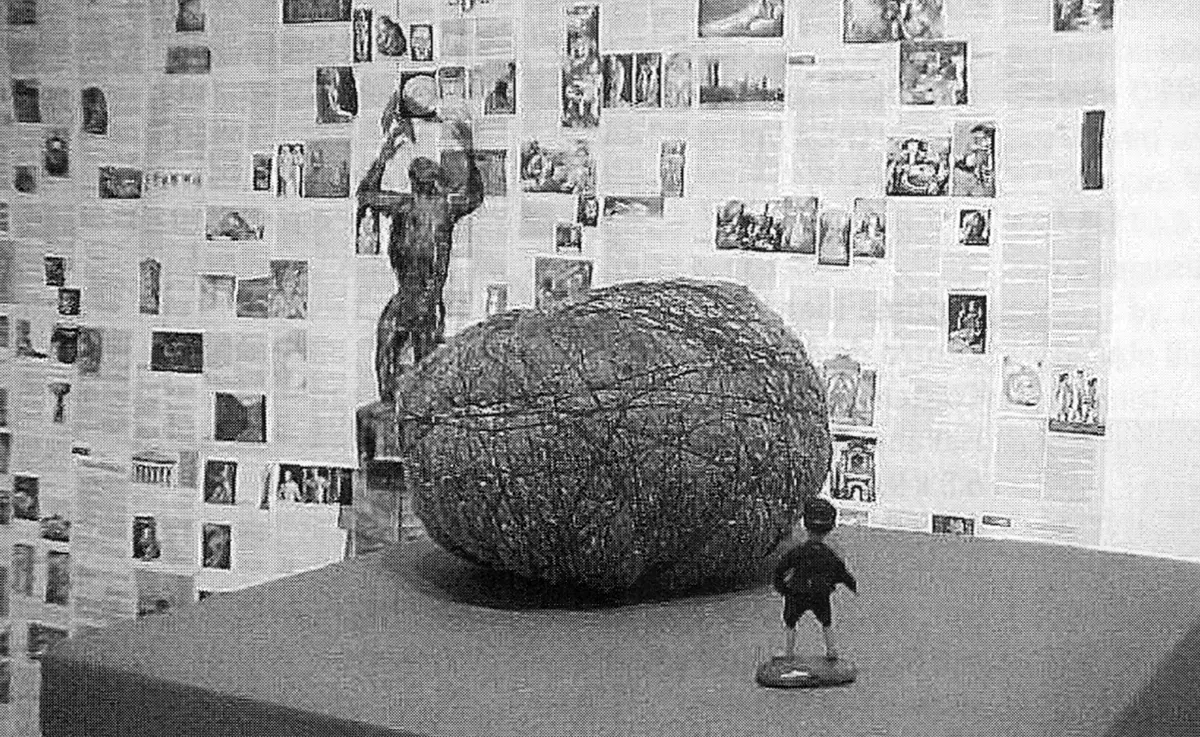
The apparent chaos, however, is given meaning as soon we discover that the gathered materials revolve around the artist’s emotional memory. She has transformed this mess into signs of a regained world, a world deeply intertwined with her daily life. Here, as in most contemporary art, creative discourse is articulated through the recycling of throwaway materials, to which new layers of meaning are assigned. Objects—in this case, toys—cease to be playful elements and become the emblems of a personal drama full of references to psychoanalysis. For an adult psyche, returning to this magical universe is painful, since yesterday’s toys turn into the icons of nostalgia for a lost childhood. Bunimov’s work solves this problem with frankness and without resentment, especially in those pieces with a greater autobiographical charge, such as Lo Que Mi Papá Me Pagó (What Daddy Paid Me). This work, a kind of palimpsest made from restaurant receipts on which the artist has drawn a small, roofless house, expresses a slight sense of loss. On their part, Bunimov’s soft sculptures with pieces of dolls, canvas bags, and stuffed stockings seem to retain the violence of childhood games. Her photographs, on the other hand, import a critical stance regarding the serial, industrialized production of toys as consumer goods. In this way, La Señora Lumpuy o la moral del juguete generates a system of open relationships for both the subject and its environment.
Far from being just diverting objects or pastimes, toys seem to incarnate a form of wisdom that adults often forget. Perhaps this is why Western literature and film have paid plenty of attention to tales of toys that challenge their status as inanimate creatures and undergo prodigious adventures. Carlo Collodi’s Pinocchio, the frightful Chucky from the child’s play movies, the characters in Toy Story, and Julio Garmendia’s malicious dolls. All of them face their destiny with the same earnestness as children at play. In general, each of these stories presents the opposition of two worlds, one positive and benign, oriented towards the achievement of noble goals (goodness, friendship, justice), the other negative and evil, dominated by fear of the unknown (darkness, monsters, ghosts). But behind this basic, simple opposition of good and evil one discovers a number of conflictive traces—Freud would call them symptoms—related to infantile subjectivity, family life, and social relations. Those traces or symptoms are what Mariana Bunimov explores in her work, placing herself in the uncomfortable position of one who probes her own most sensitive and fragile side.
Beyond the Freudian references in Julieta González’s sober and pertinent curatorial interpretation, childhood symbols, personal garments, and domestic allusions in this show are long-held objects inserted in an environment that is at the same time living space, playroom, and studio. Relocated in this orbit, these toys become a kind of corporeal, actualized memory, and their signifying strength derives from experience.
FÉLIX SUAZO