
The works by Raymundo Sesma shown at the Galería Nina Menocal established a simultaneous dialog with works by Alfredo Jaar, Félix González Torres, Ambra Polidori, Joseph Beuys, Yolanda Gutiérrez and Eligio Calderón, and others. This crossing of visions produced some moments of high tension, given the disparity of artists under the same roof. Summoned by Raymundo Sesma, the other artists were present with works while they shared the space with large (300 x 200 cm) diptychs made by Sesma himself.
This isn’t a group show, even if it seems so at first. It’s a solo exhibition where Sesma himself has “invited” those artists he feels are pictorially close to him in terms of work or discourse. Turned into a sort of curator who includes his own work, Sesma speaks to us from the personal selection of those conceptual motivations that have accompanied the development of his work during the last several years. Though on other occasions and in quite different forums he has done a variety of performances and actions, this show is singular in that he has set it on the big stage and the invited authors depart from his work without compromising their own efforts.
Near Joseph Beuys, we see the rose with the graduated mattress. Alfredo Jaar is present with his unsettling cross and The Eyes of Gutete Emerita, a text on the Tutsi slaughter, while Yolanda Gutiérrez presented her Panal con espinas de agave, bejuco e hilos (Beehive with Agave Thorns, Liana, and Threads). These works, disassociated in appearance from Sesma’s work, have an intimate relationship with what he has decided to see in his show, titled Globally De Constructio.
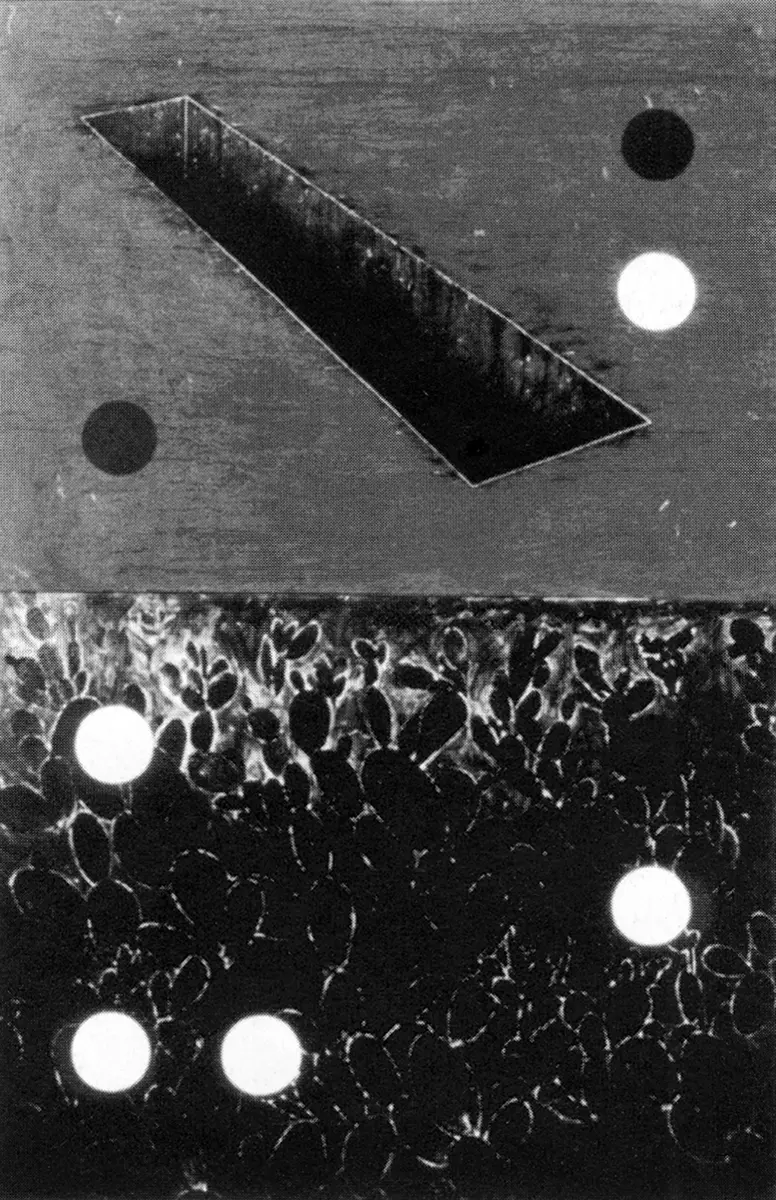
In every case, we see diptychs in which the juxtaposition of elements generates extreme situations that sometimes are complementary and other times contradictory. They create a particular language in sepia and black tones provided by natural pigmentation and resins on the canvases and are consistent throughout the series. So we see a wheelchair sharing a space with a cornfield, or an arm prosthesis with a field of cassava plants, or a huge foot with circular shapes under it. It’s about an internal debate between what has been lost and the distancing from what’s wished to be abandoned. We find a filia, a thematic preference that after so many years has become recurrent in Sesma’s work. I’m referring to the objects and the meaning they have in human defects. The handicapped, those forced consumers of objects that will help them thread along a world that apparently wasn’t designed for them, have in this painter an accusation made on their name and a simultaneous, silent homage.
Some years ago, Sesma produced several works for the blind. It was a series of artist books (or book objects) that crossbred a group of techniques applicable to artistic expressions directly related to what he calls “surface reading.”
"I read the surfaces according to their depth and I apply the colors based on this, thus giving a tonal value to texture value. The range covers all that is between black and white: white is the softest while black is the roughest."
It isn’t gratuitous that in this show, aside from exhibiting his paintings, is his book for the blind which includes Este lado, a poem by Octavio Paz, who also participated in the making of the book.
Is Raymundo Sesma an interlocutor between the world we lose and the one we rebuild accidentally? Is there a conscience of temporality? Yes, as long that temporality is only of those fleeting moments in which we realize what’s not there. That which is missing or only lives in our memory is substituted by something else that reminds us of what was always there: the wheelchair supplies the legs; the arm prosthesis becomes the possibility of an embrace; fingertips turn into eyes—to such an extent that a great machine shaped like a mechanical hand is over the potatoes as if it wanted to hold them all and satiate its artificiality with as much nature as possible.
But there are also other objects that don’t necessarily substitute the body’s faulty parts. You also have to put on a prosthesis towards the past, and its representation, giving it the shape of a church, a landscape, cattle, fruit, and skies that lasted only the moment they were seen. History, Sesma seems to be telling us, also crumbles and it becomes an act of reconstructive remembrance. The objects belonging to the other artists then join in because they tell us not only about their authors but also about the environment in which they were born.
The retrieval of those images, those hours of life, is a medullar part of De Constructio, as they were, in another moment, the apparently inoffensive lyrics of that children’s song that in Sesma’s hands became the denunciation of forgetting: Frère Jacques, Frère Jacques, Dormez-Vous? Dormez-vouz?
Even if it’s a world loaded with the notion of “behindness,” of what has been left behind our backs, Sesma’s world doesn’t include shadows. The objects in his work, although they’re light receptors, don’t leave a mark in the location they’ve been placed, for the simple reason that they are nowhere. That’s to say, they are everywhere. It is interesting to note that the goats, the potatoes, the cabin with an old rag, or the façade of the small church don’t produce darkness against the light reaching them (to exist, one would suppose). This places all that Sesma has painted in a sort of limbo, where everything seems to have remained suspended for centuries.
It seems that Sesma registers those places lost from great societies. From such spaces, he takes the monuments that tell something to the intimacy of the community: the church, the haystacks, the animals, the abandoned machinery that one day meant progress and well-being but now are just junk—a reference to what it was, to what still is but in its mutilated state cannot say anything else with the same words used before. And the objects, like those with whom they’re related, talk about a sort of architecture emerging from the past. A psychic architecture that by emerging from a communal interiority brings to the present a delicate historical structure that repeats itself again, even if it’s fragmentary, giving life to the things, objects, and landscapes we see once and again.
That is why there’s an enormous thick bell flying over a house that is barely able to stand on its own. Or the rigid, geometrical blocks under which lies a recently felled tree. Or the most disturbing of all, the prickly pear thicket and its fine thorns standing under the rectangle that has made a long, pit-like perforation on the ground.
We’re before a sort of survey of objects and documents that after a first glance become intimately and profoundly related with that we tend to forget—even if it is important to us, such as the sense of sight, which has been put to the test in his work. Each of the white or black circles that Sesma has placed on canvas are in reality letters or letter fragments of the Braille alphabet. To see the tactile, to discover without touching that one can be blind not only to the eyes but also to the memory. That’s De Constructio’s thematic backbone.
SANTIAGO ESPINOSA DE LOS MONTEROS