
Remo Bianchedi (Buenos Aires, 1951) was a key figure in Argentine art during the 1980s. During that time, his work, and that of other artists of his generation, made a determined U-turn back to painting. Pictorial sensoriality, large format, and dirty hands were key to the action program of a group of young artists who set out to interrupt the continued conceptual dematerialization that characterized a great portion of art during the 1960s and 1970s.
But Bianchedi didn’t count only on his undoubted gifts as a painter. He developed a brilliant thought on the aspects that have traditionally defined painting, which were also treated by the aseptic conceptualists. He questioned the idea of authorship by producing, with some of his colleagues, paintings “for four hands.” He critically represented themes such as originality, which is related to the genesis of the work of art. He revealed his admiration for and the influence of, among different artists, Malevich and Alberto Greco. He also participated in the debate surrounding the notion of finished work, many times blurring the boundaries between the first and final draft, between “major” and “minor” work.
These deconstructive questions, which reveal a production process, had as much relevance in his works as the ones concerning the problem of human existence. Death, anguish, and solitude took shape in many of his pieces. Moreover, the implacable criticism of social injustice and intolerance was an important thematic axis on more than one occasion.
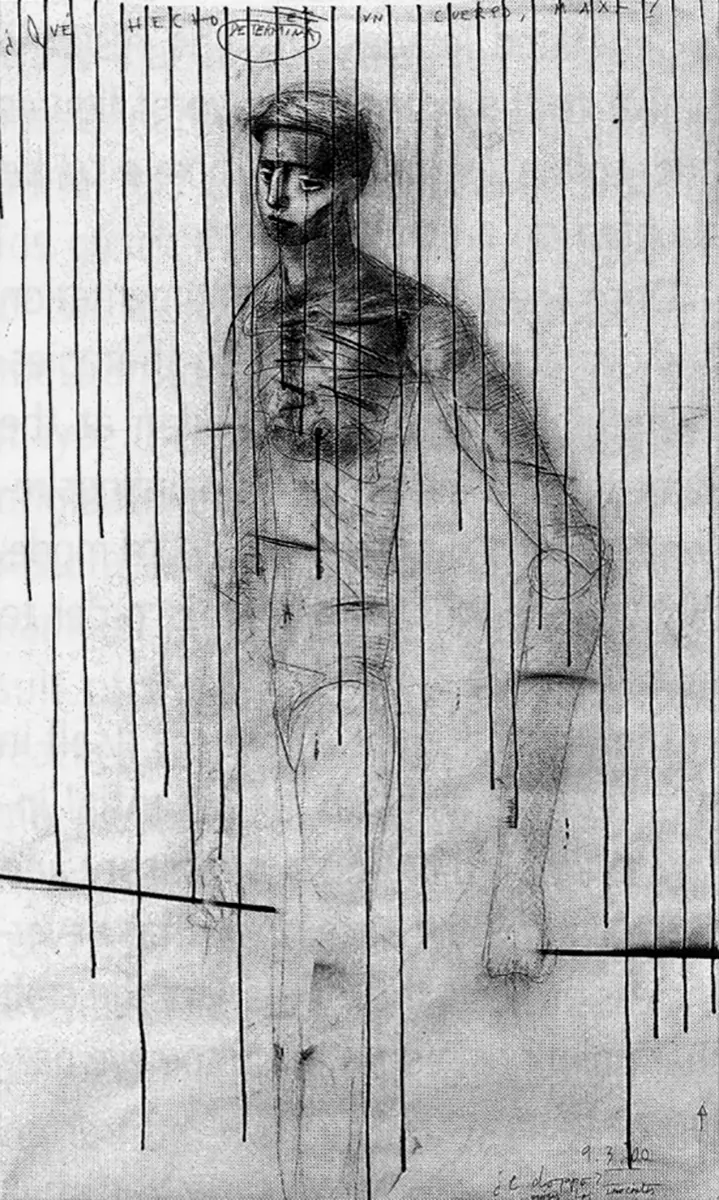
The series Los inocentes (The Innocent Ones), exhibited in three adjoining halls of the Fundación F. J. Klemm, had a concrete point of reference: Argentina in the year 2000. Whereas before Bianchedi saw the innocent ones in the Holocaust or the disappearances during Latin America’s military dictatorships, this time around they were “youngsters vulnerable to unemployment, poverty, violence and their subsequent exclusion from social structure.” He believes, remembering Bruce Nauman, that “drawing is equivalent to thinking” and with his new series, he tries to generate a “current of responsible opinion and action” in favor of socially unprotected youth.
The fifty pieces shown represented many wounded, broken, evanescent bodies suffering from different postures (standing, lying, upside down). All the work—mixed technique, done over large sheets of paper—requires an attentive, slow reading. It so happens that Bianchedi always seems to want to say more than what he supposedly says. Even if he provides clues, it’s not easy to resolve the riddles he presents. Why are there footsteps soiling the paper’s white surface? Do they indicate that someone (the artist) was there, or are they an eloquent sign of self-inflicted violence? Another riddle to resolve are the huge dates telling the exact day that each drawing was done. Why are the numbers dripping paint? Perhaps they’re telling us that art, in order to fulfill its mission, cannot but only accompany human suffering, “hemorrhaging” like the bodies of today’s innocents.
An aspect worthy of attention is the relationship that figures have with accompanying texts, written in careful calligraphy. As in previous works, in many of the pieces of Los inocentes, Bianchedi talks with his alter ego or imaginary friend named Max. “What fact is (determines) a body, Max?” asks the author—or someone from inside the drawing. But Max doesn’t reply, at least not directly. Maybe the answer is the spectator’s perceptual reaction, a crucial element in these pieces, which have been conceived as works in progress, in permanent evolution.
A couple of days before the opening, Bianchedi had delivered a small book of intelligent reflections, poetic and ironic, in which he continued his dialog with Max. Titled Max y la bestia (Max and the Beast), it served as the show’s virtual beginning. “Things happen, Max, because before something,” reads one of the short phrases. In some way, this book was the show’s “before something.” We could deduce that the “after” would be in each receptor who’s decided to participate in the Bianchedi-Max (serious) game.
To conclude, let’s add that Bianchedi has not limited himself to showing the social wounds of today’s world. He has also conceived and materialized action programs to fight injustice and hopelessness. Guided by the expanded concept of art elaborated by his teacher Joseph Beuys, he created the Fundación Nautilus and the Taller de Diseño y Oficios in La Cumbre, a locality in the province of Cordoba, central Argentina. There, a group of youngsters, under the guidance of the “maestro” Bianchedi, provides community services, recovering labor’s creative capacity. All assume that art can be a vehicle for social awareness and transformation. No more a “useless beauty,” but a job inside work in general.
ELENA OLIVERAS