
Two very important solo shows took place recently at the Galería Valenzuela y Klenner in Bogotá.
While watching Rodrigo Facundo’s objects, we can allow ourselves to remember American author Paul Auster’s phrase, “What we see in a picture is different from what we see elsewhere.” The phrase is related to the show’s spirit. Since creating his early works where he printed news photos in rough clay, Rodrigo Facundo has worked with his country’s sense of reality and historical memory. We have seen this throughout his work, and for spectators they have become, from the perspective of art, a sort of public ritual, heartfelt and true, which society hasn’t performed for so many collective deaths.
But in this case, it seems as if the artist is resolved not to tolerate what society has tacitly burdened image creators like him with, by forcing them to use news media images as reference. It seems as if he could no longer bear the imposition of representing the violence of others. He has decided to investigate the experience of dreams, that is lacking in society and is outside the realm of images produced by the mass media. He works with the dreams of others—friends and acquaintances— as told by them to him. Dreams constitute a different type of memory, with a particular elaboration of details and events that move and come together with a life of their own. This doesn’t mean that the pieces lack unconscious tension or that there are no unsettling or violent images. But they are the result of a freer game, if not to play with fear and desires which is where these pieces tend to go, but to illustrate freely the same historical yarn. The show is a way of digging into the collective memory that recycles experiences in a particular way. This attitude is important because, in our country, those artists who base themselves on newspaper images don’t realize that photojournalists take pictures from the same stereotyped angles, hiding life’s suffering instead of revealing it.
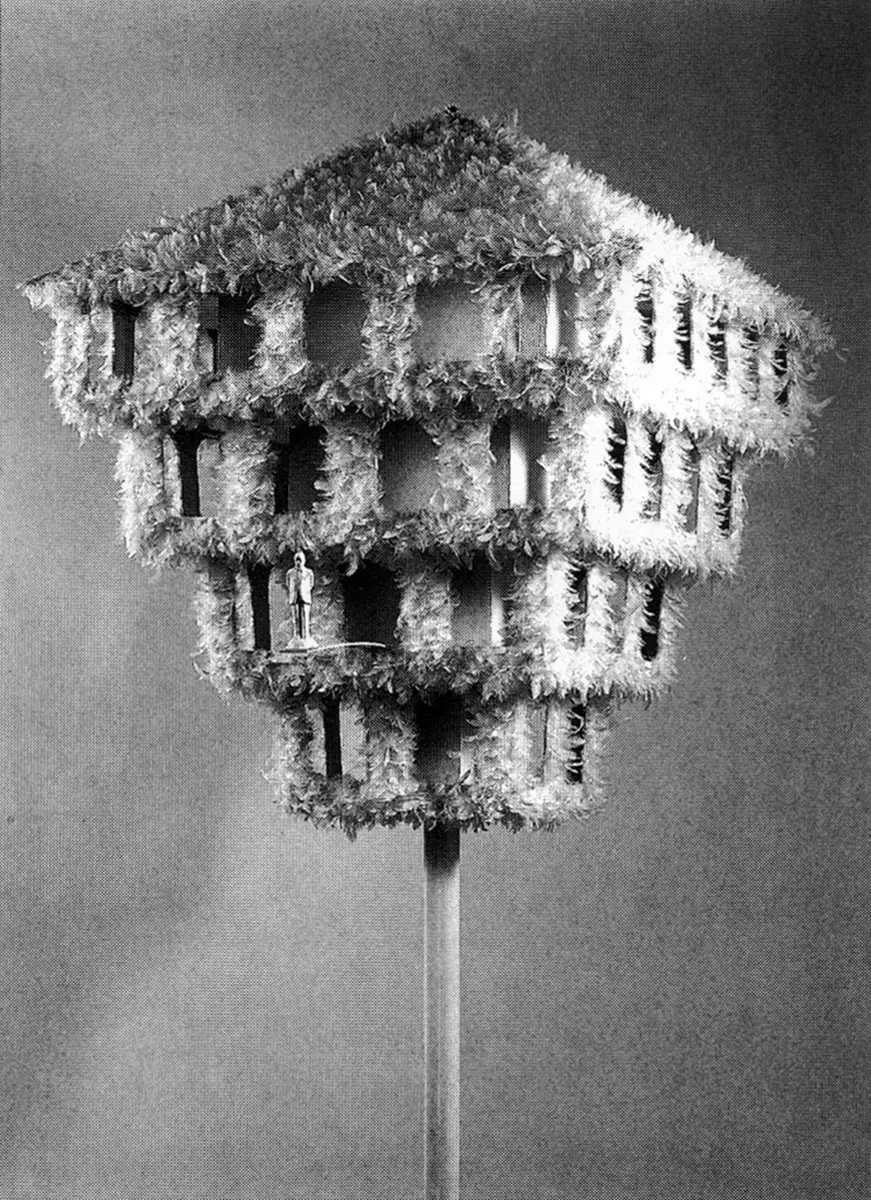
The objects shown are “different from what we see elsewhere.” A high pigeon house with many doors and covered with white feathers, and a small, lead figurine solemnly stepping out through one of them. A fishing rod bent due to the apparent weight of abundant plastic fish stuck together as if attracted by a magnet. A desolate image consisting of a ghost-like desk made of metal rods, and on the wall a printed image of a dream of destruction. Toys warming up in their doll houses. A table with desiccated fishes floating on a liquid and casting their shadows on the floor. We said before that Facundo decided to work with the type of experience lacking in culture. It’s the sort of experience that interests him less and less and is reflected, for example, in the education hashed out at art schools. He then decided to set photography aside for a while and return to matter or, better, to specific materials that have been handled by others, giving them a particular treatment. The show’s titled Patafísica (Pataphysics), perhaps a reference to a given movement —Dadaism— which penetrated so precisely into those other logics that Facundo also explores.
Juan Fernando Herrán’s show was composed of color photographs of landscapes. They’re loaded with two pertinent searches—one sociological, the other, aesthetic. Generally speaking, the artist’s interest often concentrates on archeology that only rescues places, facts, or objects hidden by ideology, many times foregoing the artistic research. In other words, how to insert that rescue in a language such as art, which has been fed by centuries of discoveries and in turn enriches “the way of building” a society. Herrán explores both with the same acuteness. He moves in two axes: one horizontal, and the other, vertical.
The show’s title, Papaver Somniferum, refers to the opium poppy, something Herrán has been interested in for a long time, an interest intensified by a trip to Turkey, where the controversial flower is legal. “In the photos, there are details problemizing the notion of place.” The artist explains. “For example, there’s a large expanse of poppies with elements complicating the reading.” And they complicate it because in a Turkish field, poppies occupy large fields with electric towers hovering over them, much like industrialized crops. In Colombia, on the other hand, they grow on small plots in which the small cropper, persecuted, tries to eke out a living. The artist expands the sociological horizon that culture has as a reference, pointing out without adding additional discourse to the geographical and ideological spaces that poppy harvests occupy in other places. Here, art ends up expanding and completing the information we have on the concept of space.
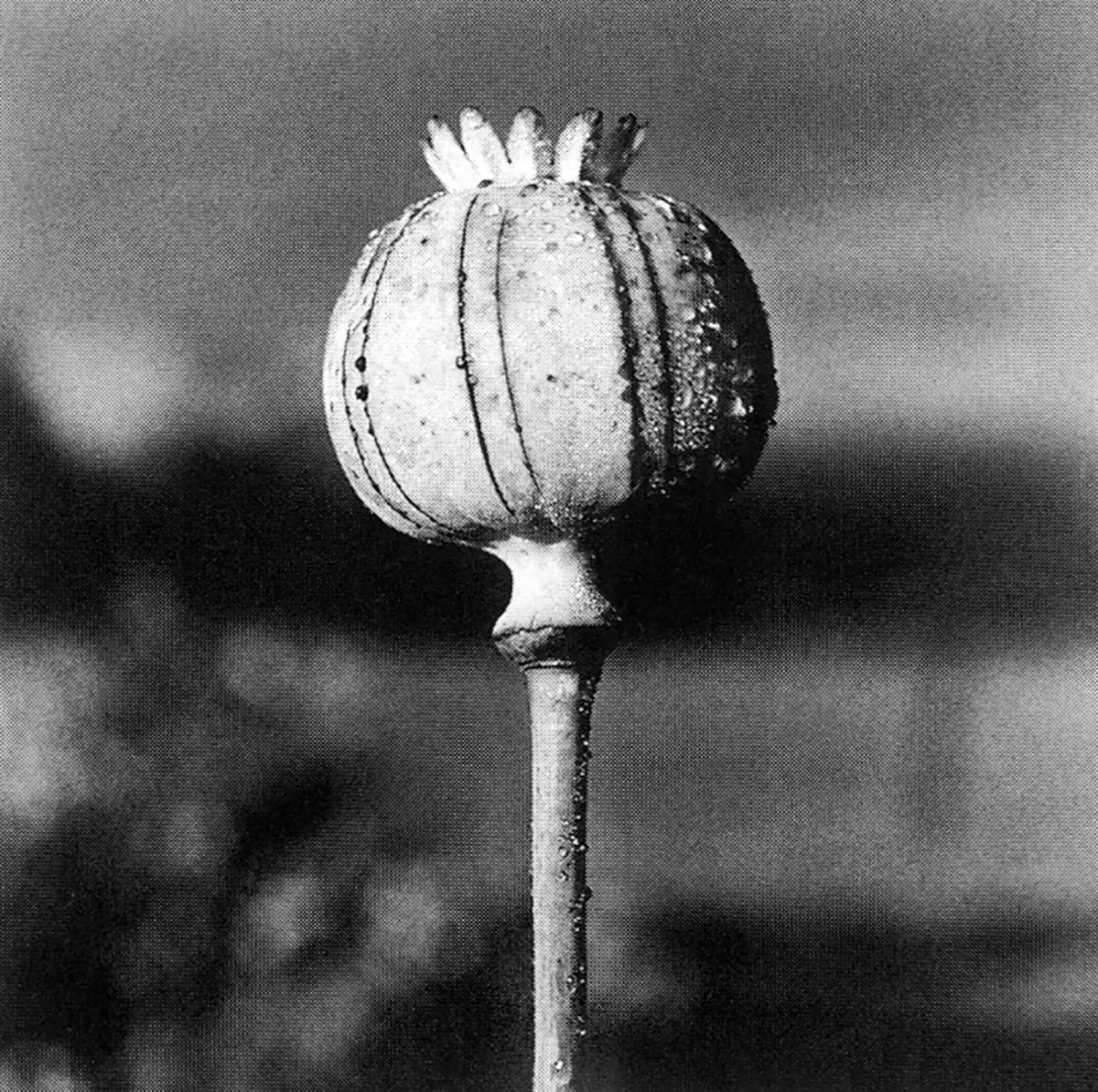
But the photos detailing the flower delve into one axis, the one we call vertical, the one Hal Foster refers to, borrowing from the concept of anthropology. It has to do with the landscape’s formal tradition and the artist’s subjective impressions. In these large, square photographs, the poppy’s calyx is centered, it is the protagonist, and it appears as a sculptural shape which at times reminds us of pre-Columbian objects or ritual remains. But the flower also appears fresh, over a background treated with subtle, hallucinatory colors. If panoramic photography is used as it is, it reinforces the idea of indicating and inserting new types of landscapes into our cultural list. In this case, it has intervened, and it rescued the whole tradition of color in photography before its industrialization. Herrán’s work seeks to unsettle spectators intentionally since the landscape is most “innocent” to art consumers. Here it appears as “beautiful” as any tourist or ideal landscape, but it’s also contaminated with a question about a plant that could be considered legal or illegal. The diagnosis falls upon the croppers’ lives, as Herrán has pointed out in previous works, where peasants appear confronted by both their legal situation and their livelihood. Art then becomes an important tool to hear what is not said about a fact or to show what is unknown in any given space. And it becomes more powerful when that hidden reality can be inserted in a language that is part of society’s ideological tools, in this case, color photography.
NATALIA GUTIÉRREZ