
Colombian artist Santiago Cárdenas has passed through numerous phases in his artistic career but is perhaps best associated with his rather minimal “blackboard” paintings of the 1990s that explored the relationship between spontaneous markings and their ambiguous environments. Their chalklike scripts are barely visible against the stark reality of the blackboard surface, these simple works made a statement about illusory notations laden with associative context and the act of creating art. The ghostly residue seemed to have been created by the technique of erasing, a familiar schoolhouse activity, that subverts the immediate notion of graffiti which is intrusive and spontaneous and by its very nature, on the surface. Cárdenas creates marks that are submerged, so his blackboard paintings are also exercises in painterly restraint, spatial contradictions, and trompe l’oeil facility.
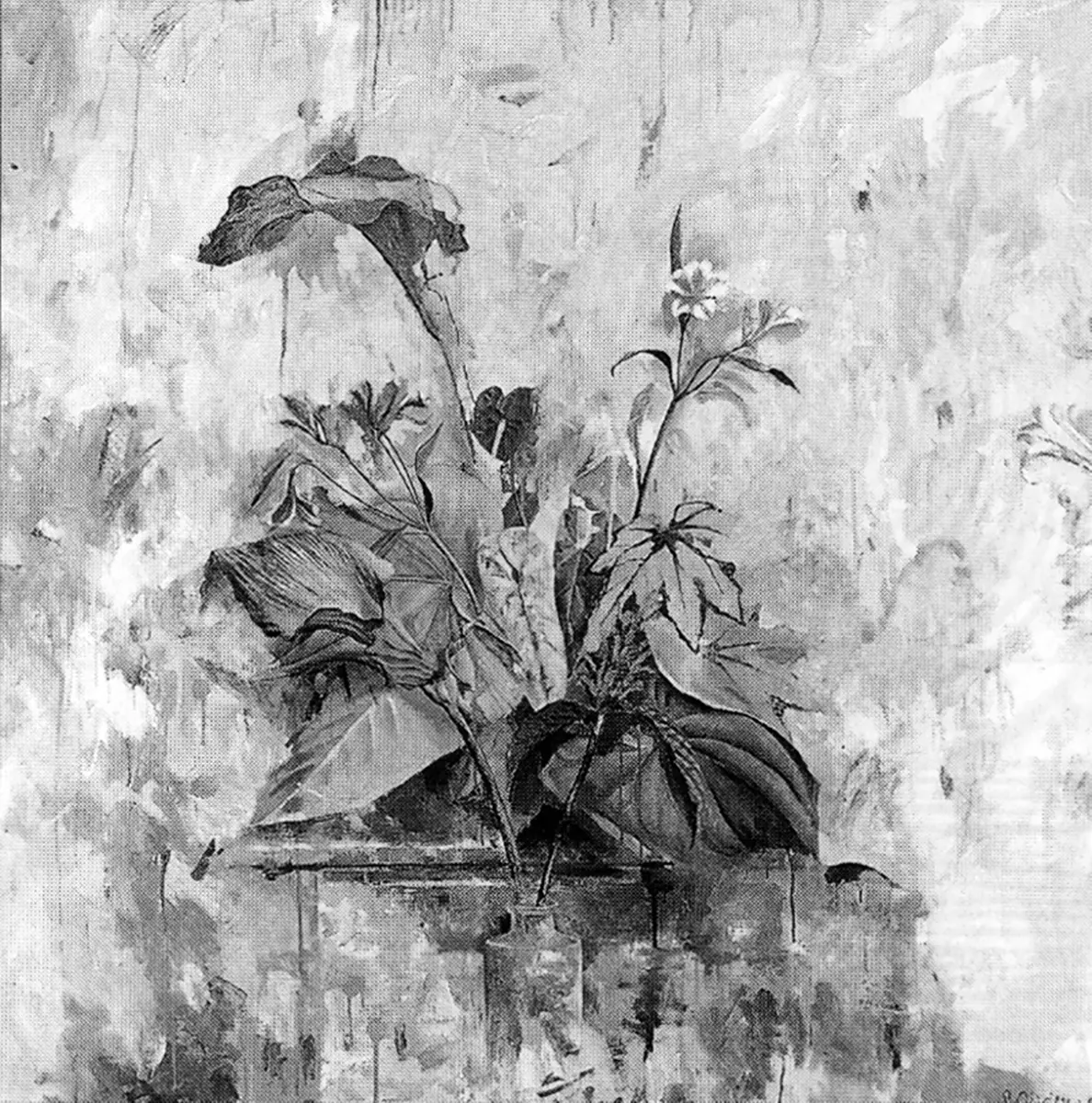
In this exhibition of recent works, it is as if early restraint had to be counterbalanced by elaboration, though always with nuance and refinement, even when image-packed and beautifully colored. His chalkboard notations give way to expressive slashes of color aesthetically coordinated with super-real images of flowers and objects. Each stroke of color is accorded a conceptual presence reminiscent of late Abstract Expressionism as the artist makes a component of his recognizable subject matter a subject unto itself. This is especially evident in the vessels or shelves holding the flowers that exist as independent exercises in abstract color harmonies. There is an aspect of Impressionism in the color harmonies that affects the description of his objects in particular. The image takes on a different meaning with studied concentration and distance.
In Amarillo sin Fin (Endless Yellow), 2000, an exotic bouquet of flowers emerges from the depths of infinite yellows in direct contrast to the color’s painterly exuberance. The background is treated as a totally spontaneous demonstration of fluid brushwork highlighted by drips and spatial anomalies, while the hyperreal flowers and leaves form their own visual counterpart. The meticulous accuracy of the flowers resonates against the painterly vitality of the heavily impastoed surface planes. The same emergent effects appear in Taller Rojo con Musa y Espejo, 1998, a large canvas layered with gorgeous reds and pinks that bears evidence of the artist’s process in its drips and stains. The tools of the trade are presented in a still-life arrangement on a table. The objects emerge (or are they submerged?) from the textured strokes of color to transform the entire field into opulent effects of pulsating energy.
Cárdenas also paints with sublime reticence as he continues to use his blackboards as background for elegant exotica. Unlike such combinations of earlier years that featured total trompe l’oeil effects in the rendering of the flowers and their vessels, the Bird of Paradise in Florero Galileo, 2000, sits in a vase that is less object than a passage in an abstract painting. Each stroke floats like a plane of color over the surface to define autonomous shapes and forms that are as pure as they are intangible. The three small paintings of apples, Manzana Roja; Manzana Verde; and Manzana Amarilla, 2000, are stunning examples of extreme formal purity. Set upon a wood ledge against his familiar blackboard, each apple is described with loving attention to texture and detail. It is their placement in front of the chalk marks on the blackboard that is so confusing it blurs the distinction between reality and painting, something Cárdenas excels in doing, especially in this exhibition.
CAROL DAMIAN