
Tonel’s (Antonio Eligio Fernández) work is virtually unknown in the United States, despite his having worked actively in Latin America, particularly in Cuba, for several decades as an artist and critic. His first solo show in the US gives us the opportunity to put his work in perspective. The exhibit at Art in General, titled Lecciones de Soledad (Lessons in Solitude), consisted of a series of medium-size drawings, two sculptures/ installations on wood, and several drawings done directly on the wall. The pieces don’t stand out because of their technical virtuosity; in fact, most of them are simple drawings done in a deliberately naïf style. But his messages are quite mordant, due precisely to that lack of affectation. A great part of Tonel’s pieces are self-portraits or personal confessions about topics such as masculinity, sex, society in general, or politics. The works—maybe a simple sketch on an intimate diary’s page or perhaps as a comic strip found in any magazine—always have a narrative or everyday scene along with an acid editorial, a scatological commentary, or an unexpected twist.
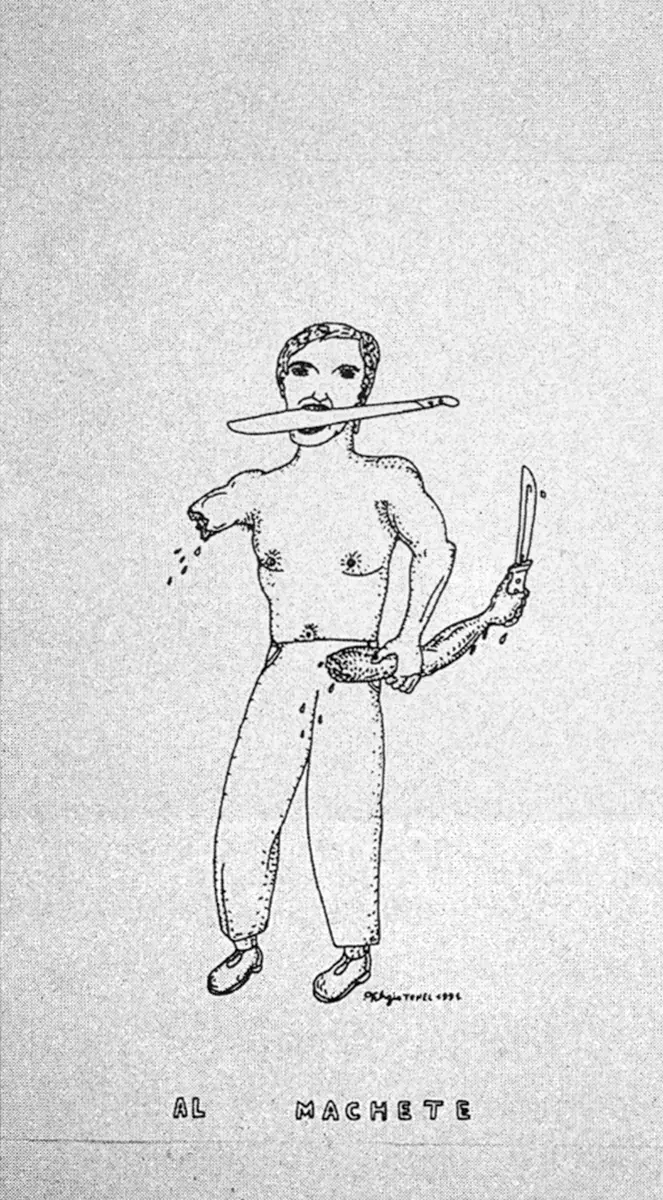
In this show, Tones unfolds a parade of characters as grotesque and absurd as they come. Un Hombre De Boxeo Total (A Total Boxer) is presented to us with three gloves, one is his erect penis. Another, Un Sujeto Con Mucho Brazo (An Individual with Strong Arms), has such a large penis that it becomes a useless burden. Yet another, titled Al Machete (With the Machete), shows the artist after he’s severed with his machete the same arm that uses it. All of them seem to exemplify the waste of resources, reason, and potential. Tonel’s characters live in a drama with their bodies, transformed by the states in which they live and express themselves. No matter how strange or anonymous the situations are, they have a familiar resonance because they reflect sensations, existential moments of frustration, shame, or self-questioning we resist facing.
The scenes are mixed with everyday phrases such as “What time is it” or “There is no water.” They float about as pieces of daily life contrasting with the representation, sometimes describing it, but others work as verbal echoes of the conflicting images they accompany. Tonel’s drawings are erotic psychodramas that almost invariably have a subliminal message. In Tonel, eroticism functions as an instrument for irreverent analysis of society’s taboos and dogmas, but it also acquires a particularly intense meaning when inserted into Cuban society. In one piece, a character who’s masturbating exemplifies the phrase “difference between manual and intellectual labor,” which could come from a classic socialist treatise. El Demócrata (The Democrat), on the other hand, is presented with a huge penis, another allusion to the absurdity of a notion of collective well-being.
In scatological terms, some of the pieces show the crudest aspects of human existence, particularly those intimate activities though private have a place in our public lives. One example is the piece titled He Dicho: Voy Al Baño (That’s That: I’m Going to the Bathroom), or the piece on the wall, titled Las Partes Que Más Me Sudan Cuando Me Pongo Nervioso (The Parts that Sweat the Most When I Get Nervous). Tonel monumentalizes those embarrassing moments we experience in society precisely to call our attention to the absurdity that rules our lives. His drawings are like magnifying glasses set on those areas we prefer to forget, those zones we’ve repressed for personal or collective reasons, but when we see them they are uncomfortably familiar.
Tonel is a sort of Cuban Saul Steinberg who shares humor and existential thought with the Romanian-American artist. But he adds a sociological corrosive commentary expressed in his sexually graphic drawings as if they were the illustrations of a treaty on futility and oppression.
The piece that opens the exhibit is an upside-down self-portrait in the “Hegelian dialectic” style. Again, a sarcastic commentary about Marxism. In a certain sense, this piece summarizes the sensitivity found in this artist’s work. While making a deep and merciless self-analysis, he also gives an equally eloquent testimony of the contradictions found in the society surrounding him.
PABLO HELGUERA