
Galeria Espacio Alterno Colombia’s graphic art history is intimately associated with the activity of Umberto Giangrandi. Born in Italy, he moved to Bogota in 1967 and has lived there ever since. In 1967, he became a professor of fine arts at the Universidad Nacional, and the following year he founded the print shop at the Universidad de los Andes. This discipline, which at the time was searching for a highly expressive language and was in need of ample diffusion, became his specialty.
Giangrandi’s work is characterized by an expressive and direct representation to register his immediate surroundings. At times, he resorts to the expressive force of color; other times, to the incisive line of etching’s or aquatint’s dark tones.
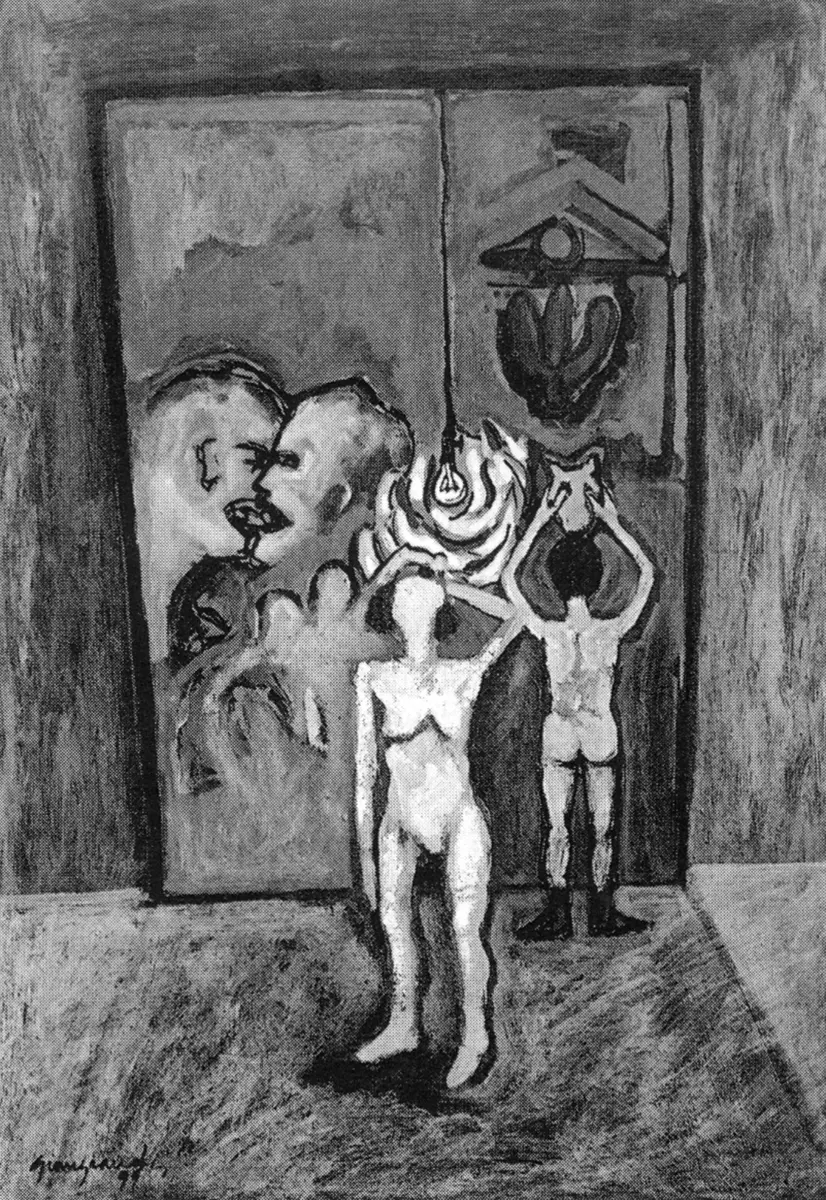
The traits of his latest works could be seen at the show late last year at the Galería Espacio Alterno. Titled Cuerpo es x cenario (The Body is a Stage), the exhibit was made up of a series of paintings on paper and his latest graphic works. In his paintings, Giangrandi directs his gaze toward indoor spaces, closed spaces in which, as noted by Raúl Cristancho, “his work moves from the social space into the private space, which is where a person’s great dramas take place.” He then adds, “That’s where eroticism, madness, and human passions take place. It’s not a placid, contemplative bourgeois intimism; his intimacy is dramatic, claustrophobic, and decidedly marginal.”1 Evidently, in this series of paintings (in a 61 x 91cm format), the scenes focus on diverse moments in which figures, by themselves or grouped, are engaged in personal, intimate, and private rituals. The figures are enclosed in dark, dense atmospheres loaded with a sort of chromatic lyricism, on the one hand, and, on the other, with the dramatic and claustrophobic element we just mentioned. This density was already present in some of the works in La doce, for example, in the one where we see a man dressed in a corset and women’s stockings; he exhibits his sexual ambivalence before a mirror and before the spectator, generating a brutally direct crash.
That same mirror appears and reappears in his recent works, almost always reflecting the image of a woman’s body that in each picture adopts a different posture. But in those intimate scenes, there’s something that calls our attention to the refinement of color. Pigmentloaded thin lines illuminate the dense and dark atmospheres where violets, greens, and blues predominate, and where touches of pink or yellow grant the environments a lyrical and moving melancholy that’s in tune with the artist’s current intentions. His paintings, which are based on monotypes printed on paper, are linked to the Lacan readings that tackle psychoanalysis from the concept of loss. This psychoanalytical perspective distances him from the direct language of his previous series. It submerges him in a world related to the unconscious, suggesting instead of pointing out. Thus the effectiveness of the color used in, for example, the only painting devoid of human presence. In this painting, the gaze is fixed on the floor of a room; a line and a geometrical object signal de presence of a wall; a couple of objects on the floor capture one’s attention. One of them casts its own shadow, and amidst this silent composition, it makes us think of de Chirico. The colors—pink, lilac, blue, and violet—suggest an unsettling and solitary atmosphere.
Another important element in this series is the repeated use of words alluding, as we said before, to the notion of loss. In regard to this, Ivonne Pini comments, “Departing from Lacan’s texts on the body, Giangrandi picks up words that send whoever reads them to the notion of residue and dispossession. These terms are placenta, which is the first loss, then feces and weaning, which supposes the estrangement of the breast, and then gaze and voice, which remains as the memory’s last referents.”2 This notion of loss, which in Lacan alludes to any person’s many faces, is associated by Giangrandi with the situation of the country he lives in—a country that has injured him through violence and death. This relationship between image and word, which is also explicit in the show’s title, is repeated in the catalog, where on top of each image there’s a poem written by Luz Ángela Caldas, with whom Giangrandi had produced in 1994 a book of poems and prints from his workshop.
In the show, we could see some graphic works done with traditional techniques, but at the same time, they reveal new facets of his work, where a more intimate and delicate craftsman contrasts sharply with the directness and expressive force found in his initial works. Other pieces were done at the art faculty of the Universidad Pau Gargallo in Barcelona, where Giangrandi studied in an intensive post-graduate program concentrating on the digital image and non-polluting printmaking processes. These last works presented urban scenes made with photographic images. In this new, experimental stage of his work, the urban stage continues being a constant that’s now presented through fragmented images made up of details speaking of a street, a sidewalk, some iron bars, and the urban environment presented through a mobile perception. In this series, man and his environment, the body and the place, know another gaze and a new way of thinking and treating subjects, proving once again the versatility of this master who promoted the graphic arts in our country.
NOTES
1. “Raúl Cristancho, Umberto Giangrandi: El espacio actuante,” in the show’s catalog.
2. Ivonne Pini, in the same catalog.
MARTHA RODRÍGUEZ