
The large bronze sculpture that confronts visitors to the new Aroca Gallery in Coral Gables sets the tone for the powerful works of Cuban-American master Agustín Fernández. Never one to shirk from dramatic imagery and forceful physical statements, Fernández at age 72 seems to have gained strength from the creation of super-sized drawings, paintings, and now his first bronze sculpture. The installation reveals how his sculpture and paintings complement each other, and with the similarities in the imagery so apparent, it is surprising that he has not explored such grand-scale three-dimensional expressions in bronze before. His now familiar, industrially inspired forms easily lend themselves to volumetric articulation, coming to life with remarkable physicality in bronze (as they once did in his surreal objects of earlier years).
The bronze, titled Venus, was commissioned for a sculpture garden in the Châteaux de Roaix in France. The female goddess, headless and armless, has multiple breasts that reproduce like the fruits of a fertile tree, as she is transformed into a superwoman. Her torso unfolds within the rounded pleats of industrial fabrication; bands of metal wrap around like handles to replace her arms. She is both a mechanical invention and a semi-human being designed for worship in the industrialized world. A large sanguine drawing from 1995 reveals the inspiration for the sculpture in a monumental female image often represented by the artist that pays homage to Venus, the Goddess of Love, and Artemis Ephesia, the Goddess of Fertility who personified the nourishing powers of nature and was depicted with multiple breasts (most recently identified as a necklace of bull testicles). The female form, especially with allusions to the statuary of antiquity, appears often in his work, but his references are more psychological than natural and his aesthetic interpretations transcend any clear definition.
The dramatic painting Image of a Sculpture with a Bird’s Beak, 2000, may be understood as a compendium of the many complexities found in the art of Agustín Fernández. Beyond an obvious fascination with combinations of industrial materials and elements derived from antique statuary, his art is fraught with the tensions that exist between the real and the surreal, the organic and inorganic, and the figurative and objective. The head of the mysterious image in the drawing is covered by a hood and has a bird’s beak. Its block like torso comes to life with breasts and other extrusions, as it appears to hover, poised to alight or balance its weight in confusing spatial surroundings. Depicted with meticulous attention to realistic detail, the shadows are also deceptive and allusions to movement belie its massive integrity. Fernández is always playing with spatial allusions in his renditions of quasi-mechanical, quasi-human creatures, and enjoys breaking physical boundaries in painting and sculpture to emphasize their psychological context.
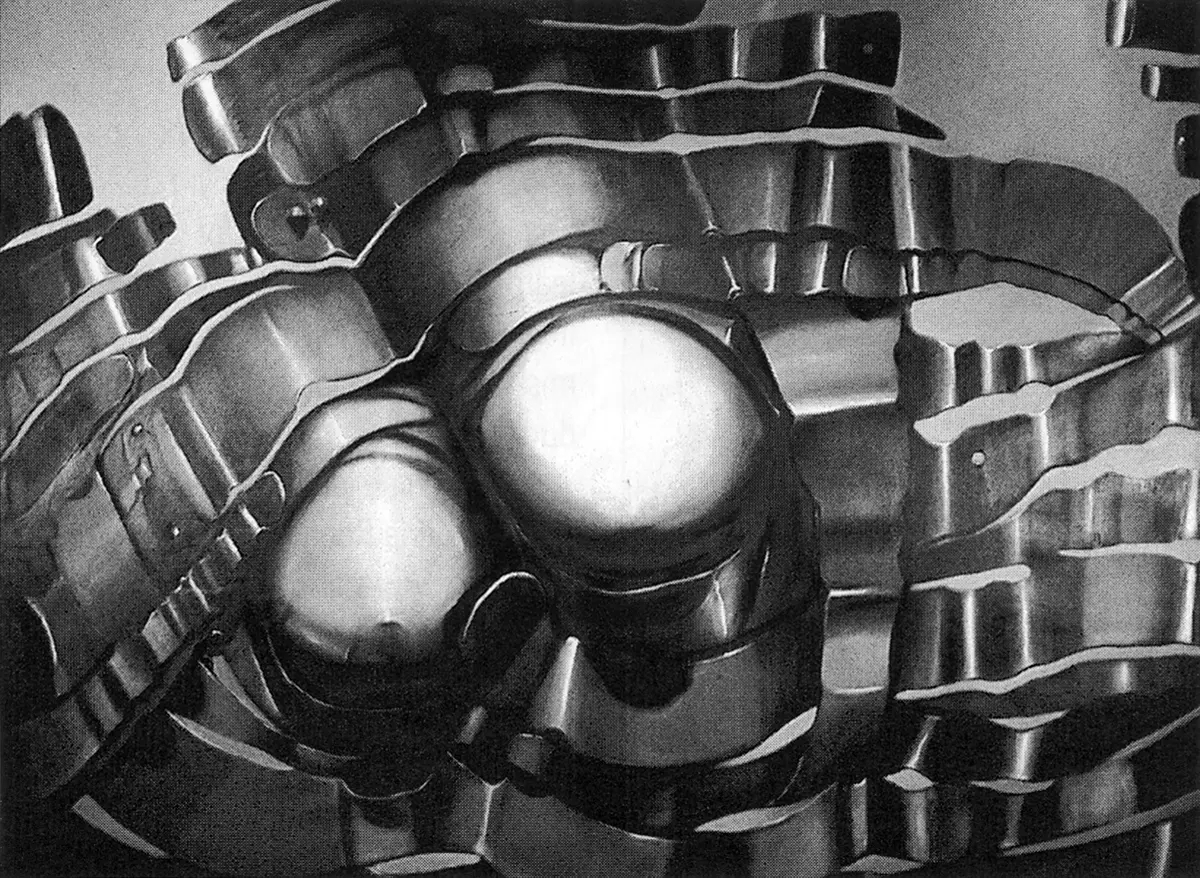
Six exceptional still-life paintings reveal Fernández’s continuing interest in the exploration of dual realities. In small works like Bananas; Papaya; Object; Fruit; Zapotes; and Pulp, the frames are painted by the artist to become part of the subject. This brings each image into a new dimension that extends beyond ordinary boundaries and blurs the reality of their painted form. The same allusion occurs in the painting Andromeda, 2000, which features an object with organic and inorganic properties floating in a deep blue space. It is made out of tapes, straps, and bands supporting two circular forms that make reference to the classical theme of Andromeda, the chained lady of astronomy who escaped the rocks of captivity to become a constellation.
In this exhibition, Agustín Fernández works in a variety of media to bring his well-known themes and images to monumental definition. In doing so, he maintains the same high level of artistic commitment that has distinguished his career for over fifty years.
CAROL DAMIAN