
Gironella’s is among the most resounding names in modern Mexican art. An artist and poet, he’s a direct heir to the iconoclastic, rebellious spirit of the avant-garde. In fact, Gironella shared with the avant-garde’s major figures, particularly André Breton, the revolutionary strivings and anxieties of the 1960s, and he attempted to present his work as a marginal manifestation of the last avant-gardist movement, Pop Art.
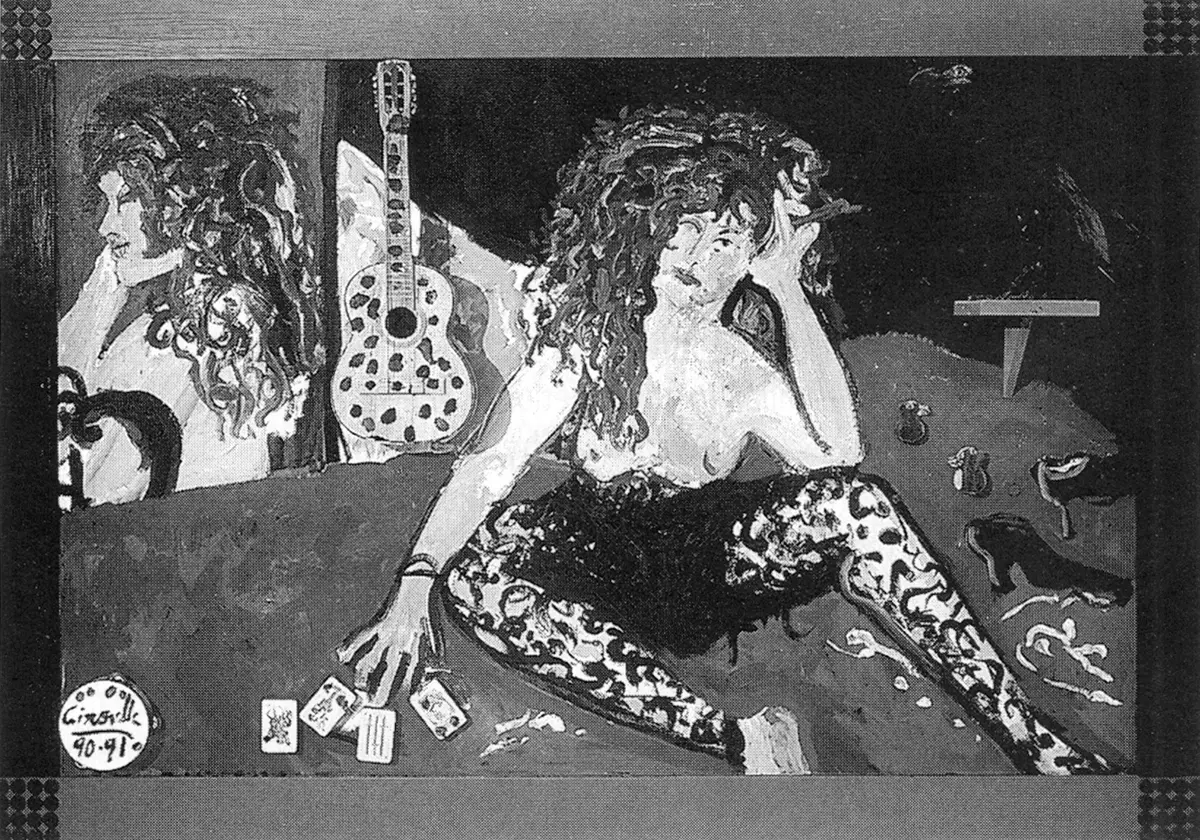
Gironella is a careful student of Spain’s strong pictorial tradition, and many of his major works drink from that fountain, receiving influences from the Golden Age to Spanish modernism, from Velásquez to Goya to Picasso. All of these artists, and many others, have been revisited by Gironella, in a kind of dialogue with elements of continuity and breaking with tradition. According to Octavio Paz, Gironella’s art is nonsensical. But not with the intention of creating an artistic school based on that idea, as the Spanish writer José Bergamín wanted, nor of recreating the absurdist components the dictionary relates to the term, but as an affirmation of his own marginality and rebelliousness. Paz defines Gironella’s work as a kind of ontological foolishness that’s part of the human condition. “Nonsense,” Paz writes, “makes reality unbelievable. According to Bergamín, nonsense is a style, and he uses baroque architecture as an example, nonsense in stone. It seems to me that nonsense, more than a style, is an act of rebellion. It’s man’s shot against his nonsensical fate, and against the Great Nonsense that gives it closure; it is man’s shot against death.”
Gironella’s supposed affiliation with Mexican Pop Art should not be taken as an absolute. It should be understood in the context of the many explorations the artist undertook in his career. There are obvious elements from the pop canon in his work, particularly the influence of Robert Rauschenberg. However, the origin and the sources of the Mexican artist’s stylistic devices are to be found in the great tradition of modernism. To speak of tradition with respect to modernist art could be seen as a contradiction in terms since we are talking about an art historical period characterized by departures and restorations, rather than by continuities. Gironella is a modernist in the sense that avant-garde pontiffs like Picasso or Duchamp are modernists. His demystification of the art of the past has a revolutionary precedent in Duchamp’s best-known readymade, LHOOQ, created in the midst of Dada’s turbulence, in 1919.
Gironella’s work is at once an esperpento and a greguería in the canonic form of these styles we inherited from authors such as Valle Inclán and Gómez de la Serna. His work, like the esperpento, de-sacralizes and recontextualizes past works of art with admiration but also with irreverence—as in Carmen or Las meninas, both seen in the show at Enrique Guerrero Gallery. The greguería is seen in his playfulness and the pure joy and pleasure his work takes in the act of painting. Among his many intellectual preoccupations, Gironella seems to emphasize his interest in Nietzsche. More than an intellectual affinity, though, there seems to be a common sensibility. This may explain certain aspects of Gironella’s career. In any event, Gironella’s work deserves study and promotion, and we are still awaiting the catalog raisoneé and the monographs that will give this artist his proper place in contemporary Mexican art.
ERNESTO SOSA