
Becky Guttin’s current solo museum show titled An Aesthetics of Conflict profiles work by the promising, young artist who will represent Mexico this coming fall in the Venice Lido OPEN 2001. Both the present exhibition and her inclusion in the upcoming European-based art extravaganza confirm the transcultural importance of her work. Questioning Modernist interpretations of the relation between nature and culture, her art challenges inherited concepts of the “primitive” and the “civilized,” playing out its implied innuendoes in relation to notions of so-called “third” and “first” world cultures, while also challenging the associated genderizations of these binary terms. While the concepts she wrestles with are complex, her works evolve from the simplest of means.
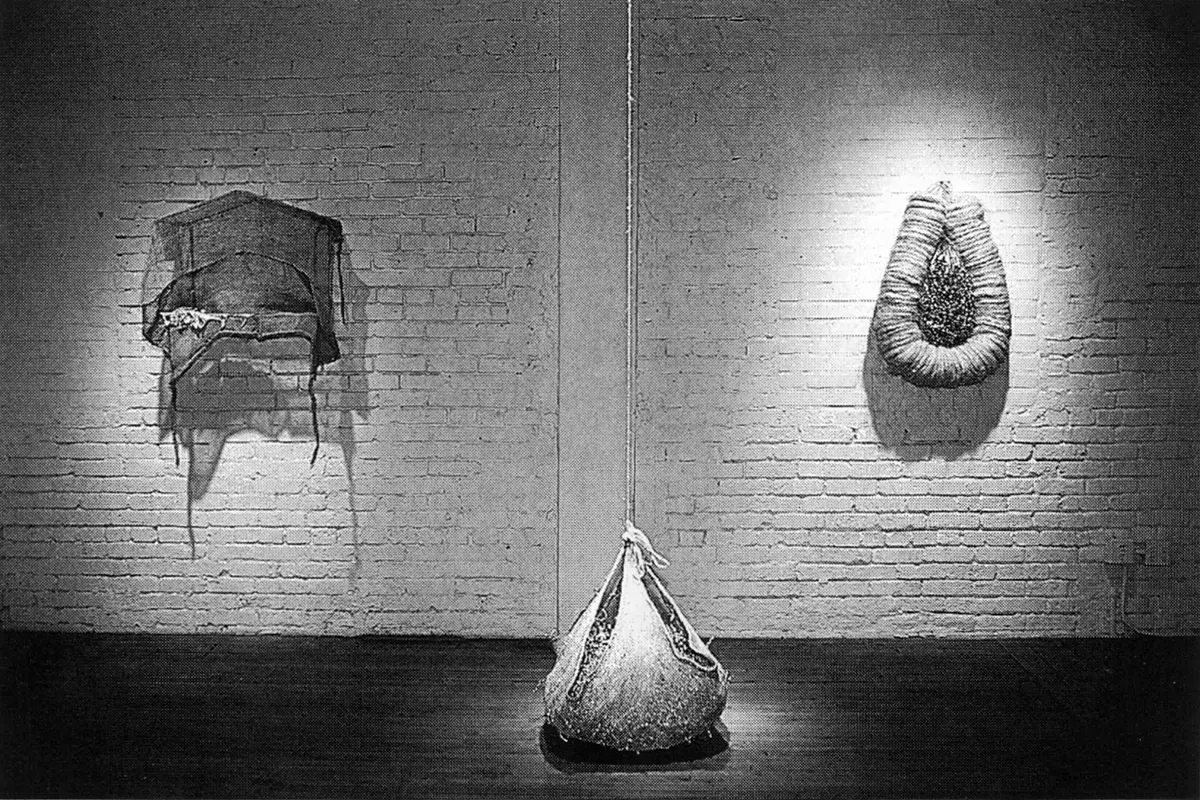
Simultaneously elegant and humble, Guttin’s meticulously handcrafted pieces quietly unfold their themes by pairing and comparing the substances of nature and industrial culture. The California exhibit profiles eighteen new works that variously sit on the floor or hang from the walls or ceiling. Some pieces like Dwelling, Untitled, and She, are singular, sculptural entities, while others such as Encyclopedia, Loose Pages, From Oaxaca, and The Week’s Groceries are composed of serial component parts. In all cases, it is the selected form patterns and the works’ material contrasts that reveal conceptual themes.
The most didactic work in the show, From Oaxaca, compares and contrasts scrap aluminum shavings and discarded orange peels in a sequence of five acrylic bubble compartments. These move sequentially from aluminum shavings on the left to drying and decaying orange peels on the right. The compartments in between combine the two substances in varying degrees. Suggesting the oversimplification of extant, binary discussions concerning the interface of nature and culture, this work underscores the baroque mixing of the two. With a postcolonial poignancy, Guttin articulates the fallacy of lingering late 19th and early 20th century European interpretations that conceptually link some cultures to nature and the imagined paradigm of the “primitive,” while upholding others as “civilized” and connected to industrialization. As Guttin’s works suggest, cultures throughout the world are amalgamations of both. Moreover, since the power dynamics of the European concept of the “primitive” is frequently configured as “feminine,” Guttin’s work She approaches the nature-culture praxis from a feminist as well as a postcolonial vantage point. Juxtaposing what looks like jute twine with aluminum shavings in a work configured as a symbol of female sexuality, the sculpture confounds traditional distinctions by interfacing natural and industrial materials. Whether one chooses to interpret the work as a critique of misperceptions of Mexico as an alleged “third” world country linked to nature rather than technology, or as a redress to that false notion of women as beings more closely aligned to biological processes than men, the sculpture insists on the irrefutably twined co-existence of nature and technology, foiling inherited, stereotypical denigrations.
Melding materials gleaned from the natural and industrial worlds, Guttin’s works thus address the complexities of contemporary existence. Combining materials and concepts often deemed antagonistic, she narrates a tale of unity that is filled with not only hope but relevance and grace.
COLLETTE CHATTOPADHYAY