
Carlos Vega’s first solo show at the Jack Shainman Gallery exposes long-forgotten connections between private histories and public spaces. Superimposing paintings over original archival documents, Vega animates the memory of particular individuals and associates them with architectural sites that bear a relationship to their worldly lives. Although his imams are emptied of the human figure, Vega brings his characters to life using historical texts that render their presence material.
Vega offers a voyeuristic look into the personal histories of anonymous and forgotten individuals whose legal wills, land deeds, accounting ledgers, religious texts, and private correspondence have become available in the flea markets of Madrid and New York City. By reading through the documents, the artist unearths site-specific references intimately linked to the life of his subject and photographically records the present-day architectural sites. These contemporary photographs shape the visual structure of the artist’s multi-layered paintings.
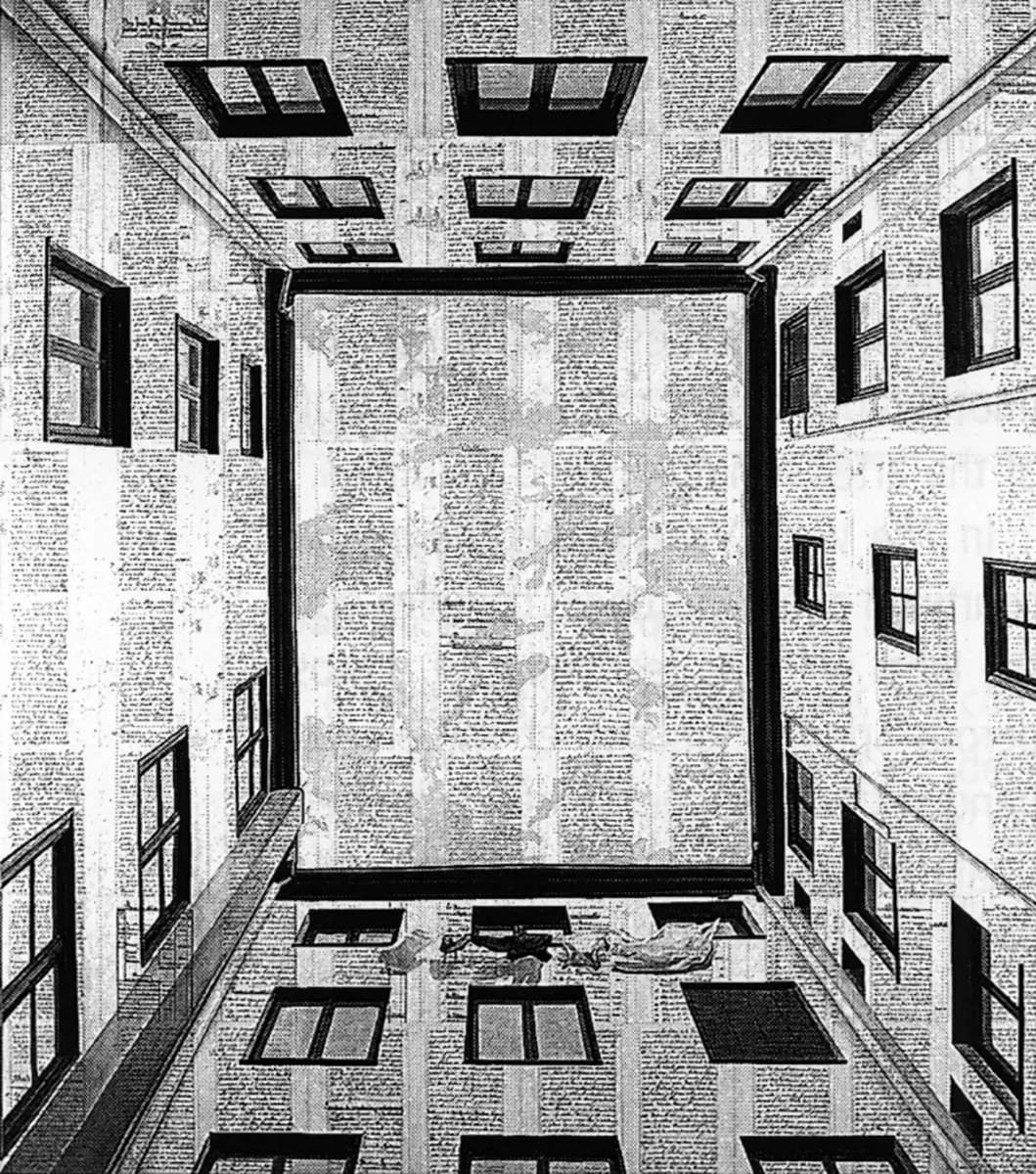
In The View, Vega paints the interior courtyard of an apartment complex onto the legal will and testament of a prosperous Spanish landowner. The elegant handwritten document details the gentleman’s many holdings and personal possessions and depicts the apartment building where is said to have passed away. Displaying a vertiginous tunnel perspective looking into the heavens, The View implies a metaphysical reading of the pictorial space. Similarly, in Misas en su nombre, Vega manipulates perspective, depicting the upward-thrusting architectonic line of an elevator shaft in a building sold by a wealthy aristocrat. As with all Vega’s works, there is a story to be told: in Misas the legal will requests that the building be sold and the proceeds be used to procure 1.500 Catholic masses for the redemption of the individual’s soul. Clearly, in these works, Vega is playing with the metaphorical notion of a transcendental space that leads from one life to the next.
As with many of Vega’s works depicting unnatural and forced perspectives, it is evident that Vega has been heavily influenced by modernist photography. His “worm’s-eye” views of stairways, elevator shafts, courtyards, and the like, have a visual clarity and directness that stand in marked contrast to the personal and intimate nature of the archival documents. This refusal of naturalized conventional viewpoints and Vega’s depictions of deep recessional space create a formal and philosophical tension with the two-dimensional handwritten texts. The result is a distinctly modern viewer’s temporal sense that presents us with an ambiguous relationship between absence and presence, physicality and ephemerality.
Not all of Vega’s works, of course, deal with the lives of the wealthy. A great many of his paintings incorporate items from the everyday lives of ordinary people grocery lists, accounting ledgers, and private correspondence. Vega investigates these quotidian lives, and reintegrates their personal artifacts with specific places and times, such as the Spanish Civil War and various institutional spaces, creating intimate portraits from seemingly irrelevant and discarded documents.
Knowing that the personal papers of those included in Vega’s paintings have been found and sold as commodities on the streets leads one to question the idea of transience and the ways in which our lives will be remembered or not by future generations. The critical distance presented in Vega’s paintings permits us to see those lives remembered not purely as a nostalgic recovery, but also as a reflection of our contemporary and modern daily existence.
CHARMAINE PICARD