
The Jemmy Button Inc. Society owes its name to a Tierra del Fuego Indian who was bought for a sack of buttons and taken to England by Darwin’s expedition crew. During the following trip of the legendary ship, the Beagle, its captain, Robert Fitz-Roy, painted a portrait of Button dressed as an English gentleman before he was returned to his land. The members of this Society, artists Mónica Bengoa, María Navarro, Cristián Silva, and critic Justo Pastor Mellado, believe that the Fitz-Roy portrait of Button has become a symbol of the participation of Chilean art in the international scene. According to them, just as Button had experienced, “Artists are returned to their home for being incompetent; unless they become collaborators of contemporary Darwinism and accept being decontextualized and interchangeable pieces in a symbolic market, homogenized by the desire for the primitive.”
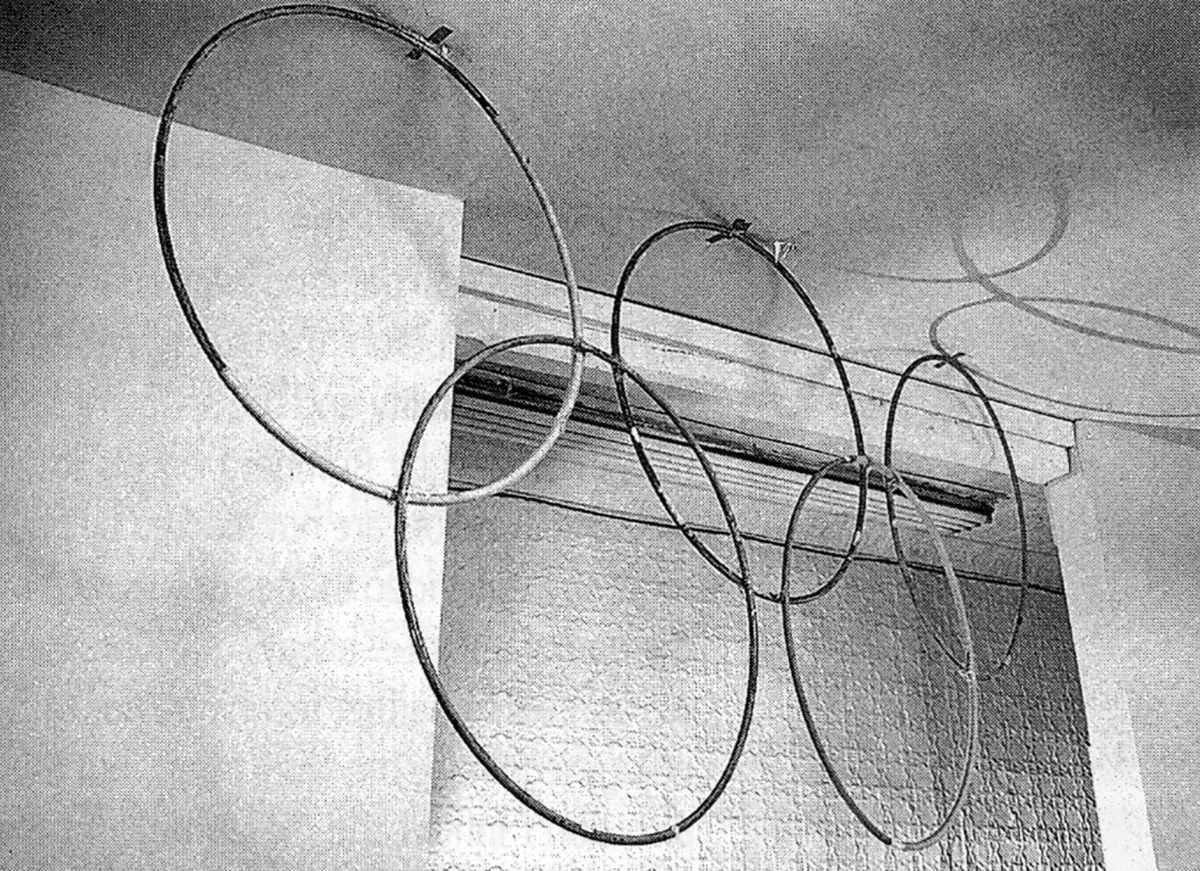
Cristián Silva’s (1969) work is an act of rebellion against what it is expected from him. He claims that the purpose of his work is, “to try and start before coming to the verge of the unknown,” meaning that he tries to re-examine “that which we already know, those differences and similarities that, by force of habit, have been totally assimilated and thus rendered invisible.” Superfly, Silva’s first show in New York, is a collection of apparently independent works that construct a whole, inevitably connected to the recent political history of his country, and especially to the artistic production during and after the military dictatorship.
Silva is concerned with the complexities of the notions of individual and national identity. He uses a wide variety of resources (sewer pipes, photos, plastic bottles, potatoes, and carved swinging doors) to reflect on his relationship with his native city, Santiago de Chile, an isolated, remote, and hybrid city that seems to be hidden between the Atacama desert, the Andes, the Pacific Ocean, and Antarctica. Silva is not interested in exploring his ethnic roots or following the stereotypes imposed by the market on South American artists. In his personal iconography, things are not what they seem. The Olympic rings do not symbolize the five continents but instead represent power relations amongst countries: Cooperation, Assimilation, Competition, Accommodation, and Conflict. Most of his pieces are cryptic and deliberately ambiguous (built of “elements that function as permanently oscillating indicators”) with the exception of works like Tortured Soul, a paper collage made with comic strip clips of The Incredible Hulk in several languages. This piece conveys the pain and confusion caused by the transformation from a human being into a superhero, a metamorphosis similar to the one that the Chilean (or from any other developing country) artist may have to endure to access the international art world.
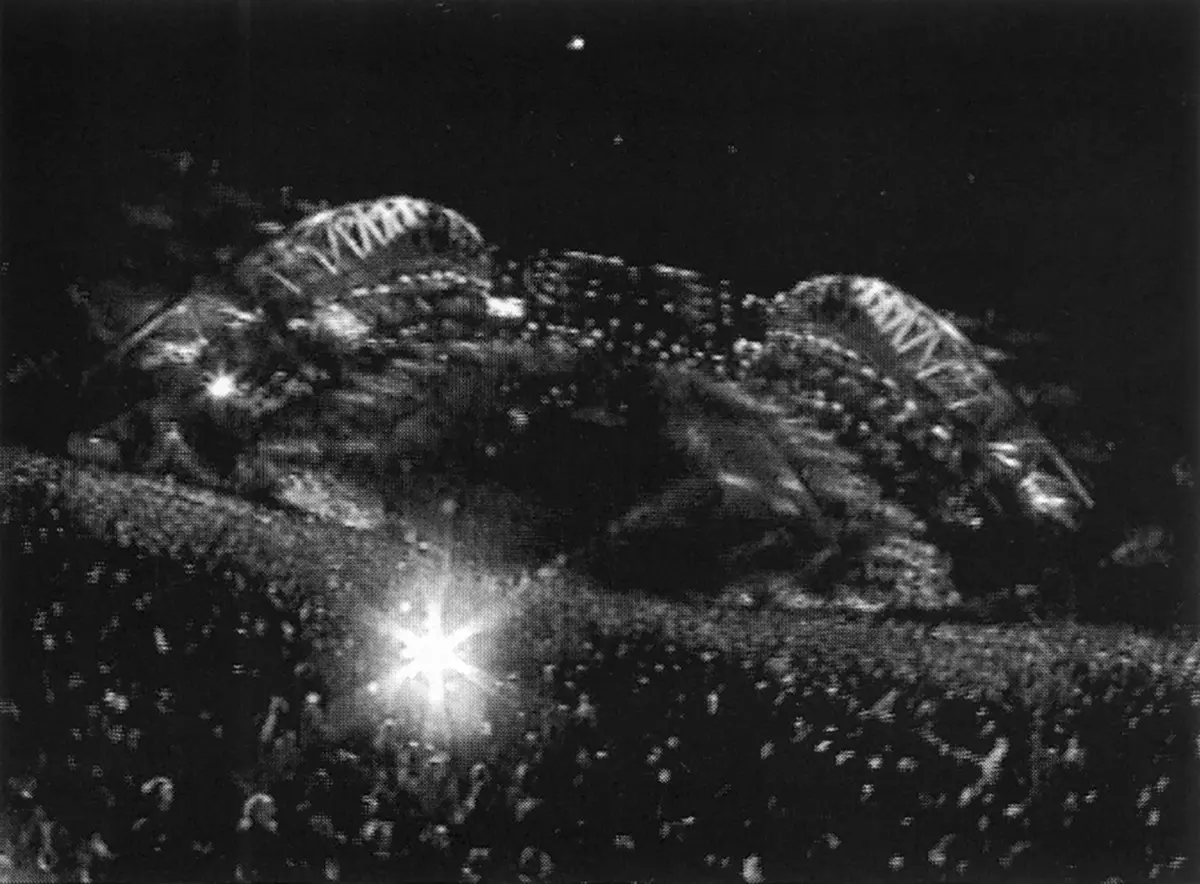
On the second floor of the gallery, Grazia Toderi’s video Olympia is shown continuously. At night, a crowded Sydney Stadium spins slowly looking like a strange flying object. Toderi’s videos consist mainly of one image and one action that happens in cycles. Her extremely simple narratives are totally devoid of emotional weight; nevertheless, their cyclical nature is very effective at creating and transforming emotional states in the viewer.
In this case, the rotation of the stadium is accompanied by the cheers and screams of the fans distorted by the repetition of the loop, transformed into a rhythmic and spectral space melody. The camera turns into an analytical tool capable of transporting the observed object by detaching it from the ground. The stadium lights and the occasional flashes from cameras and lighters create the illusion that the stadium is a nebula, a sort of floating moist flower or a perturbing humid eye in the sky.
Toderi has used sports imagery in the past, in particular, the stadium (Il Decollo). But more recently her work has dealt with the mysteries of the universe, cosmic paraphernalia, and the conquest of space. In Olympia, spectators and performers (players and/or pop stars) become undifferentiated by the unexpected expansion of the perspective. The place of gathering becomes the central character, a space voyager trapped in a hypnotic weightless rotation. Just as in Silva’s works, here the familiar becomes alien, the balance is disrupted and the position of the observer is no longer certain: Who is floating, the stadium or us? Toderi’s video is a brilliant piece of minimalist perfection and formal purity that works like a wonderful introspective haiku in which the absurd creates a fascinating and obsessive trip through inner space.
NAIEF YEHYA