
Zinny and Maidagan, the young artists from Rosario who have settled in New York, offered a small but solid sample of the work they have been doing as a couple for some years now. Educated as architects, they’ve developed a body of work strongly committed to the investigation of space: their pieces are conceived and exhibited as interventions and interferences in the assigned area of the exhibition. Winners of prestigious national and international scholarships (Fondo Nacional de las Artes from Argentina, IASPIS from Sweden, and Pollock and Guggenheim from the United States), Zinny and Maidagan are frequently invited to develop specific projects. Throughout 2000 they created works for the Blue Star Space in San Antonio (USA), the Museo Rufino Tamayo (Mexico), Artist’s Space in New York (USA), and the Moderna Museet Projekt in Stockholm (Sweden). At the request of Dan Cameron in 1999, they restructured the access section of New York’s New Museum. The show at Ruth Benzacar was their first exhibit in the Argentine capital city.
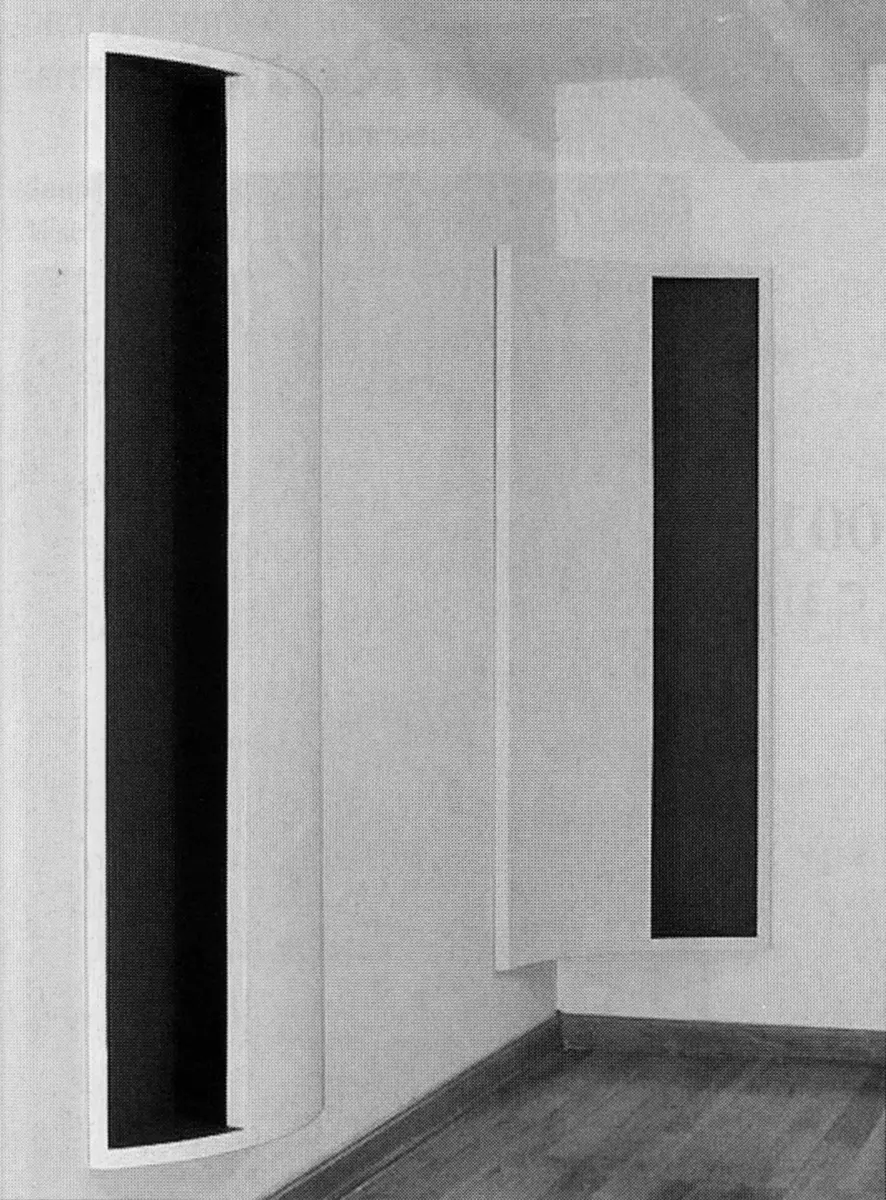
Among other works, in the gallery, they presented two pieces that remind us of the main concept applied in Movement in Art, the work they exhibited in Stockholm last year. It’s a huge hollow structure propped against the wall, which the spectator can cross by means of a sliding door. Visually speaking, the piece makes use of the legacy of Minimalism; the ascetic colors, perfect borders, and impeccable surfaces accent the promise of an expressive neutrality which, in the first analysis, leads us to interpret it as part of Frank Stella’s “what you see is what you see” tautology. Dominating the initial image are rationality and asceticism; but the second reading—that which historical Minimalism strove to eliminate—allows in Zinny and Maidagan’s work an explosion of the senses, not only in terms of the possibility of an illusional and narrative effect but of elements that are undoubtedly affective—such as the perception of the spectator, who is invited to interact with his/her body and/or sensitivity, which here gain a particular relevance.
In its less arid and more phenomenological version, a conceptualist attitude rules the functioning of the Zinny-Maidagan team. The incorporation of time, be it real or imagined, conditions their works, leading them into a dimension of instability and its subsequent richness in meanings. The emptiness behind the sliding door served for a few minutes as the hiding place for a small boy—and this is only one of the many appropriations the piece suffered during its contact with the public. Among their other works, the artists have done more subtle modifications of space. In the New Museum, they established a dialogue with the materials and shapes of the exhibit hall; in Ruth Benzacar, they barely altered the monotony of a wall by inventing the slightest opening. In both cases, the imagination used for the moment of reception performs a key role, which not only finishes the proposal but to a large extent reformulates it by sending it in unpredictable directions. Undoubtedly, urban intervention—the most contemporary facet of traditional public art— is a promising field of investigation for Zinny and Maidagan, two artists who are set on the politics of perceptual expansion through art. Minimalist and paradoxical, conceptual and sensitive, they work with criteria that have been opportunely influenced by the vanguard’s idealist optimism.
EVA GRINSTEIN