
Ernesto Pujol’s retrospective, is a conscious reconstruction of a complex identity, a “political body” in which his representation finds the social, the racial, and the sexual. Parallel to this process and through personal experience, Pujol has striven to recover the historical memory of a collective event. This event registers a family history of exile, of physical displacement that helped preserve class and race values of the Cuban bourgeoisie decontextualized from its place of origin, and which was part of the shaping of Pujol’s identity.
It is here, through the representation of the body or its obvious or subtle image, that he questions the past. The human figure is precisely the object of questioning, the stage, and the center of the oeuvre itself, individualized and personalized in the artist’s figure—not in its biological or anatomical sense, but in the clothes covering it and the objects identifying it. In this sense, Pujol’s work acquires the dimension of performance identified with the practices of feminist art in which the body is the “battlefield” of political action. Each one of the media utilized—painting, photography, video, or installation—serves as a tool or object to assemble the stage on which the body will take action. The complexity of Pujol’s work is given through the performance of the body understood as a social and as an incisively personal entity, where we have, on the one hand, the subjective exploration of the shaping of identity (sexual, class-conscious, racial) and, on the other, the reconstruction of personal memory.
Each of Pujol’s shows could be seen as a chapter in this great retrospective, a register of the decisive moments of a person’s life—in this case, Pujol’s. These stages have been his childhood, exile, the memories of a country through family tales, the practice of religious life, and the unequivocal awakening of “deviant” sexuality not accepted by the bourgeois and deeply catholic family. Loss of Faith represents “the artist’s or the painter’s learning stage.” This learning takes place in a visually undifferentiated world, a mish-mash of religious images, art reproductions, and cartoons.
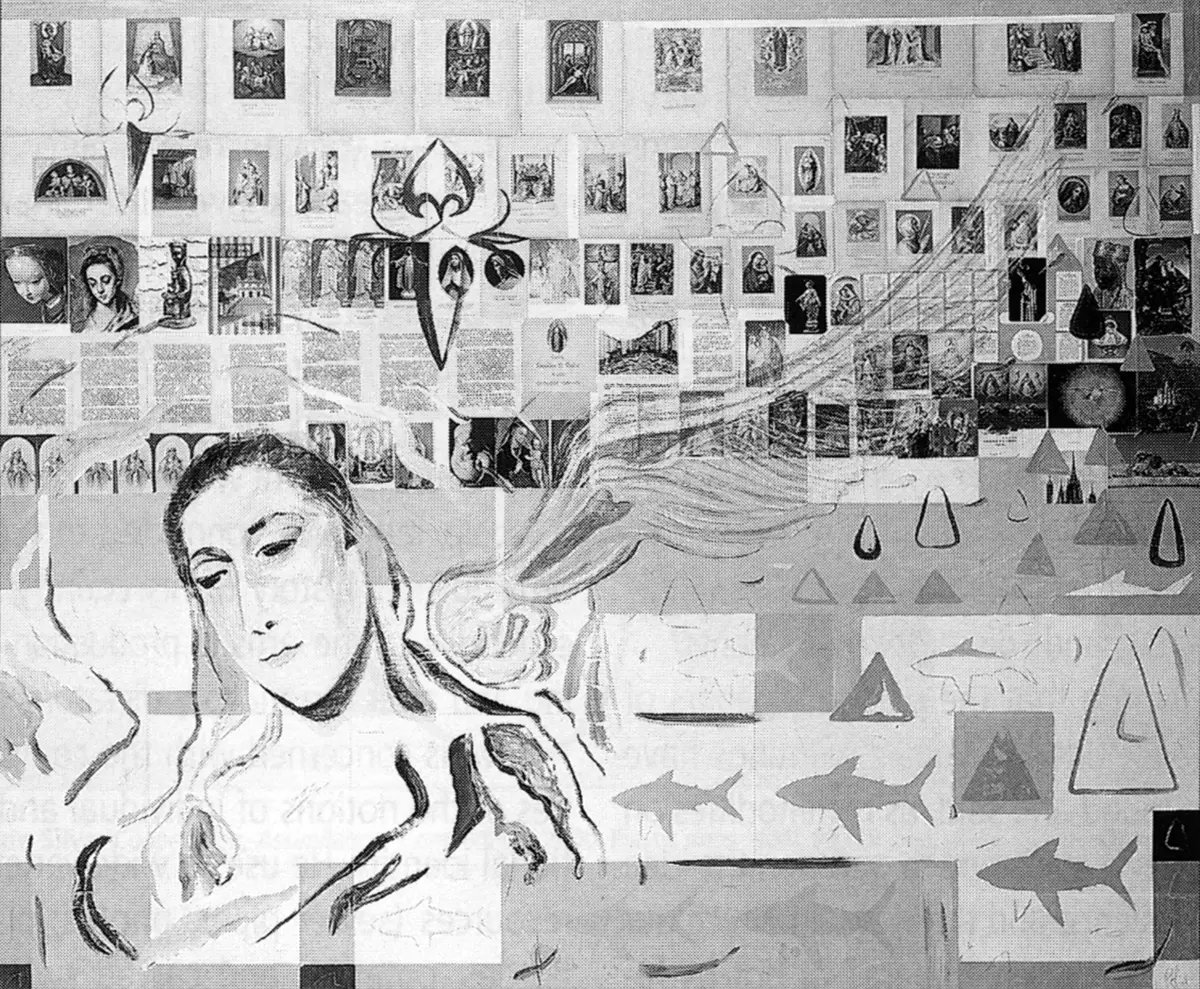
Twenty-nine paintings are presented at the Galería Ramis Barquet, along with Hagiography, a photographic series. The paintings, if that’s what they can be called, are drawings over collages from missals, Catholic devotional books taken from Pujol’s grandmother’s library, brought to Puerto Rico from Cuba. Printed with images of saints (male and female) and typed text, they were dismembered from different books to completely cover the canvas surfaces. On top of this total “cover-up,” Pujol has drawn figures, symbols, and calligraphies with a stroke that’s unsure, naïf, and childish, imitating a child who wants to reproduce the visual world surrounding him using the covers of the books belonging to the adults.
The naïf drawings of human or animal figures or a simple abstraction done with acrylic, oil, or color pencil is contextualized over a “tapestry” of religious stamps and reproductions mixed with other “artistic” references—residues of the cultural heritage of a culture of appropriation. Sometimes the drawing exceeds the frame and continues directly on the wall or the empty frame is drawn on the concrete with no other visual sign, underlining the presence/absence in the montage. Over this strong representation of catholic imagery, other “cultural” references—which are part of the artist’s learning period—intervene to engage in a more artistic discussion. The discussion is about modern art, about the historic vanguard that valued the naïf and the expressionistic and was against academia. It also talks about the use of collage with typographical impressions to highlight the two-dimensional representation of reality through the artifice of painting. In this learning also comes postwar abstraction through the reproductions in art magazines seen in Puerto Rico. Cold abstraction, colorful, two-dimensional, reproduced in another massively reproduced medium.
The unsure, childish drawing with the personal references is, on the one hand, a joking response to those “historic” appropriations in which criticism of the white Cuban bourgeoisie’s gaudy religious taste mixes with the criticism of the sad state in which the discussion over modernist representation has fallen. On the other hand, all that sensual, visual, “baroque” world is a reaffirmation, almost a retaliation against the return to the “minimalist esthetic” that tries to “universalize” so many Latin American artists, as in the case of, example, Félix González-Torres.
In a certain way, Marian Blue (2000, 187 x 153 cm) encapsulates the whole show, with the particularity that in this inventory of visual and cultural references, Pujol included his own imagery. The piece is divided into two sections. On the upper part, Pujol combined works of art representing the Virgin with religious stamps. But the lower part is covered with painted symbols repeating the leitmotivs of sharks and triangles so commonly found in his work during the early 1990s. A predominantly blue naïf drawing of the Virgin is superimposed over both halves, the painting and the reproductions. The symbol of the fleur-de-lis shares the same place as the Virgin. The use of cultural emblems and references in the same space creates a complexity of meanings that go beyond an empty, cannibalistic visual appropriation devoid of hierarchies. Pujol refers to a world saturated with iconographic representations that surrounded him during his childhood, occasionally serving as “presences, objects that were more real than the child or the young man trying to reproduce them.” The young man who appears as a shadow in El Greco’s Doves (2000, 121 x 91 cm), at the side of the predominant and central figure of a Dominican friar, is Pujol, the artist who learned painting by reproducing the masters of the Spanish baroque.
In Hagiography, the sequential series of photographs-performances, Pujol assumes the feminine religious identity in the form of a habit, not to subvert it but to underline the ambiguity of a genre’s definition within a social class’ collective imaginary.
The nun is the pure virgin offering herself as God’s bride. She doesn’t have a “biological sex”; she is purity, chastity, she’s whiteness, clinical. Nevertheless, in these two photo sequences, moments of human vanity are deconstructed prior to the construction of a pose that will remain as an icon in the catholic religious stamp. Also, in these two sequences, two moments in religious life are present: the novice and the nun. They present subtle differences in pose and movement. The novice’s gestures are freer and seem worried with the habit; the nun’s gestures are more reserved and concentrated on the face and the hands. No decorative frame encloses them: they, like the stamp that will render them eternal, are the central figure, the stereotypical representation of an icon that’s out of sync with these times.
DERMIS PÉREZ LEÓN