
Straying slightly from its habitual policy concentrating almost always contemporary, two-dimensional works—the Galería Soledad Lorenzo decided to present two technically complex, large format installations by Iñigo Manglano-Ovalle, along with a small series of photographs deriving from them, along with other works by the same artist.
In both physical and conceptual terms, the two installations appear to depart from the notion of suspension. They’re both constructions in which the back screens, audio circuitry, and metallic structures hang from the ceiling. Nothing is fixed, thus the sensation of lightness, despite their complexity. But this suspension is not limited to the works’ physical and constructive aspects; on the contrary, they seem to propose a discourse on modernity, esthetics, and politics, which appear to remain unresolved.
In Climate (2000), we encounter three screens contained within a huge aluminum frame that has the double function of enclosing the piece while at the same time preventing the spectator from entering it, although the latter is more a sensation than anything else. In these huge screens, one can simultaneously see a series of close-ups involving a group of characters appearing to be spies or bodyguards (in the catalog we read that they’re “guardians” speculating on the influence that changes in weather conditions have on the world’s stock market); a woman waiting for something; and some hands continuously assembling and disassembling a pistol. The music accompanying the installation is anodyne enough to be forgotten quickly, but above all, it maintains the slow and monotonous rhythm of the video images (once in a while we see a shot of the sky that the guardians are presumably watching). We’re not dealing with action videos here, and undoubtedly they demand an unusual type of attention for this medium. The piece’s central element seems to be the sound, which mixes music with a group of voices heard offscreen in English and Korean, among other languages. Parallel to the catalog, the sound supports what the installation proposes —a world without frontiers manipulated by weather-watchers, in which everything, especially information and economic benefits, is “for everyone at the same time.”
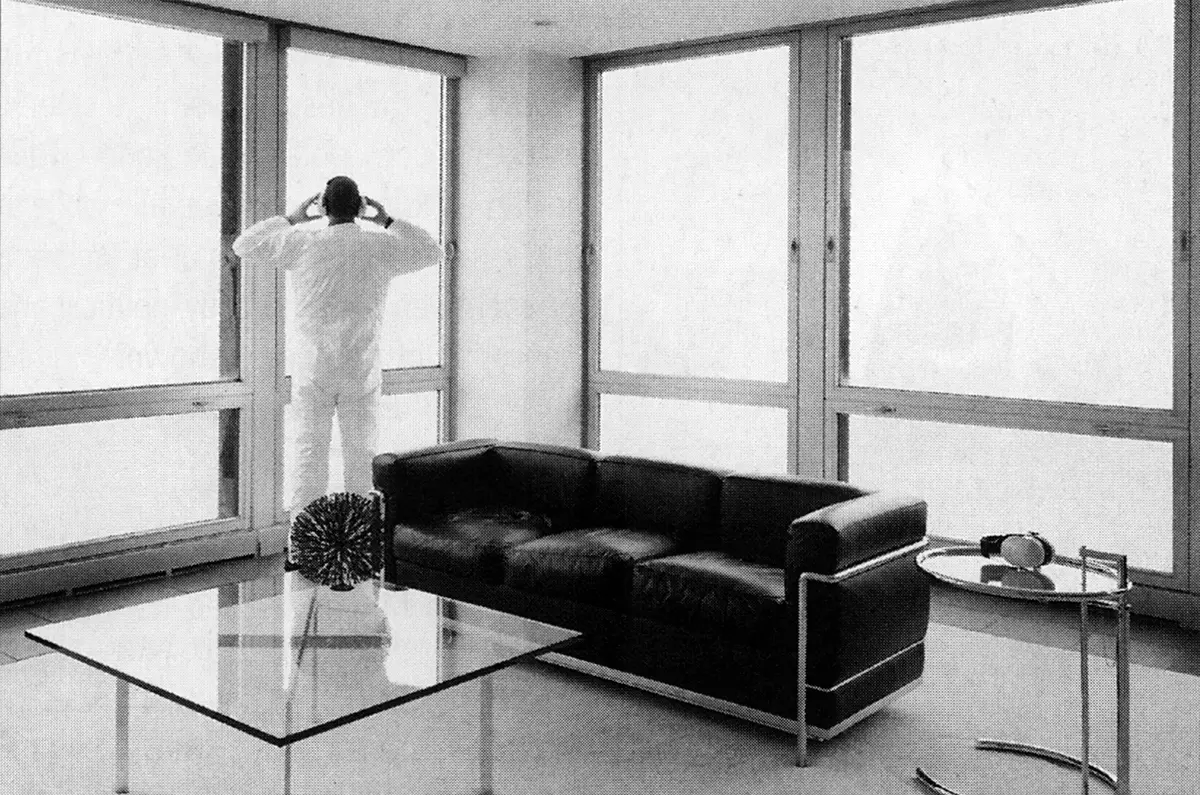
In FM (0169275275S) (2000), the hypnotic effect on the spectator works more effectively due to the combination of the slow, minimalist music with the rhythmical movements of a camera that almost completely surrounds Mies van der Rohe’s glass house. Amidst the modernist furniture, a woman dressed in white stands inside the house with a set of earphones on her head. While she listens (to the weather report?), she placidly looks at the garden surrounding her, but at the same time, she’s separated from it by the construction’s implacable walls.
Despite their technical complexity, the installation of both pieces is clean, to such a degree that they could appear almost cold. And, indeed, they don’t seem to give much room to the spectator who’s not familiar with Manglano-Ovalle’s work or hasn’t perused the catalog. In any case, it’s a coldness that leaves us intimidated: the imminent physical presence of the steel structures that seem not to be there end up steering our attention toward them. The music, especially in FM, makes it impossible for us to leave the room in which there’s an uncommon sort of calmness—even on the opening day. The curiosity to see what the guardians are seeing entraps us. In this sense, it’s hard to resolve the piece’s intent: Is it a conceptual piece or an artistic one? Is it a critical look at modernity or a celebration of today’s technology and gadgets? In any event, the answer seems to swerve between both poles. Manglano-Ovalle invites us to reflect conceptually while at the same time implicating us at the bodily level, even if it’s the body, political and sensorial, of the pieces shown.
ISSA MARÍA BENÍTEZ DUEÑAS