
Before he was fifteen years old, José Moroles had been deported to Mexico twenty times for attempting to cross the southern border of the United States. When he was finally able to evade the immigration officers, he got a job cleaning floors in a Rockport optical company in south Texas. There he met and later married María Bautista and in 1950, upon the birth of their first son, given the historical weight of their own names, they invariably named him “Jesús.” In spite of his evangelical name, the peons called him “the baby of the cotton fields” because as soon as he was a month old, María took him to the fields where she worked picking cotton. She would place him in a small crib under the loading cart so he would not get scorched while she gathered the white buds. Thus, lying face up, the infant Jesús got used to seeing the vastness of the sky under the threatening weight of the cart. When he finally managed to sit up he glimpsed at that other axis of our existence: the horizon. These fundamental images of vastness and orientation must have made a strong impression on Jesús’ consciousness.
Jesús must have been around eight when his father noticed the skill with which his son sketched fish and mountains, coyotes, and trucks. “He’s a born muralist!” boasted Don José and, although he already had been promoted to supervisor, he barely managed to set aside $10 a month for Jesús’ art classes at the YMCA. Fortunately, his teacher, impressed by his precociousness, insisted on giving him private art lessons—so long as the other children did not find out.
At twelve Jesús grew so much that he became as tall as most of the adults in his family. That was the age at which he learned the craft of masonry from his uncle Julián Tapia. During summer vacations he worked with his uncle building seawalls. In this modest but certain way, his talent, his character, his will, and his entrepreneurship were forged, while at the same time, his familiarity with tools molded his imagination. Thus it is not surprising that Edward Lucie-Smith asserted that Moroles "is also someone who is knitting the link with the traditional craft skills until recently almost deliberately neglected by artists affiliated with modernism."
By the time he was sixteen, Jesús was already running a prosperous silkscreen business. The Vietnam War, however, interrupted his artistic progress as he was drafted into the Air Force. Unlike many of his high school friends who died in the war, Jesús did not have to face combat duty because, strangely enough, of his mathematical skills. The Air Force considered him to be more useful in repairing electronic equipment at bases in Nebraska, Mississippi, and Thailand than in killing Viet Cong guerrillas. When he was discharged after four years, Jesús studied sculpture and engineering at El Centro Community College in Dallas, and later at North Texas State University in Denton. It was in the latter school that he first sculpted limestone, marble, and granite. Moroles remembers the first time he faced granite: "I was holding a hammer with both hands, I had on earplugs, goggles, a dust mask, a scarf around my neck, and a hard hat. The overalls I had over my own clothes were covered with a cake of dust. I couldn’t hear or see anything. You have to face the stone alone and you can’t do it for over thirty minutes at a time. When I stopped I realized there were about thirty people around me watching what I was doing. The stone took over me. It was so hard it barely showed what I had done to it. I had not even scratched it! It controlled me. I fell in love with it."
After graduating from North Texas State University, the established sculptor Luis Jiménez took Moroles under his tutelage for a year. From that association a complicitous friendship between the two artists. Although Jiménez’s postmodern and figurative fiberglass sculpture is very different from his, Moroles says, “What I got from him was a sense of aesthetics. It shows in both abstract and figurative work: quality and craftsmanship.”
The following year, during a pilgrimage to Pietrasanta, Italy, Moroles experienced a sort of epiphany. At thirty years of age, while he was climbing some worn-out marble steps leading to the legendary quarries of Carrara, it was revealed to him that in the work he would do, the stone would be set in the midst of nature so that people could touch it. However, his sculpture was not to be made of the marble with which Michelangelo carved his David, but rather of the granite of the great Egyptian pyramids and the temples of Machu Picchu. About marble he speaks with a bit of disgust, “It’s so soft you can cut it with a nail file.” Whereas when he speaks about granite it is as if he were talking about the fundamental element, calling it “the living stone” or “the core of the universe.” That is why Moroles works almost exclusively with granite, a material whose hardness and unpredictability scare off many sculptors.
Moroles openly states his admiration for Isamu Noguchi, one of the great artists of granite: "He can do so much with so little. He can take a piece of clay, walk on it and say, ‘This is it.’ And that really intrigues me. He’s to a point where almost whatever he touches becomes art . . ." The power of art to transfigure the commonplace into an entity bordering on the sacred seems to be one of Moroles’ main motivations. Moroles’ mystical relationship with stone has led him to understand it as perhaps the ancient Peruvians did when they adored apus(deities of the mountains and stones).
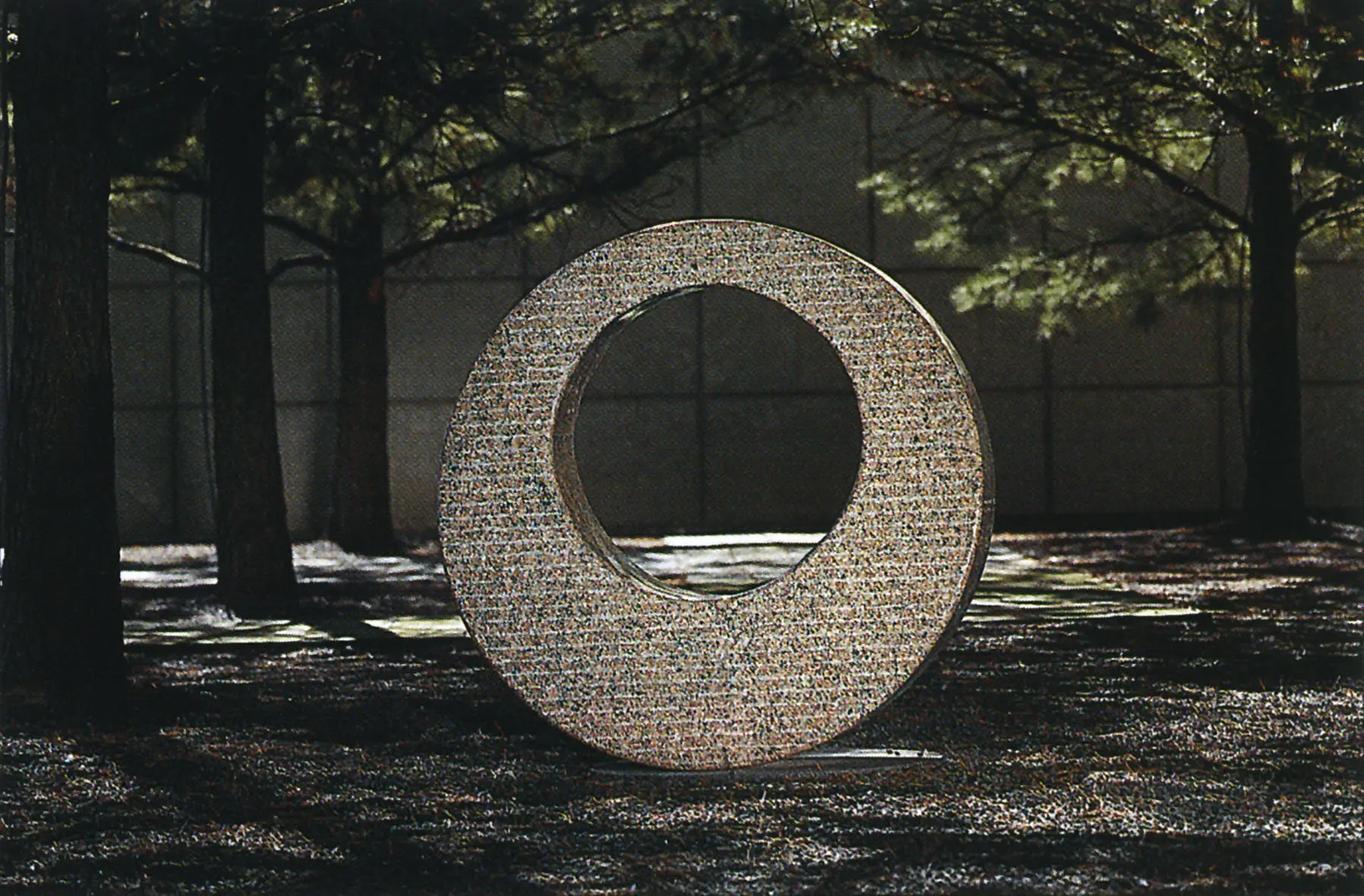
The intimacy that Moroles has with stone is such that he can predict exactly what its behavior and even its “voice” is going to be. One of the most memorable milestones in his career proves it. The Houston Chronicle’s art critic, Patricia Johnson, reviewing his show Tearing Granite: Thunder in the Stone (1993) at Davis/McClain Gallery, described an evening of sculpture, music, and dance. From his alma mater, North Texas State University, came the musician David Schrader and a dance group. Moroles carved keys on stone sculptures like Black Musical Stele (1999) so that they could be played as musical instruments. Playing the steles as if they were xylophones (with sticks, stones, and wire brushes) and the Molcajete (grinding stone) as a drum, Schrader accompanied a recording that had been prepared previously at Moroles’ Rockport studio. The resulting recording was Larry Austin’s composition Rompido, done with the deafening sounds of hammering, high-powered diamond saws, grinders, and other machines used for cutting and moving granite sculptures. The dancers, choreographed by Sandra Combest, danced climbing onto and moving around sculptures like Moonscape Ring (1993)—an enormous oval piece of granite weighing 3,480 pounds. Notwithstanding its weight, Moonscape Ring could roll like a bicycle wheel, making its own sound as it did so. The highlight of the performance came about as one of the steles was played with a certain force producing a certain note, and broke exactly in half.
Sometimes Moroles speaks with the calmness of a fisherman and other times with the intensity of one possessed. In 1981 he showed up to see gallery owners Robert McClain and Barbara Davis “driving a little pickup truck with two pieces of sculpture and some hand tools in the back.” Barbara Davis recalls, “He told us he was going to build the premier factory in the country for making granite sculpture. Jesús had such drive in his eyes that we believed him.” Today, Moroles’ factory occupies three city blocks and works as a family village and business. His brother Hilario, his sister Susana, and his father, in addition to 20 employees, work in the different stages of production, transportation, and installation of the works. If it were up to him, the factory would work twenty-four hours a day, but the noise of the gigantic diamond-tip saw blades cutting the stone and the hammering disturbs the neighbors’ sleep and limits the nocturnal activity of the factory. Once Moroles stated in an interview that he ought to have been born a pharaoh in ancient Egypt so he could realize all the ideas that constantly assaulted him.
Jesús Bautista Moroles is a man with a mission and a vision that seem to escape his conscious wishes. His mission is to disseminate stones throughout the world; his vision is to give them the shapes they hold captive and that he intuites and liberates as would a shaman. Moroles has carved totem-like sculptures whose verticality connects earth and sky, the axis mundi of which Mircea Eliade speaks. He has built contemplative fountains like Bernstein Fountain and works where different pieces of stone come together fraternally as in Brown Interlocking Triptych (1984). The world seems to give way to his wishes because countries where the stone has played a historical role—Egypt, Mexico, China, Japan—have invited him to make sculptures in situ. About Egypt he says, "The day I arrived I was taken down the Nile in an old Egyptian sailboat. I found myself looking at the triangular sail of the boat and it was so beautiful and so spiritual that I became entranced. When I got to the quarry to look for a stone I found a 35-ton block that reminded me of the sail on the boat. It was the biggest stone in the quarry—18 feet wide by 22 feet long by six feet high. It was too big to take out of the quarry in one piece, so I had to work on the stone in the quarry to bring it down to a reasonable size. . . I kept working on the piece and eventually, it turned into a sail."
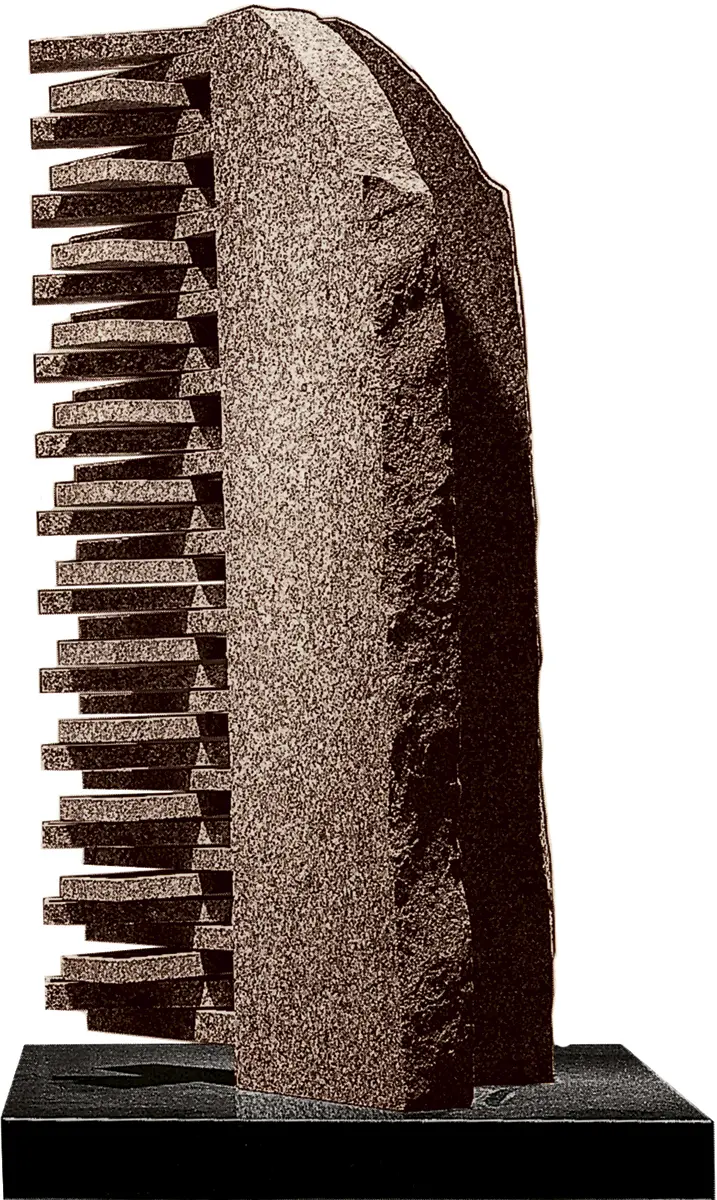
In the United States, Moroles’ sculptures are found at places including the Botanical Gardens of Birmingham, Alabama; at the Museum of Fine Arts of Santa Fe; at the Ulrich Museum of Wichita State University; and at the Smithsonian Institution. Many of these works are also water fountains and/ or invite the viewer to interact with them. In New York, Lapstrake (1987), a 64-ton, 22-foot tall granite monolith, stands at the Columbia Broadcasting Company plaza across the street from MoMA. The concept of the work is simple: perfectly rectangular slates appear to quash two formless columns as if they were made of clay. It is as if geometry were overcoming amorphousness, and at the same time, sustaining itself from it. About works of this sort, Lucie-Smith has written that one of Moroles’ "most characteristic procedures is to cut deep grooves in the recalcitrant block, so that a second form appears within it, a shape within a shape."
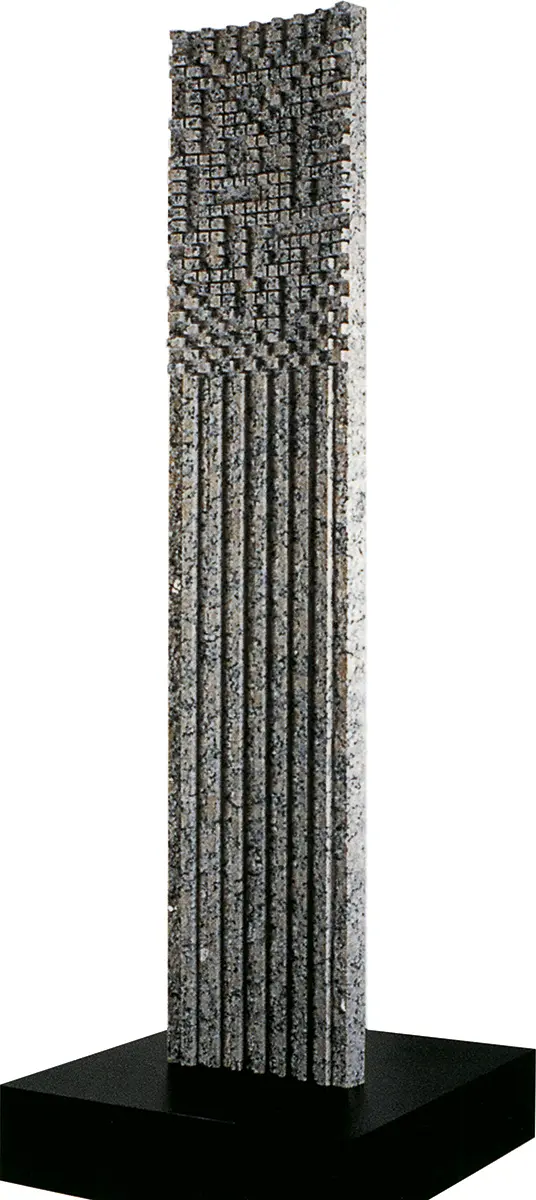
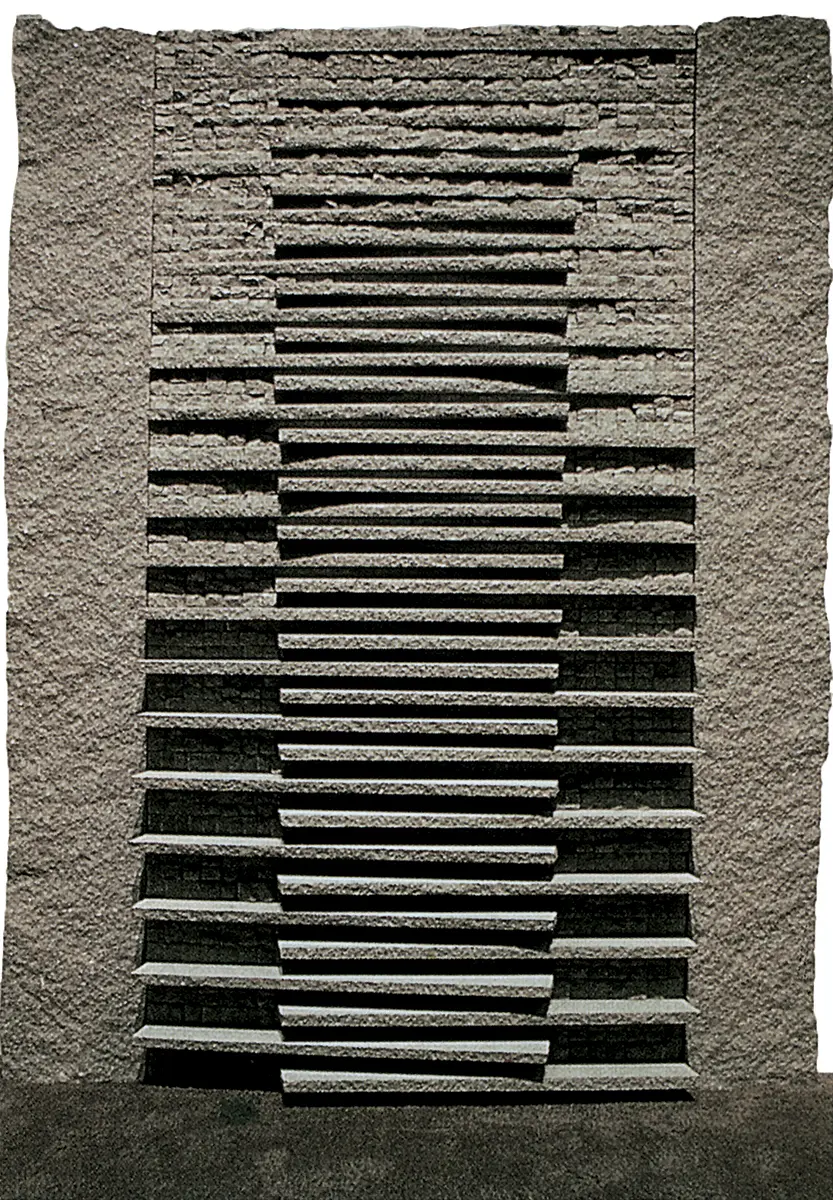
One of his most successful pieces, Granite Weaving (1987), is at the American Art Museum of the Smithsonian Institution in Washington D.C. It is an eight-foot-tall block of granite shaped like a rectangular prism. On its main face, perfectly rectangular rods in basrelief bud out of the stone itself, weaving together in a rhythmic pattern. This effect of high geometrical precision plays a defining role in most of Moroles’ works. The cuts are so precise that it is difficult to imagine that they were not forever in the stone. The allusion to weaving in the title is not merely hermeneutic; it also points to a poetics Moroles has spelled out many times: namely, that the crystallography of the stone sustains the form that his stereotomy only discovers. It is part of Moroles’ cosmology that the fiber of the world is in the stone, in its geometry and its presence. His stones are the omphalos with which the ancient Greeks marked the place of a divine occurrence. Moroles, as if heeding the call of an ancestral voice, place carved stones in profane places, perhaps with the hope of reinstating to them a lost gift.
Although works like Granite Weaving or Concave Stele (1986) have induced many writers, including Lucie-Smith himself, to compare Moroles’ work with that of Uruguayan artist Torres-García, in the former there is no programmatic line but rather a mystical vision. Moroles has not sought the recovery of pre-Columbian culture nor has he reached for its symbols and representations in order to modernize them. His pyramids are Egyptian as much as they are Mayan. It is true that looking at some of his steles the perspicacious viewer unavoidably recalls pre-Columbian steles. It is as if the viewer were looking at pre-Columbian steles through the pixel squares that cover up the identity of the people in the videos. Moroles has a talent for creating a sort of mirage of cultural icons, quoting their essential geometrical forms. One may agree with Lucie-Smith in that “The influence of pre-Colombian heritage may be more profound than the artist [Moroles] realizes,” but that influence does not necessarily arrive via Torres-García. Granite Weaving reverberates with a simplicity that is host to all meanings and none.
Very early in his meteoric career, Moroles was included in the exhibit Hispanic Art in the United States: Thirty Contemporary Painters and Artists, curated by Jane Livingston and John Beardsley of the Corcoran Gallery in Washington, D.C. Nevertheless, his work escapes the ethnic/linguistic nomenclature of “Hispanic” whose domain of pertinence does not go beyond the country of fifty states and which has been a useful tool to trivialize the work of artists like Moroles who —if anything— is more Native American than Spanish. Moroles just opened a studio in Barcelona, where he will probably install work that will probably not be considered Hispánico. Once he was asked whether in his work he felt some influence or ethnic obligation. He answered, "My only obligation is to my name. My name is very Hispanic. My middle name is my mother’s maiden name. My first name was given to me by my uncle, my last name is from my father, and we have been fighting to keep it from being changed. Everyone wants to spell it, and pronounce it ‘Morales’ with an ‘a.’ That’s the only time I really feel ethnic when people try to play with my name. I have no feeling beyond that. But I know, because of my physical features and body build, that somewhere in my heritage or bloodline, or mixed bloodline, I am from one of the Maya-Aztec ancient Mexican civilizations. My father has that nose chest and stature. I only got tall because of all the food and vitamins. I have that strong connection physically, but other than that my mental aesthetics are more worldly, universal."
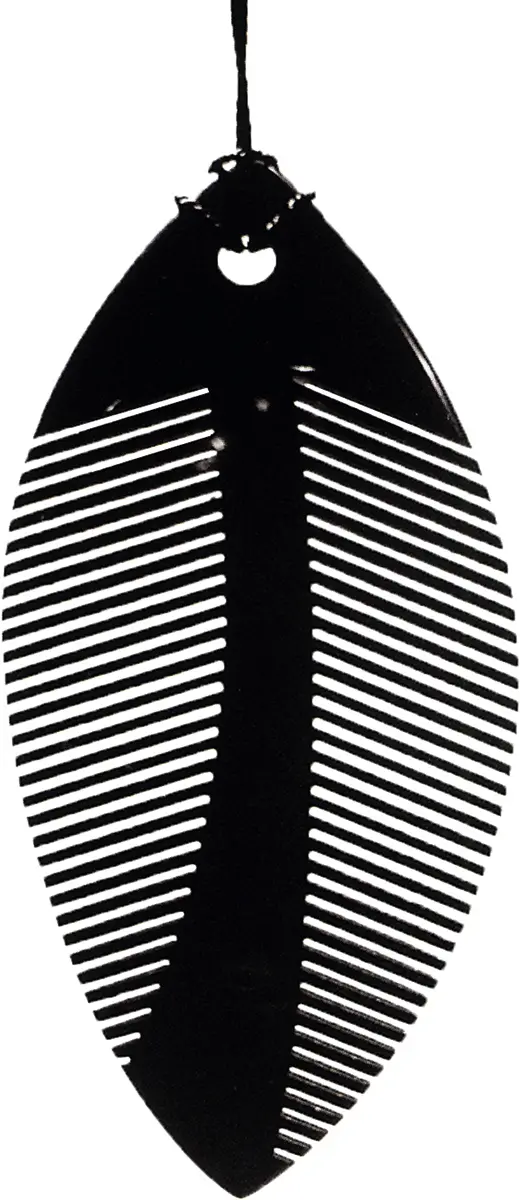
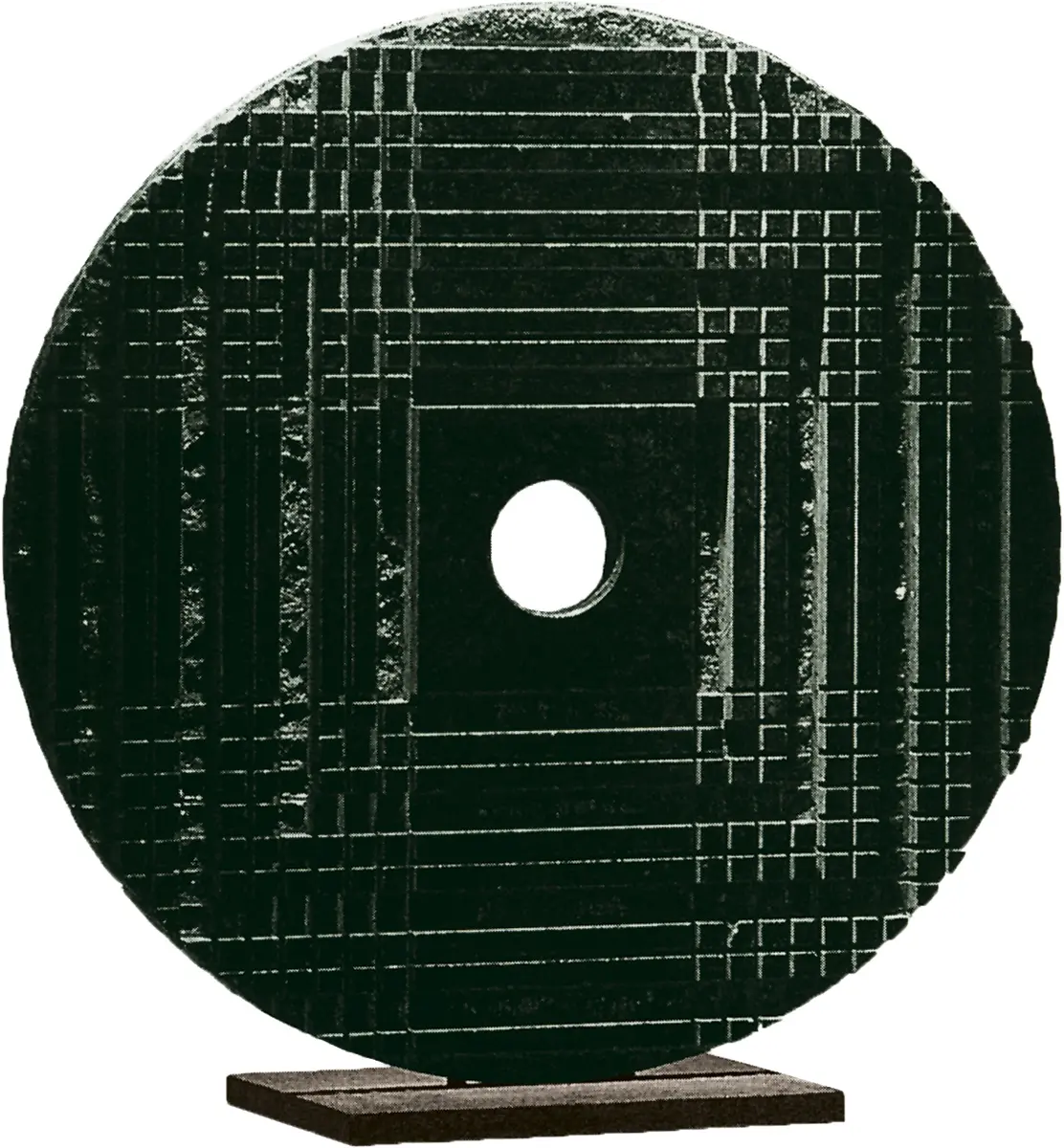
“My work rings back to Stonehenge,” said Moroles. What did he mean (aside from the obvious reference to stones)? Those pre-historic monoliths, placed along the perimeter of an imaginary circle, have the power of the mystic which the modernity of Moroles’ aesthetics secularizes in his work but does not always dismantle. Stonehenge is not the only pre-historic monument with these characteristics in Great Britain and Ireland; it is only the best known and largest of the ones that have survived. Aubrey Burl’s recent book Circles of Stone is an annotated inventory of dozens of other archaeological sites in which stones define a circular area. The speculation is that these sites were places of social gathering and cosmological contemplation; maybe they were built because they resemble the circular craters caused by meteors. That the chosen area of these sites is circular is an indication that the circle has a natural relationship to the cosmos. The evolution from a circular area to a circular stele occurs in one of these sites 3.5 miles away from Pengance, where there is a circular stone known as Men a Tol (stone with a hole). People of the area through the centuries have called it Lucky Stone or Devil’s Eye, according to the prevailing views at the time. Moroles’ drive is to create around his sculptures spaces of gathering and contemplation like Stonehenge. On the other hand, the discovery of the circle is an important finding in Moroles’ mystical pilgrimage. Moroles’ most recent Houston exhibits have reflected his China experience. The predominant figure in them was the circle, a form which had previously been absent in his work, except as part of his mostly rectilinear sculptures. These disks or circular steles are slates that vary in thickness from one to two and half inches and in breadth from the sixteen-inch diameter of Disc Sun (1999) to the seventy-inch diameter of Disc Labrador (1999). Typically, one side of these disks is carved with subtle reliefs and the reverse is polished—in other words, reduced to a tabula rasa. The latter might seem like a contradiction in terms because polishing requires much manipulation and the idea of tabula rasa is of a surface clean of intervention. In general, in the exhibits of these works, little attention has been given to the polished side, losing sight of the paradox posed by them. In antiquity, polished stone disks were used as mirrors. This fact suggests that the polished side of Moroles’ disks ought to, as a mirror, reflect the world not just the wall. Curiously, it is the reverse side—the carved side of the disks—whose surface is inscribed with the forms of the world, e.g., the geometric patterns of waves as in the first version of Ocean Spiral (1999). Thus, what Moroles has done is draw on that side what a mirror could reflect of the aquatic world. In the process, he has found two kinds of permanencies: that of stone and that of the sea. However, the mirror metaphor does not suffice to explain all of Moroles’ circular steles; specifically, it is not relevant for most of the steles bearing large symbolic holes.
To begin, it is necessary to understand that these disks have at least one hole (sometimes two) through which is inserted a thick, usually black nylon rope with which the sculpture is tied and hung like a gong. They presuppose, therefore, an architecture from which to hang. They are sculptures that find their place suspended somewhere between heaven and earth. In contrast to most of Moroles’ sculptures that do not disguise their mass, the suspended disks create an illusion of lightness. But in addition to the holes destined for the pendular support of the sculptures, there are other holes that open space inside the circle—holes that draw with their absence. These are the symbolic holes that require further reflection.
There is in Moroles’ disks an obvious reference to Chinese culture, albeit not an easy one to define. They could simply take us back to modern Chinese coins or more remotely to the pre-historical Pi disks—the most ancient cosmic symbols. These Pi disks represent the heavens and they are generally made of jade, a material to which protective powers are often attributed. But how does a semantic relationship between heaven and a perforated disk come about? From the top of a mountain, heaven is circular and the horizon is its circumference. Visually, heaven, i.e., the sky, is a hole on earth. Bolivian painter, Fernando Casas, showed this visual phenomenon in his painting Sky, Noon (1981). We could reasonably conjecture that Pi disks gave the bearer protection from the vastness and unpredictability of the cosmos as they disposed the viewer to the contemplation of a single point. Moroles’ translation of Pi disks to granite has that same effect. The second version of Ocean Spiral (1999) brings together the Pi disk and mirror disk, establishing the union of heaven, earth, and ocean—form, material, and continuity holistically.
Moroles’ sculpture patently shows the horizons that have marked his life from a very tender age. Moreover, through his peculiar understanding of stones, he has revealed with his works the universal traits of the relationship of man with the cosmos; with nature, and other humans. If his totemic columns are indices that point to the sky, his perforated disks are fullness and absence: the most abstract parameters of human life, expressive of joy and deprivation, life and death. Moroles says he builds works that will endure physically. Many of them also will endure in the lives of people who touch them and who are touched by them.
NOTE
Jesús Bautista Moroles is represented by Barbara Davis Gallery and Robert McClain & Co. in Houston, Texas, and by Lewallen Contemporary in Santa Fe, New Mexico.
FERNANDO CASTRO R.
Robert McClain & Co. in Houston, Texas, and by Lewallen Contemporary in Santa Fe, New Mexico.