
Beauty and horror sustain Manuel Esnoz’s notable paintings and drawings at Dabbah Torrejón, Arte Contemporáneo, a new gallery that opened recently near the old Mercado de Abasto, a porteño neighborhood far away from the habitual circuit of galleries.
It seems a little too much to talk about the career of an artist who is only 26 years old, but the fact is that Esnoz has already earned a significant place in Buenos Aires’ contemporary art scene. He won the Antorchas scholarship when he was 16 years old, which allowed him to study under Guillermo Kuitca, and he held his first solo show by the age of 20. Since then, he has shown yearly in Buenos Aires and at the Kravets/Wehby Gallery in New York.
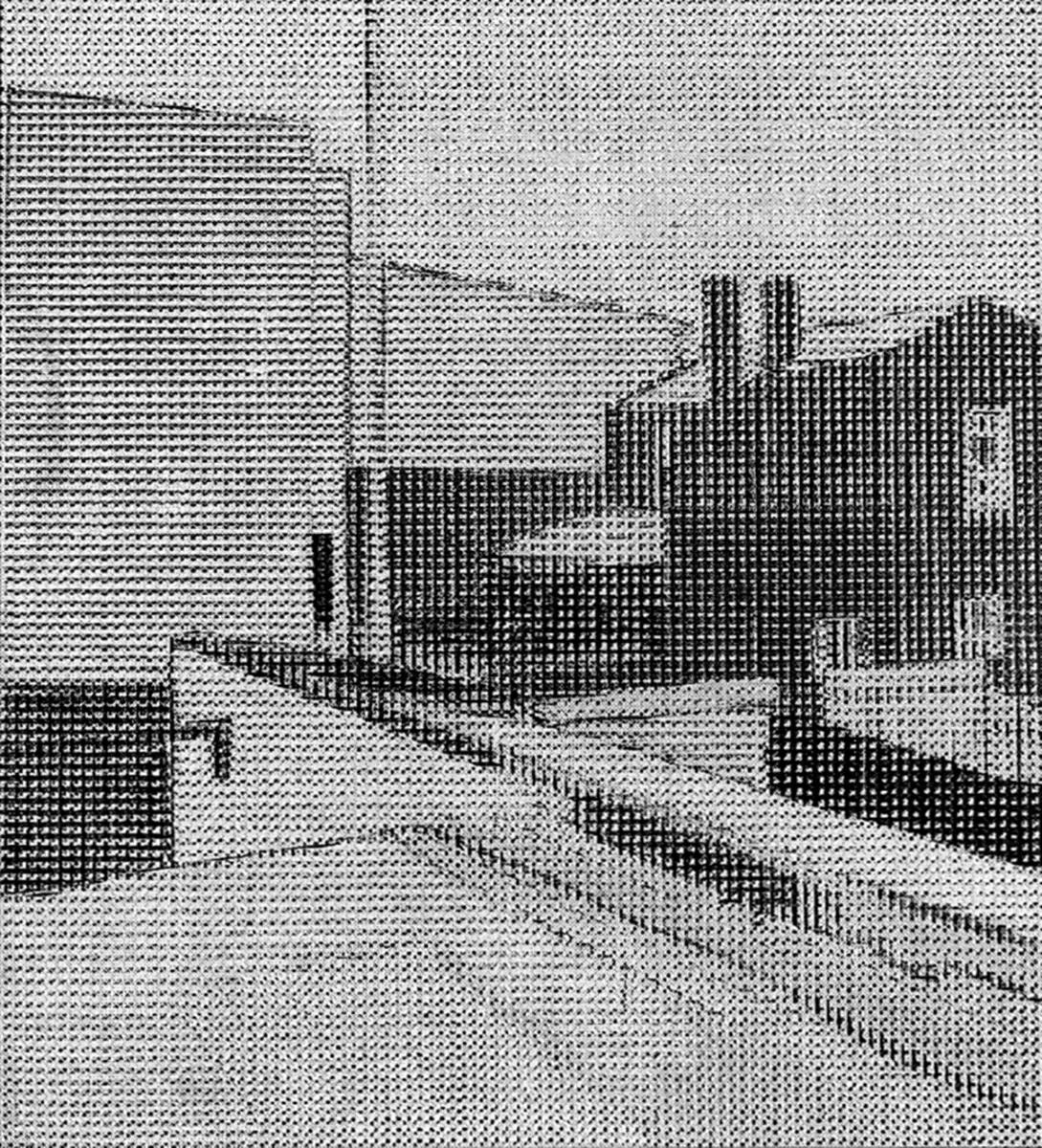
Well installed, with the necessary space and the appropriate light, the pieces of the young Esnoz seem to open, once again, the door to a world where not everything is decipherable and where the spectator is but a tourist. These paintings move us with the same intensity now as they did years ago when they surprised us with the virulence of which passions seemed to mesh with one another. Back then, Esnoz proposed an apparent game of numbered dots, lines without a fixed direction, erasures, and blotches that resulted in unfinished images that besides suggesting a strong sexual tension, also alluded to a certain secrecy or distancing.
The artist uses color, light, shadows, dots, and lines quite aptly, putting to the test the spectator’s capacity for visual assimilation. The paintings shown at Dabbah Torrejón are constructed largely through a pictorial procedure that includes glued painted strips that have been unglued and repainted. They are pieces that appear to reflect a dark and dense plot on the verge of explosion.
There is neither noise nor pretense of fidelity to the so-called reality of the situations, landscapes, and characters he builds with utmost patience. The artist sparingly gives away his images’ ultimate meaning. Is it indifference or horrified distance from a deaf threat and/or persistent violence that appears to imbue each and all of his works? Has something sinister already happened or is this merely terror put to the scene?
Depending on the spectator’s gaze, the associations and sensations produced by the paintings can be numerous. For some, Esnoz’s works are similar to a photograph blown up to saturation, in which meaning, far from being revealed, becomes ever more enigmatic. What counts is the pure formal exercise, offering information while at the same time hiding it.
Philosopher Lucas Fragasso writes in the show’s catalog, “Esnoz’s images exacerbate the self-reflection of the pictorial ... they don’t copy technological effects; they have incorporated what is technological simply because they configure the substance of what is visible.” True, many of them remind us of digitally-generated images. The end result is similar to the breaking down of figures and colors into individual pixels to be counted on a computer screen.
Once again Esnoz uses fragmentation and distraction as production strategies. Everything is seen and hidden at the same time. At moments, his paintings resemble video clips in fast-forward mode, highlighting what is hidden in order to make it bloom.
The artist’s talent evidences itself in this series holds an essential internal ambiguity and a necessary and surprising formal excellence that nevertheless protects the intimacy of the craft that paintings request from the eye gazing at them.
VICTORIA VERLICHAK