
The recent retrospective curated by Pedro Luis Prado, surveyed half a century of works by Mario Calvit and represented an unprecedented occasion to understand the place that this master occupies in the history of Panamanian art. Calvit, born in 1933, began his long career in the early 50’s. He was a part of the first group of youngsters anxious to learn about what contemporary art outside the isthmus had to offer.
Calvit’s abstractions possess, on one side, affinities with a certain South American informalism —given their cryptic atmosphere and masses placed in contrast with extended and empty backgrounds —, and on the other, with constructivism. The expressionistic vigor of his entire production distances him from the categorical geometry and postulates of the more rigorous constructivism, but certain factors define Calvit as the Panamanian who comes closest to this tendency that has been so important for the art of the twentieth century. Factors that include multiple and exhaustive use of metal, the geometrical game, and the creation of structures that attempt to be “vital images of space and time,” as Naum Gabo would say.
The curating seemed better conceived in the hall that gathered works from the first three decades of Calvit’s production. The proper placement of the sculptural and pictorial abstractions clearly showed the viewer their intimate correlation. Both genres flaunted a sure, measured rhythm that was also dynamic, with open forms. Calvit’s sculpture —which gains even more when he makes use of the rawness of metal— shows several styles. His male figures find inspiration from Giacometti, and they also stem from his own drawings. The abstract pieces are much more numerous and at the same time they are subdivided into those with overwhelming forms that contrast with their curves and folds; those that look like intricate doodles in the air and those with strong diagonal lines extending toward space, at times contained within a three-dimensional rectangle —simulating an empty box— or framed into circles. Then we have the pieces that makeup more static forms, whether through distorted objects, as in his flutes, or abstract assemblies whose detail has been worked with great care. All of his works have been created in small format, but the beauty and power of several of them would qualify as public sculptures as great monuments to the unknown.
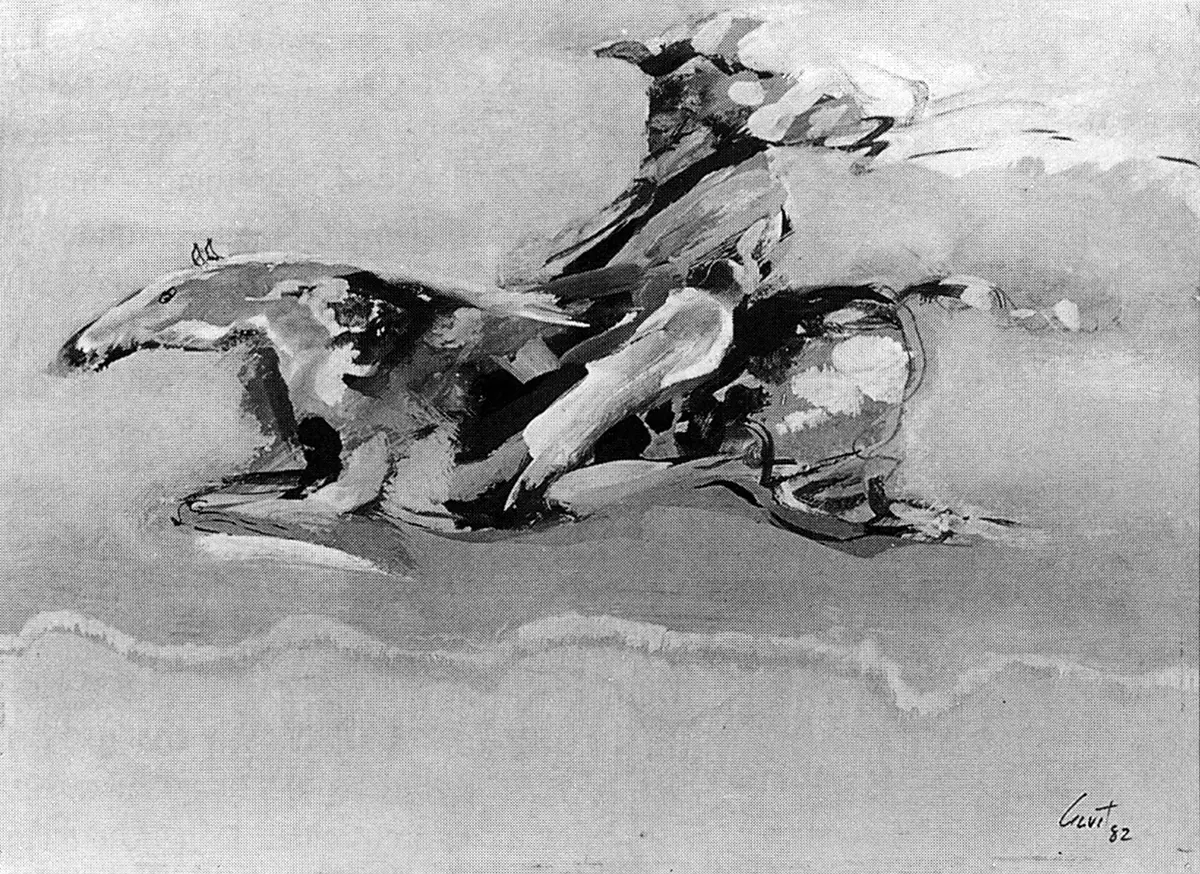
The evolution of Calvit’s work reveals that his constant concern to misarticulate pictorial space —contrasting mass and emptiness—, slowly transferred to figurative terrain. In this new stage, painting becomes much more gestural and fluid. Anatomical precision is not important. Calvit also distorts the contours of the body, enlarging the brain and even “opening” it in order to pull out all that agitation that moves in the interior. Calvit has given the impression of having turned his work into a “humanized” abstraction: these characters and horses (metaphors of the human being, or of the artist himself) suggest mental and spiritual interiors.
However, throughout his work, there is a very obvious oneiric breath, reinforced by the voluntary irresolution of his paintings. The fear of emptiness felt by many artists prevents them from falling into simplicity, but Calvit has decided to take the risk over and over again. In his best pictures, the sensation that something is missing tempts the viewer to complete the scene, and it constitutes one of the most enigmatic and seductive characteristics of Calvit’s art.
It is in his landscapes that Calvit most frequently achieves that synthesis of the two stylistic approaches that rule his artworks. The landscape seems to offer him the mechanism to achieve the purification of the superfluous and that precious balance between the spontaneous and the constructed form. But perhaps the painting that best joins all of these conditions gathers all at once: a mix of landscape, abstraction, figuration, and even self-portrait.
Cabalgando con viento norte
(Riding with the North wind), from 1982, is, in my opinion, one of the masterworks of Panamanian painting because of its captivating simplicity and impeccable balance of shape and color.
ADRIENNE SAMOS