
Bésame mucho: un hipertexto acerca del amor (Bésame Mucho: A Hypertext on Love) is the title of the videopera-installation that Osvaldo Romberg opened in New York. Born in Argentina, he’s thus a citizen of the world whose works are collected in today’s most dynamic museums. The other places in which he’s settled are Israel and the US; he has studies in New York and Philadelphia, a city in which he practices academia. For this hypersensitive, irascible, and questioning artist, neither technique nor technology is a work of art’s legitimizing factor. The works from his youth were resolved in stamps; already back then he was convinced that a constant and reflexive work included the confrontation of cuts, turns, and changes whenever it was needed. The only style was, and continues to be, the “un-styling,” not repetition.
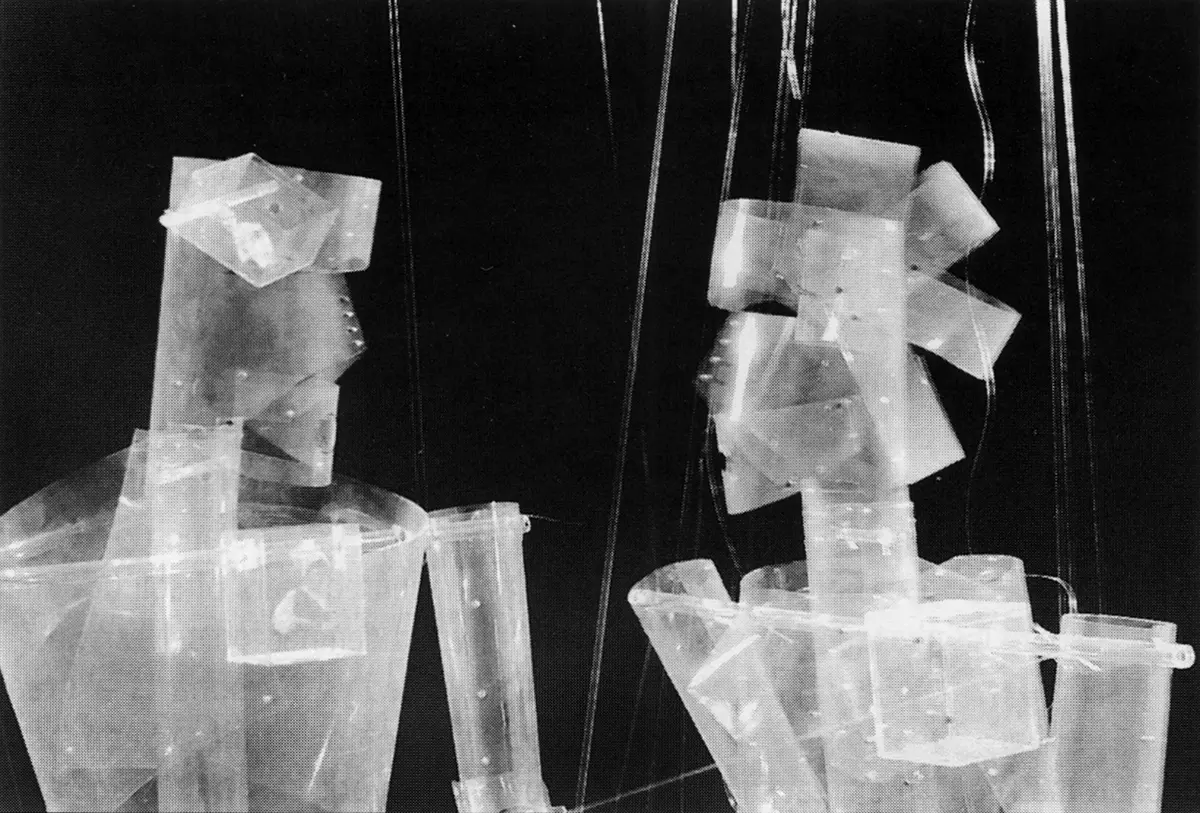
The work analyzed here could presuppose a correlation with his history, his speed, and his deceits, as well as his frugal generosity and his unkept promises. Nevertheless, Bésame mucho: un hipertexto acerca del amor goes beyond the real and the evoked, the expected and the cinematographic, with scenes of ungraspable physical presence. “Videopera-installation” is the description of the media that the artist attacks for this sophisticated creative work. It’s an opera, so he presents the elements of lyrical theater: music, characters, and vocalization of a text. The characters here play the role of “images.” The text is an “anti-script” and it doesn’t establish the traditional thematic narrative or linear order.
This is an installation in the widest and least orthodox sense of the word, and Romberg goes positively beyond it. Digitized black-and-white photographs, small videos big-screen videos, music, and “steps in the story” resolved through classical painting were conceived to be installed before the gallery’s acetate statues. The quality and the speed or lack of it imprinted by Romberg on his intellectual metaphors are not marked by photography and video in themselves, but by the author’s spirit—always question. Here we agree that neither technique nor technology legitimizes the work of art, but they also don’t inhibit the metaphor, and the meta-stories forward the artist’s own esthetics, always departing as a result of his work. There are no excuses, and that’s the situation.
Marvin Kinsky, co-founder of MIT’s Artificial Intelligence Laboratory, states that from origin to destination there are several “trans-frames” throughout a thought’s path until its resolution. According to us, this, being so appropriate for artificial intelligence, in visual arts is a fundamental curve of diverse and occasionally successive trans-frames, from the origin of a work of art until its destiny (here we characterize it as “destination-achievement”). We perceive the trans-frames in the videos, the musical collage’s composition, and the images. Romberg combines the trans-frames (impulses generated while questioning) with small modules. In this fashion, the videopera-installation closely links scientific work with esthetics. A transparency’s immateriality is a resource of high esthetics; it refers to this society’s extermination as well as to the disillusionment with itself. The size of the characters resolved in synthetic polymers is related to natural size: they’re isolated or coupled, fragmented or complete, in loving, copulating, attentive, or dead-like postures. The physical is diluted everywhere. From Turner and the Impressionists, we have seen that beings tend to dematerialize where there’s more light.
Having a deep knowledge of the history of Art, on this occasion Romberg handled several distinct penumbras. As a suggestion of the society in which we live (that aspires to coexist with robots while forgetting the spiritual), his dummies di-lute into light until they become transparency, pure brilliance, organic absence.
The sense of the title Bésame mucho shouldn’t be translated isolated into other languages. It could be executed in mime or recognizable sounds (phonemes). Since this is a printed article, the resolution would be equivalent to the small “signs” at the Brooklyn Academy of Music (BAM) or the Metropolitan Opera House in New York. Bésame mucho sounds equally sappy in both English and Spanish. But in spite of that, it must have been one of the first verbalizations on earth. Romberg’s meta-story supersedes the techniques and materials used. The implication is that he has created his own esthetic situation, and it doesn’t imitate or reproduce reality. They’re twenty minutes not completely devoid of sense of humor or even sarcasm.
The quality of “being Argentine” can be felt, which in turn should need an “Argentine being.” Un hipertexto acerca del amor, the title’s second part, could be understood as a transit from the tango to Derrida. The title whispers tango and keeps its promise. There is no abuse while tackling the love and tango elements; the music and image sequence set the pace. The spectator can sit, walk around, and look at the big screen or the video niches. Perception will vary according to the movements and the distance from each section. Without being a sum, the parts and the whole work outside the traditional frame, confirming that everything’s an illusion.
GRACIELA KARTOFEL