
To visit the Santo Domingo Museum of Modern Art today is a pleasure. Few museums in the world have the quality exhibitions the Plaza de la Cultura institution is currently presenting. An exhibition program of such stature hasn’t been carried out for some years. There is now an obvious preoccupation with highlighting the works in the museum spaces and using information and typography to present an unobjectionable environmental purity.
In an area opened on the third floor, Ramón Oviedo’s solo show imposes its richness and capacity for renovation, proving he’s an irrepressible master. Both the Museum of Modern Art and the Oviedo Foundation have distributed paintings and drawings according to a criterion that invites discovery, appreciation, and joy.
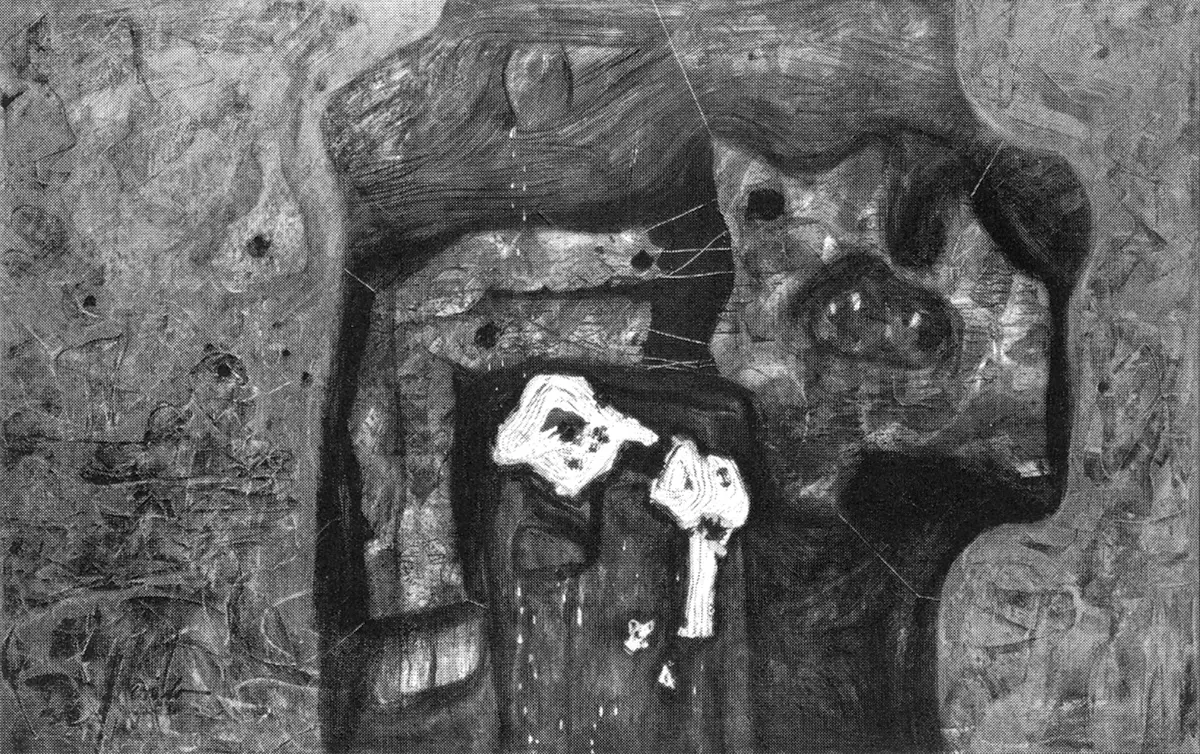
The pieces breathe signal pauses and follow a “natural” circuit between chronology and aspects purposely highlighted. So, the parentheses set forth by the self-portraits—a testimony to virtuosity in different styles—and the splendid drawings show the museum’s intelligence and professionalism. Standing before a retrospective spanning from 1996 to 2000 and enhanced by biographical and analytical notes, the spectator wishes to know what happened before...
Oviedo’s painting is, thus, a permanent challenge. When we finally believe we’ve debated, deciphered, and decoded his current work, he has already begun a new stage, provoking new reflections. In his personality there’s an inexhaustible wealth, what we call the Oviedo phenomenon—a compulsive capacity for self-renewal, exceptional among his peers. Even within one same piece, the artist works and reworks it in his own image. He changes style and gesture, accumulates what’s random and what’s premeditated. Engaged in a sort of pictorial archeology mimicking buried civilizations, he paints over what he did first. Only Ramón Oviedo knows what the new form hides and how the old form lies bewildered at the new turbulence punishing the canvas. X-ray studies should yield interesting data.
The creator’s ability and mastery of technique allow for that total freedom. We confirm that there’s greater self-assurance in Fábula mutante (Mutating Fable) than in Persistencia evolutiva de la forma en la materia (Form’s Evolving Persistence Over Matter), which is part of this current period, begun in 1994, and shown at the MAM. Now he plays with dissonance and cacophony, spontaneity and gesture, provocation and disturbance. But the energies in apparent pandemonium culminate in the perfect control of good painting. This can be achieved only by a virtuoso of the pigment, the color mixture, the chromatic scale.
Mordant, even violent, Ramón Oviedo no longer needs to present or represent. His works themselves should suffice. The fable has taken ownership of the act of painting, orchestrating values and colors on the canvas. It’s his story and morals that get rid of the narrative dimension and substitute it with a disconcerting visual syntax.
The author doesn’t prohibit a different reading. In abundance are those who discover a new turn in the pastiche, a forking of tones, a harvest of strokes, creatures, and elves. Known or unknown, those signs project the sense of humor and the metamorphosis.
Even if we don’t believe that in this last Oviedo, we have the most fertile reading, the presence itself of deciphering options reveals our wish to associate ourselves with his language, to share it actively and freely. . . just as he had planned it all along. No expression or formula stops him. He goes beyond abstraction or representation, squeezing from both a new symbiotic form.
Oviedo has said that he’s a figurative painter and that abstraction truly holds no interest for him. He was being honest, and consistent with history. When he excelled professionally, there were popular struggles, colonization was being questioned, and political and social movements burned in uproar. He drew and painted misery, protest, and insurrection, and whooped the dictatorship with his brush and pencil. And so, the following period was of introspection, anguish, and questions about destiny, and later that sort of transcendental era hurling the human condition to the sidereal space also demanded reference points. There was a perfect coherence between symbols and their transcription, between signifieds and signifiers (in memory of the linguists).
Although the problems remain and others have been added, turning points and art have changed. Media, schema, and expressions have also changed. Ramón Oviedo has changed. Having reached the summit of maturity, he has been coherent with his expression’s mutation that, since 1990, has explored new possibilities and is going toward pure painting. The beauty of it is that the semantic purification still moves us and communicates unconformity the Mutating Fable continues to be insurgent.
The internal dynamism has increased the metaphysical worries, particularly that of “eternity”—a favorite element in current titles, which we could interpret as time’s supreme dimension. “After this, nothing.” The words in his titles—Oviedo is a man of words and words—or maybe on a painting or on his shop’s walls, acquire a special meaning in the fashion of poets.
In the stages exhibited (the most recent one began at the onset of 2000), one of the words repeats itself accompanied by an adjective or a complement. It is “form.” We’re not talking about a module, a contour, or a relationship with content. We understand those successive forms, meriting a lexicographic study, as a synonym for “world.” Oviedo’s world qualifies itself as “unknown,” “voracious,” “drifting,” “protuberant,” “anti-time,” “transitional,” “confused,” “entrapped,” “extinct,” “precipitated molecule,” and, of course, “persistently evolving.” For those shapes without borders, titles, at times surprising, reveal the explorer and the magician as well, who certainly tends a “fertile garden.”(The title of a drawing.)
World, shapes, works: Ramón Oviedo’s history continues. In the mutating fable unfolded at the Museum of Modern Art, an artist concretely crosses the real-symbolic threshold of the year 2001. And perhaps here “genius,” such a risky word, is not an exaggeration.
MARIANNE DE TOLENTINO