
Surrounded by wooded hills overlooking the medieval town of Vaison-la-Romaine, near Avignon, the Crestet Art Center has been established in a modernist house built for the French sculptor François Stahly between 1969 and 1971. Thanks to Jacques Leenhardt’s efforts, the house workshop was turned into an art center and now belongs to the Ministry of Culture. Its mission is to promote contemporary art in the region and to sensitize visitors to all multidisciplinary projects the Center has based on the relationship between art and nature. But Crestet Art Center’s artistic project responds to the uniqueness of its location, the building in which is housed, and its implantation in a rural and Mediterranean territory. Since its official inauguration in 1993, the Crestet has received and confronted a mix of gazes, ideas, and creations not only from musicians, landscapers, choreographers, philosophers, writers, videomakers, and sociologists but also by artists from all horizons—geographical and esthetic.
As part of a dynamic policy of openness to multidisciplinary creation, each year the Crestet invites one artist-in-residence. He or she can work in an exceptional space where the site’s inspiration and flora, as well as its history and geography, can nurture a project and its progress, with the final objective of exhibiting it at the Center itself.
The Cuban artist Ricardo Brey, who has lived in Gand, Belgium, since 1991, was invited in the summer of 2000 to work on-site and then show his drawings, installations, and objects in a construction that, due to the proportion of its volumes and their relation to nature, appears as a true work of art. The majority of the works shown were done at Crestet.
The place has a magical strength—light, space, purity, and silence. It surprises, questions, and engulfs. The same happens with Brey’s work—always different, always threaded by reflection and the imagination under fire, overflowing with an insatiable curiosity for cultures and their signs, their memories, their exchanges. The topic selected for his residency was the current notion of “savage.” Around this idea, Brey gathered, accumulated, and built using natural materials such as leaves, branches, and soil but also found objects and objects he intentionally looked for a fan, strands of a lion’s mane, ostrich eggs, gloves, buttons, a tapestry or a musical score, pigments, golden bread. It’s all about the unstable balance of the impossible, in which the artist proposes different metaphors for everyday life, transgressing and superimposing objects, arranging them in gradient as if they were musical notes: order and disarray preside over their visual poetry.
The drawing constitutes the lifeline of this displacement which is also a confrontation between “nature” and “reason,” between “savage” and “cultural.” It creates an invisible structure that allows the artist to go to the “sources” of his relationship with the world. The drawing is the path and flesh of all his questioning. The works shown in both the lower and upper floors confront what is derisive or relative. In a certain way, they appear as the archeology of what is “raw” and what is “cooked,” inspired by the place and its history, upon which the artist’s destiny and culture will end up interfering.
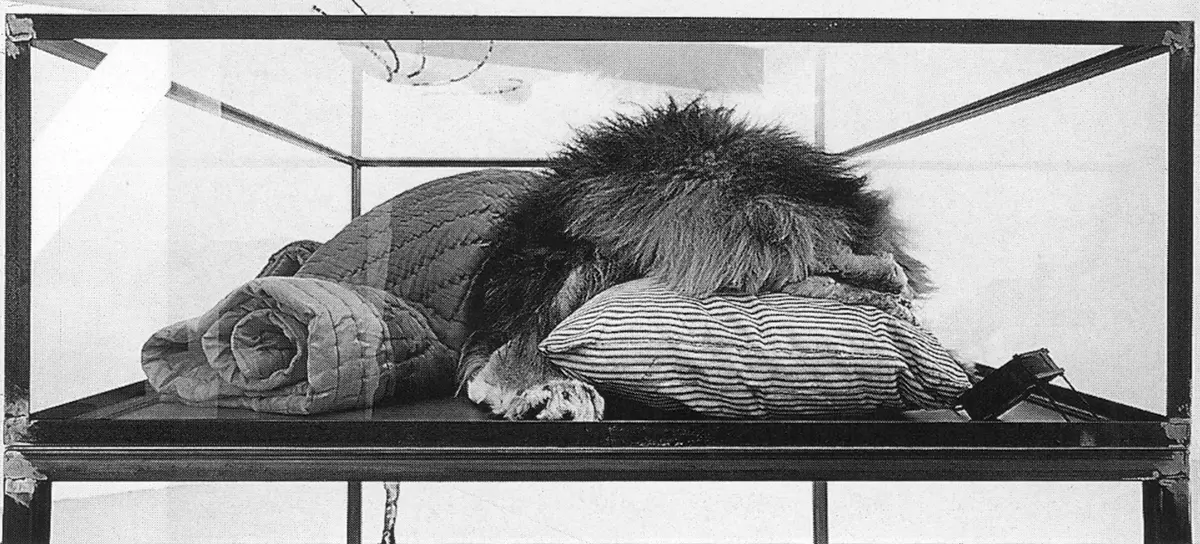
The exhibited works mix a group of signs constructed as offerings or altars. Brey invokes time, space, and love of music by transcending the lives of what was once useful (buttons, a worn-out blanket, old gloves, a used pillow) through an artistic “sentence” in which interior and exterior, intimate and public, private and collective also oppose each other. In the lower-level halls, we find three important installations and an array of objects and works made on paper. In Signs in the Dust (2000), the artist represents, inside a glass case, the skin of an old stuffed lion perched atop an equally old pillow. King of the jungle, a symbol of omnipotence, the lion is defeated and depleted of his very substance—it has been reduced to the shadow of itself. The myth (in reference to the legend of the lion of Tarascon, a nearby town) is questioned and the mythical emblem has been cracked. History has been overcome, despite the fact that the small fan still blows some life into the king of animals’ remains.
With a musical score propped on a mechanical piano (Faust), some buttons, and pearls, Brey has “made a drawing” in the space called Rag-a-time (2000)—an “aerial” and “musical” sculpture installed on the wall. Thanks to its sudden complicity with randomness, one imagines a sort of insect making the echo of a true, gigantic grasshopper (Provenza’s symbol of sound) glued onto the hall’s huge window. In Untitled (2000), Brey has placed a red hose—similar to the ones used by firefighters—as if it were a serpent coiled on an old tapestry. During his stay at Crestet, the piece’s location was changed daily. Fire threatens the forest, and with such threat, Brey evokes the relationship between the permanence and the instability of things and places. Masks and totems (pearls and motorcycle helmets), made some years back, are witnesses and games depicting the fleeting and unrehearsed encounters between different cultures.
Nest, the third installation, is the exhibit’s living heart. It constitutes its spiritual, artistic, and conceptual axis. It alludes to the Provenzal nature and to jazz—a homage to Charlie Parker, whom Brey quotes constantly. Built with dry branches arranged in a concave circle, a saxophone, an old coat, broken eggs, and chinaware fragments, the “nest” is accompanied by a small tree trunk placed as a penis and a white, intact, smooth ostrich egg laying on its side. Engulfed in a sort of timeless vertigo, one feels dated back to his or her point of departure. If there’s serenity and spirituality in this search, one must search for them in life itself as questioned by the artist and not so much in his own Cuban, African (Nigeria, Yoruba), and Spanish origins.
His interventions on paper mix drawings of stones, sticks, soil, sand, and animal hair. They’re enlarged anthropometric clichés used by the artist as support and the “background” on which his marks are placed. Here, in this isolated place, there are no more traces of the man. Only nature and matter exist, all-powerful. Brey elaborates on a soiled and blemished inventory that presides over the physical origins of all creation. On the upper floor, two pieces: Untitled (1997), which presents a phallic or totemic “sculpture” built by piling up gloves—both new and old. Black Cross (2000) is paper intervened with bones, ink, soil, and matter, where the artist has chosen to draw a black cross.
In this monastic place impregnated with the interferences of day and night, of black and white, of exteriors and interiors, Brey, attracted by oriental philosophy, could also tell us about the existential oppositions generated symbolically by the yin and the yang. In the confrontations, he proposes nothing anodyne, everything as a value and a sense. In this world paying homage to memory, Brey is far removed from the anecdote. In order to live, he must dwell in the present, in the experience itself. He’s not interested in the brevity of things but in their constant, eternal value. Brey meditates about immanence, about birth, about life. This work seems tighter, and cleaner than the somewhat “violent” sparks he showed us at Documenta in Kassel or the São Paulo Biennal. In any case, it’s not as dark: It’s an ode to life, to myths, to music, to inter-crossings. Wouldn’t perhaps be the site’s beauty that has transformed?
CHRISTINE FRÉROT