
In Jorge Luis Borges’ The Garden of Forking Paths, Yu Tsun tries to imagine his great-grandfather’s mystifying creation: a labyrinth where all men would get lost. While daydreaming he feels like an “abstract perceiver of the world.” During his reverie “the afternoon was intimate, infinite.” Space and time acquire relative and inherent values in relation to perception. The infinity of Yu Tsun’s afternoon may have lasted an instant; the intimacy was felt in the open air. To feel like an “abstract perceiver of the world,” Borges’ narrator transcends his physical existence and individual context. Like Yu Tsun, Rivane Neuenschwander (Belo Horizonte, Brazil, 1967), “forgets” her human presence to enter a Borgean dimension of another reality, not far from the imaginary labyrinth. In the intimacy of her domestic environment, Rivane’s world of “abstract perception” is that of her specimens of inquiry: the translucent trail of a slug, the evanescent movement of a soap bubble, the texture of a dead ant or dry seeds, and fruit peels, the frailty of wasp wings and garlic skins, and the minutiae of material disintegration that amount to dust. Time varies according to each specimen’s tempo, in relation to the space they occupy or trace, or sometimes merely insinuate. During the creative process that restitutes their significance, Rivane pauses, studies, and interacts closely with the specimens allowing new perceptions of meanings, forms, and metaphors to emerge.
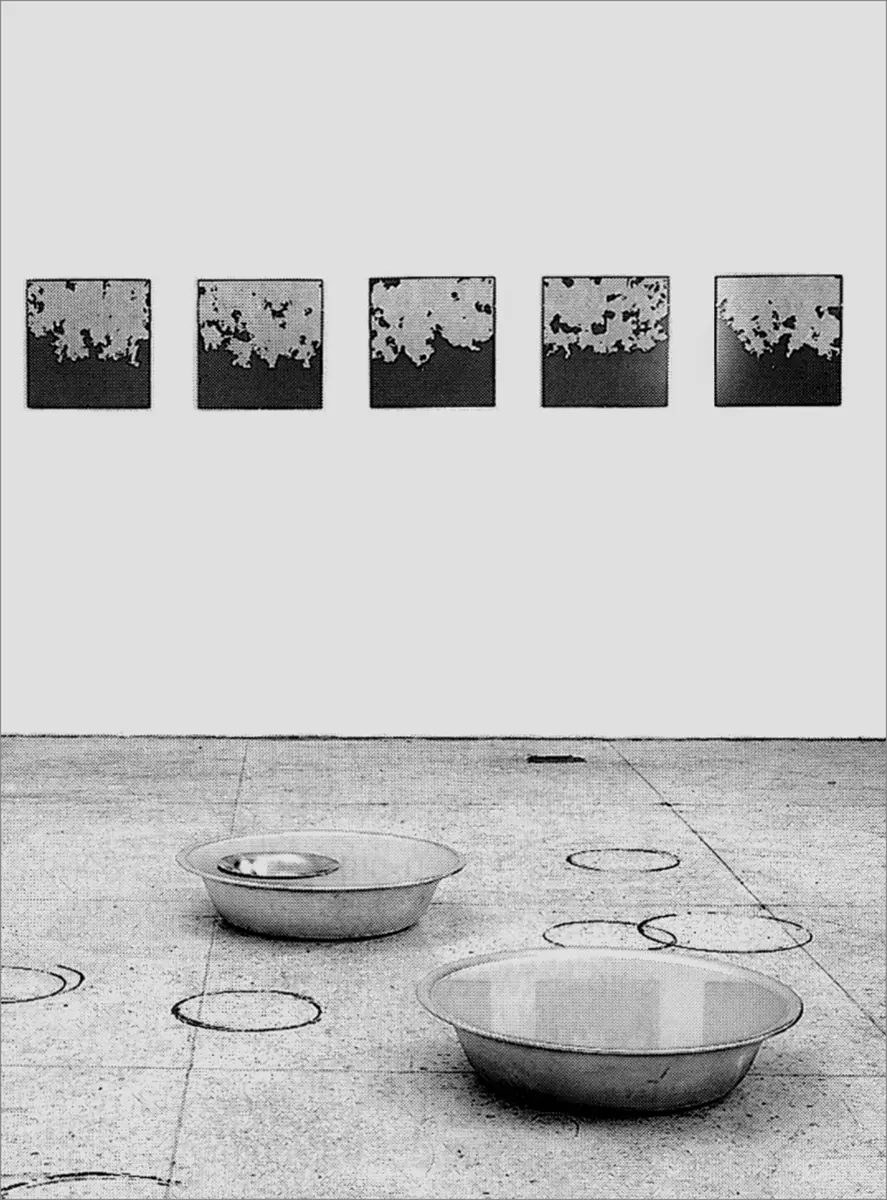
The exhibition at Galeria Camargo Vilaça consisted of 13 new works, in addition to a five-minute film, Inventário de Pequenas Mortes (Inventory of Small Deaths), and color photographs of soap bubbles from the series Pertence. Não Pertence (Belong. Do not Belong), all from 2000. The last two works were executed in collaboration with photographer and cinematographer Cao Guimarães, also the artist’s husband. The gallery floor, walls, corners, pillar, and staircase have been subtly occupied by works installed in relation to the architecture and using the space to enhance the dialogue between them. Attachment, an installation composed of adhesive tape and black pepper, coats the surfaces of two walls, measuring approximately 250 x 300cm. The straight horizontal pepper lines accumulated between each tape strip form minimalist compositions. In Rivane’s work, organic materials and dirt contaminate the purity of the minimalist grid and, on close inspection, create uneven and rough layers that also disrupt the formal rigidity of geometry and its flat surface. Rivane speaks of the transience of material life and death, while minimalism denies physical reality to search for greater truth and ultimately reach a certain essence.
A network of the complex relationships that shift daily between the domestic and public spheres emerges in the form of metaphoric instances, and in the carefully selected spatial distribution of each element: aluminum basins spread throughout the gallery floor in Continent; adjacent overlapping dark circles composed of glue and dirt in Andando en Círculos ( Walking in Circles) are at first glance perceived as the same work. The circular “drawings” seem to be the trace of the basins’ bottom circumference. The dirt-clustered circles on the ground contrast with the almost clinical quality of the aluminum basins, alluding to our contemporary obsession with cleanliness. The circles function also as cartographic marks, signs of the passage of an absent “continent.” The concept of geographic transition is ever present in Rivane’s work, translated into poetic (temporal and spatial) cartographies of the daily transformation in things. In As Metades (The Halves), suspended against the central pillar of the gallery, two peeled and dried orange halves are fixed together. Their fragile binding and delicate form paradoxically evokes the violence of the cut that has split the orange in two, and somehow deathæother than air, the object is nothing but lifeless skin.
Unlike the emptied outside peel of the orange in As Metades, in Doodles the focus lies on that which is contained inside: here tomato juice and seeds are scraped onto a white porcelain plate forming a deep-orange, textural doodle. Rivane invites reflection on the relationship between inside and outside space, the circle and the line in flat and threedimensional form, always with regards to the continuous transformation of matter. Like the human body, most fruits are mainly liquid: without it, the outer shell dries (the orange); or without the protective shell, the liquid spreads until it solidifies (the tomato juice). The doodle is also a cartography of daily automatist oblivion, a repeated circular movement, like a physical meditation.
In the series Carta Faminta (Starving Letters), slugs have been patiently directed by the artist to gnaw at sheets of rice paper, which are subsequently framed. Incorporating the ‘intimate and infinite’ sluggishness of her subject’s pace, during the repeated process Rivane realizes that the slugs move under the shade, thus guiding them around the square papers projecting shadows over them. The result is an organic cartography that has been drawn and nibbled by the artist and the slugs. In Inventário de Pequenas Mortes, a giant soap bubble filmed in suspended movement is a metaphor for fragile existence, in contrast to the natural thorns of Protection that would burst it effortlessly. The characteristic fragility of these works is present in the creative process, form, matter, and content, and ultimately points to the vulnerability of art and life.
Time and space in Rivane’s ‘abstract perception’ of a world in constant transformation bring to light unprecedented perceptions of several tempos and layers of life (and death), and this often occurs through a practice related to Zen repetition. Contrary to the standardization of production lines, Rivane finds the ellipsis in routine, the neglected anomalies of our ordered existence. If the industrially manufactured aluminum and porcelain basins are perfectly round, the two orange halves do not fit precisely, the dirt circles are irregular, the numerous incense dots burnt on a straight line across the white pages of the Japanese sketch-books in Reticências (Omission Points), vary in size and hue. In repetition, there is always a difference, a new path in an infinite labyrinth that may or may not lead to an outing or an end.
VERÓNICA CORDEIRO