
The first big surprise awaiting the visitor in photographer Ruben Mano’s show at Casa Triângulo Gallery—and a rather unsettling surprise at that—was the sensation of entering an empty house. The only “visible” object was a large stainless-steel scale, formed by two circular, concave surfaces joined at their central points. Leaning on the floor, those surfaces functioned as giant mirrors, turning around, distorting, and reproducing infinitely the images of whoever crossed by and of the space around.
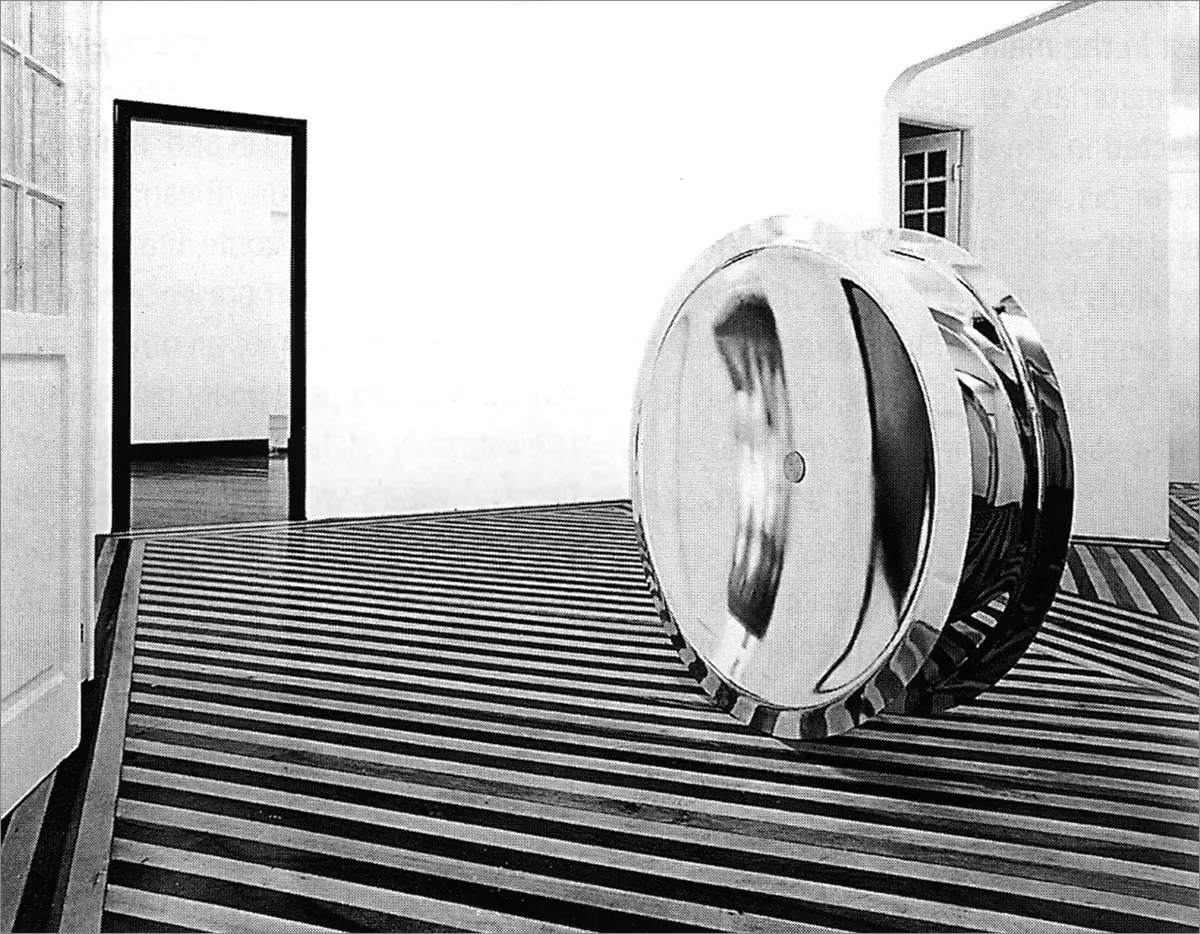
Casa Triângulo’s space deserves an aside. It occupies the first floor of an old commercial and residential building in a central section of São Paulo, a part of the city that used to enjoy high-class prestige but has since decayed considerably. Inside, the gallery retains traces of its former residential use, especially noticeable in the space’s subdivision into separate rooms with individual doors and windows, and in the wooden floor’s colorful design. It is the antithesis of the "white cube.” The very way in which the exhibition area is structured forces visitors to walk around, denying them a complete panoramic of the show upon entering.
Ruben Mano takes wily advantage of these circumstances. The space’s organization is the reason why the piece mentioned above was placed so as to be seen first. To reach the rest of his work, it was necessary to walk around the rooms, and only by walking around could we perceive the artist’s intervention in the gallery space.
These were not large works, nor were there many of them. Just small gestures sensibly alter our perception of the space. The color of some doors and skirtings had been changed. In another area, some frames and a portion of the floor in between two rooms had been covered with mirrors, so that moving through there became a playful experience: watching one’s own image in motion. Later, we encountered a small optic fiber cylinder anchored to one of the gallery's external walls, projecting an intense light beam onto the opposite wall. Mano’s most impressive intervention in the gallery space, however, was two walls painted with a reflective liquid, of the type used for route signals. It was extremely difficult to focus our sight, still affected by the optic fiber light, on that surface, which reflected the movement of images and shadows as people entered or left the hall. It was as if the walls were neither vertical nor straight.
Lastly, Mano’s photographs were also shown, documenting larger-scale interventions in the urban space carried out by the artist in recent years. Like the rest of the works in this exhibition, these photographs impressed the viewer with their effective simplicity. They reveal sophisticated optical mechanisms through which we can experience a familiar space in utterly unfamiliar ways.
VALERIA PICCOLI