
In January 2001, Miami’s Gary Nader Gallery put on an interesting show of the work of Brazilian painter Walter Goldfarb (1964). He presented a group of pieces under the title Last Dance, conceived out of a semiotic dialogue among quotes of ancient sacred dances (Matisse, Holbeib, Klee, Goya) that make the work in black and white paint converse with the refined bas-relief treatments from which the thematic controversy of his artistic poetics is constructed. The works are full of a suggestive enunciation born from the representation of the plays of meaning that are constructed through them. We feel the increased weight of the nearly imperceptible elements that work like suprematist and minimalist axes of history.
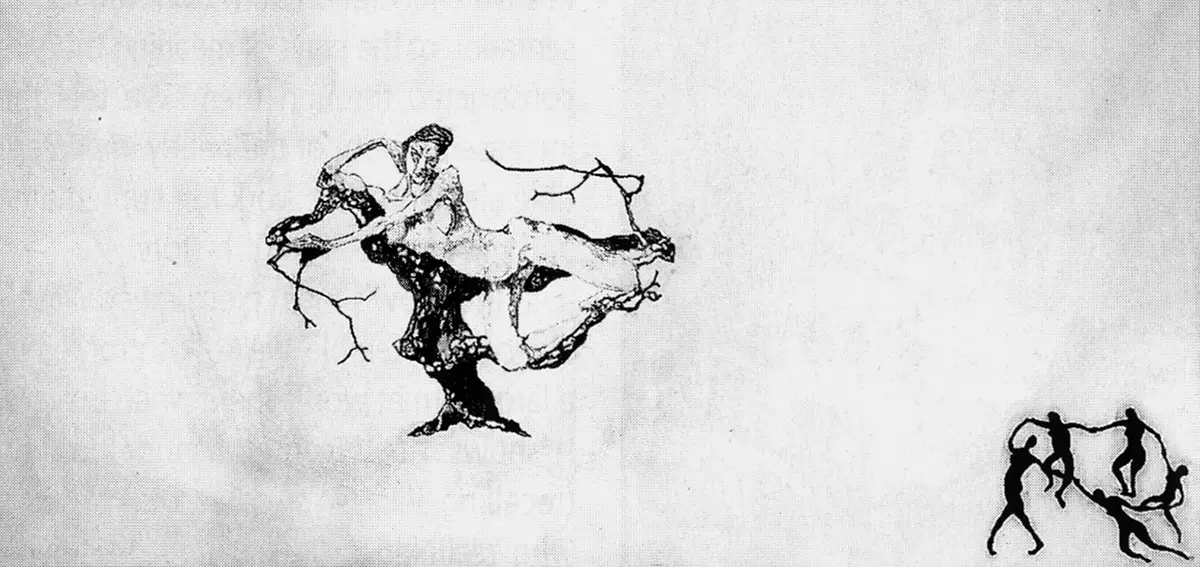
In the show’s main piece, titled Lilith’s Dance, for example, we are confronted by a large-format work where white prevails. It shows, at its center, a nude woman (recalling Picasso’s Ladies of Avignon), reclining on a tree of a decidedly oriental sort, and in the lower right, we notice a replica, in black, of Matisse’s The Dance. The aforementioned elements speak of a thematic enjambment and confirm Goldfarb’s own aesthetic posture.
Goldfarb’s strategy of substituting the signature for a quote from Malevich’s work created like a black silhouette, speaks to us of the cancellation of Matisse’s proposal and its propositional substitution by the suprematist tendency. Goldfarb remembers Malevich’s rebellion against classical painting, particularly regarding the use of color, which he synthesizes through the interaction of black and white.
Malevich was the first painter to make his opposition to the Bolshevik authorities visible in the days of the imposition of Social Realism by substituting the signature for one of his suprematist works (White on Black) in order to speak of the steadiness of his aesthetic posture, suprematism. It is this tendency that Walter Goldfarb identifies in the present show. And it does not end there. Meaning is multiplied as we notice that the central figure is framed by an ellipse that resembles the edges of fruit from old vessels and is embroidered with white thread—something that proves the minimalist character of the aim and indicates the breaking of the limits between art and decorative arts, radically changing the intention of what is represented.
As we can see, there is an enjambment of artistic meanings that lead us from the suprematist aim to minimalism, and from there to the play with the quote. This is typical of the postmodern attitude, which in this case always finds its meaning when it dialogues with elements created in black or white, through which the projection that the artist has tried to give to the work is carried out.
The same principle may be seen in the pieces titled Dance’s Eclipse and Dance’s Dance, where black becomes the force of meaning that gives them semantic content. In the first case, it is upon covering part of the image; in the second case, it occurs when the famous image of Matisse’s dancers is placed precisely at the point where the flutes, through the evocation of music, create the meaning of the festival. The pieces Ghost Dance and Dance Goes to Dance also present the play of the spectral and of life and death as the focal point of dance, which is linked through the common theme of the great dance halls of the nineteenth century.
As we can see, there is a play of recurrences from which dance is confronted as a theme that suggests a great deal about Walter Goldfarb’s expressive and aesthetic possibilities. This is an artist who knows how to test the value of expressive trends and universes concerning representation.
MADELEINE IZQUIERDO DE CAMPO