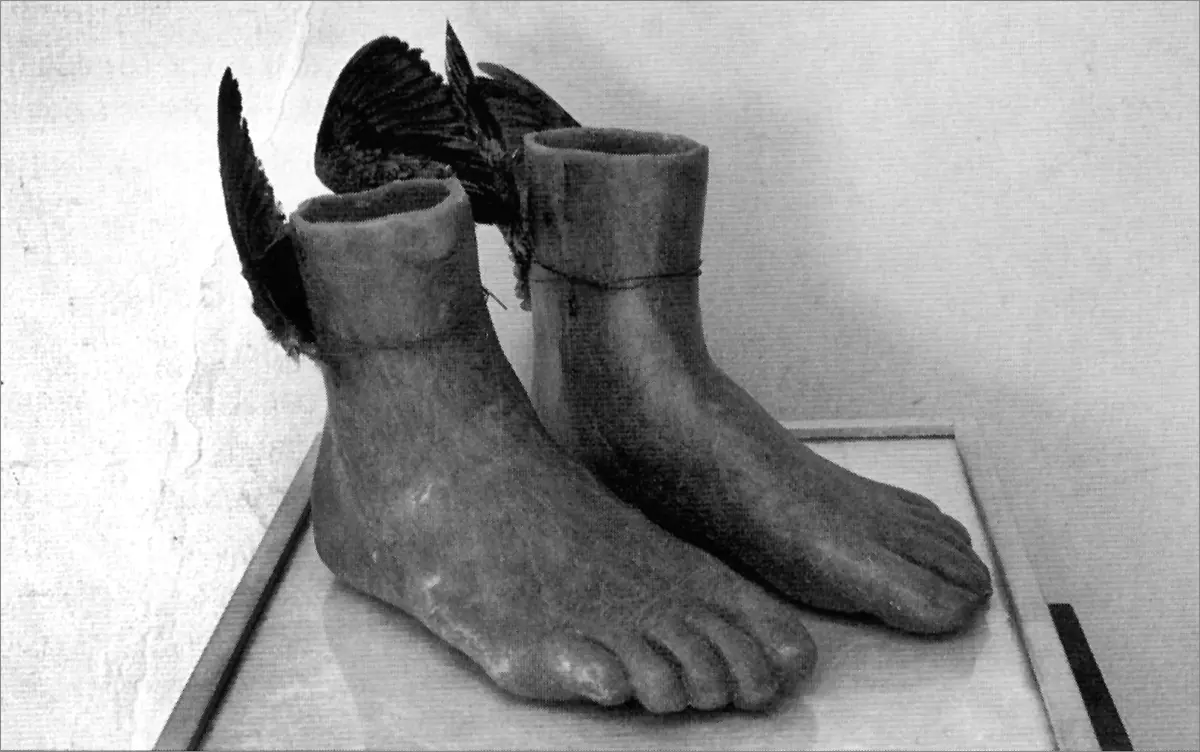
The two shows that Peruvian-Costarrican artist Cecilia Paredes held recently in Panama, offered spiritual and esthetic nourishment to a public that knew mostly her previous, traditional works done on canvas. Upon entering the Museo de Arte Contemporáneo, the spectator found himself in a darkened hall. A series of seven hands and three pairs of feet—all life-size and executed in transparent resin—seemed to project an interior light. In this series, titled Apropiaciones (Appropriations), the artist uses her own extremities as models to produce hands and feet whose internal systems, such as capillaries, nerves, and bones, are replaced by elements of nature, including complete root systems, delicate red lichen, and small branches with tied with thread. This way of relating the outer and inner world, of emphasizing the connections between nature and human beings, reflects an attitude intrinsic in Paredes’ work.
Among these translucent sculptures set atop light boxes and rice paper, a pair of wax feet caught our attention. With the most thin and precarious of wires, the artist tied to them two extraordinary bird wings. The piece, of apparent innocence but loaded with poetry, reminds us of the myth of Icarus and tells us about a yearned-for but impossible flight. In fact, wings are a favorite element of this artist, who has an extensive and varied iconography. Wings are the protagonists in the three huge, illuminated transparencies that complete the “appropriations” (Paredes was aided by Costa Rican photographer Jaime David Tischler in their creation). A vertical series of delicate dragonfly wings and bodies ran down the middle of the three impressive, backlit photographs of the artist’s back. The fascinating thing is that from a certain distance, the dragonflies quit being insects and turned into sort of sutures, like the products of painful back surgery. At the same time, Cecilia’s hands, whether resting on her shoulders as a gesture of self-recognition or spread open as if in luminous flight, contributed to multiplying the piece’s messages and possible interpretations.
Like chapters in a book, the MAC show was divided into three independent but interrelated parts. The section titled "Cartas" (Letters), consisted of two resin torsos made from direct molds of the artist’s children (or as she calls them, “production of my body, my own procedure or nature”). Inside were two poems by Antonio Cisneros that reflect their owners’ personalities. Again, light—in this case, a light bulb inside each torso—emanates from within the pieces, granting the installation an aura of mystery. Under the torsos there are two overlapping clay circles painted in different colors, thus relating the figures and anchoring them visually to the ground. Unfortunately, the exhibit hall wasn’t ideal in creating a space for this piece, since the white walls carried a heavy visual load and ended up competing with the work’s silence and faintness.
Presented in a separate hall, the group titled Metáforas de un inventario (Metaphors for an inventory) constituted the show’s third section. As if reproducing the environment of a museum of natural history, Paredes assembled found natural elements inside “glass cases” that were later hung on the wall. In this particular show, the cases lost some of the charm they had had as table cases in previous exhibits. Nevertheless, as individual pieces they were a powerful invitation to draw closer to them, only to find out that more than being just objects, the cases contained a way of seeing the world and nature, of interpreting identity and memory. Cecilia Paredes transmits her metaphors through things that she, like an obsessed entomologist, botanist, and historian, has found collected, and classified throughout the years, during what she calls her “hunting periods.” This repertoire of elements meticulously ordered in her assemblages—including tiny shells, worm nests, small bones, crab legs, girls’ dresses, pieces of embroidery, family snapshots, and pages from 19th-century medical books, just to mention a few— constitutes the working material that becomes the tool for interpreting whatever is occupying her thoughts: origins, death, pain, heritage, gender roles, or the planet’s survival.
Her exhibit Telas (Fabrics), shown simultaneously at the Galería Mateo Sariel, was a perfect fourth component of her presence in Panama. Unlike the installations at the museum, these canvases demonstrate the artist’s great talent as a draftswoman, who uses color and composition perfectly to convey different messages related to her work as a whole. In Pertenencia de los hijos de Mercurio (The Belonging of Mercury’s Children) we see the drawing of a back, apparently taken from your typical anatomy book —until we discover the wings drawn between the shoulder blades. Terra incognita (Terra Incognita) focuses on the topics of travels, sojourns, and migrations, so essential for the artist as seen in her poetic installation Los oficios del navegante (The Navigator’s Occupations) at the VI Havana Biennial. In Semillas (Seeds), we find suitcases, ships, and all sorts of seeds carefully drawn (as a showcase for those shipped from the New World to Europe during the Conquest) with shapes full of sexual connotations, and a love poem written by hand, neat and school-like, on the canvas surface. In her fabrics, Paredes uses phrases or poems in Spanish, English, French, or German, with the liberty and emotion that her history as a polyglot and traveler confers her. Last, a border made with thorns serves as a transition to works such as Self-Inflicted Pain —a canvas filled with stitched wounds and painful images, such as the hand with an embroidered cuff that’s inserting a needle and thread into its own skin.
The hybrid character of Paredes’ work, manifested through the variety of elements, techniques, and messages, holds a relationship with our times and the malaise derived from uprooting, migration, ecology, traditions, the changing role of women, and suffering as a common language for large segments of the population. In her work, the assimilation of these themes combines with an inner search through the trails of memory, emotions, and identity. That’s why her art speaks a timeless and universal language that has an impact, whether conscious or subconscious, on the observer.
MÓNICA KUPFER