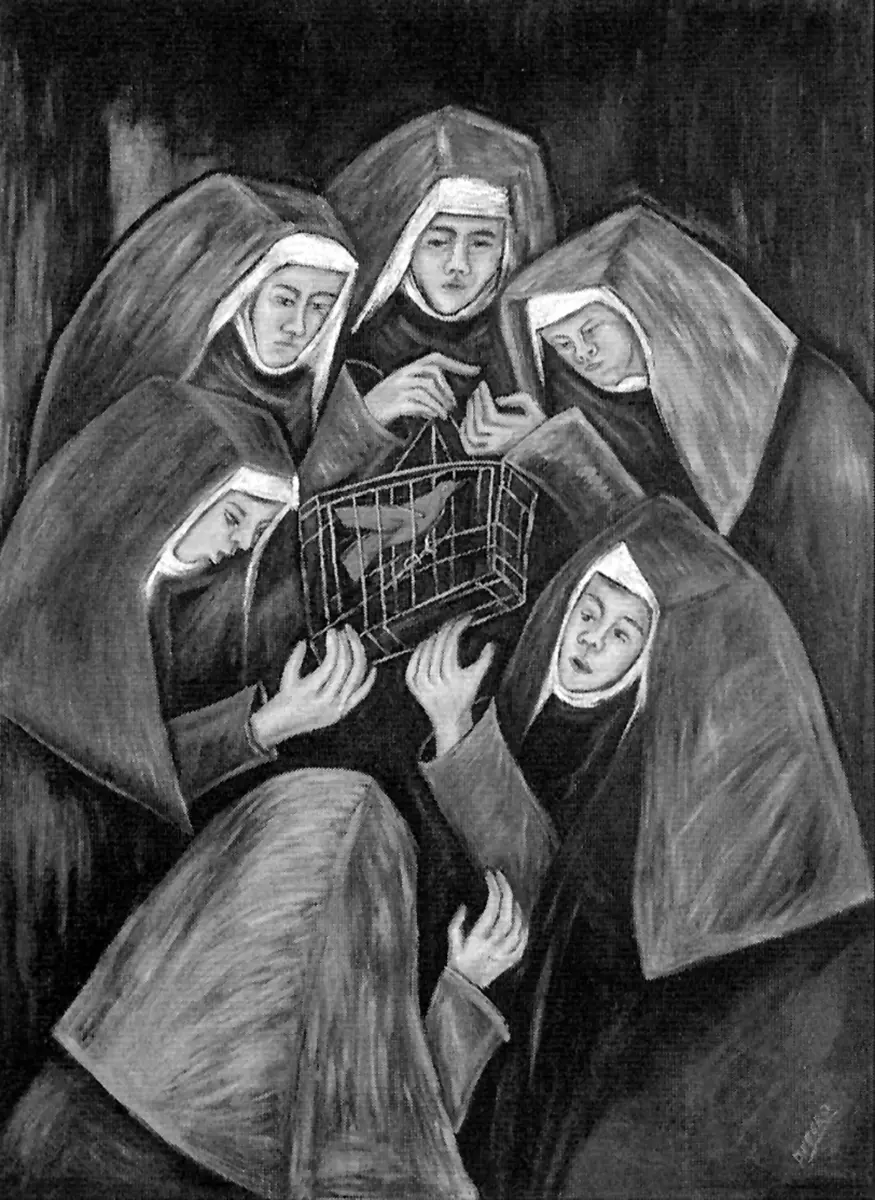
In conjunction with the meeting in Caracas of the presidents of the Grupo de los Tres (The Group of Three —Colombia, Mexico, Venezuela) this past April 7th, the Sofía Imber Museum of Contemporary Art in Caracas held a sample show from each country. Débora Arango represented Colombia; Diego Rivera, Mexico; and a selection of Venezuelan figurative art from the MACSI collection represented Venezuela. We’ll speak here about Débora Arango, a little-known artist in Venezuela, an ignorance that perhaps her first show in this country will help dispel. Due to the fact that this is the first time her work has been shown here, we should praise Alberto Sierra’s curatorship. Thanks to it, in a reduced group of 30 works belonging to the Medellin Museum of Modern Art, we’re capable of having a clear and complete view of Arango’s style and themes.
Her torn expressionism is more closely related to the German Neue Sachlichkeit from the 1920s than to any Latin American reference (but perhaps this is a coincidence and not an influence). In any case, some of her works may well bear kinship with Orozco, the most expressionist of the Mexican muralists. She shares with that vein of German expressionism the violent, caricature-esque style, obtained through aggressive drawing and altered colors. She also shares the themes, loaded with social, political, and satirical contents. But the emphasis placed on women, children, families, and poverty is very much her own. Her fervent commitment to the forgotten and the dispossessed becomes ever sharper when seen through her hypersensitive condition as a woman and a Christian compassionate. Bordering with satire, religion is also a protagonist theme. Despite her convictions, she doesn’t hesitate in poking open fun at monks and nuns, though for the latter she reserves some tenderness.
Arango appears as a marginal artist even in her own country. Even though her contemporaries, the members of the Bachué group and her teacher Pedro Nel Gómez, tackle the theme of the proletariat (especially the peasantry), they do it with a grandiloquence far removed from her terribly deformed effigies, painted with the brush of desperation and rebelliousness.
Arango’s images are shocking, and they were occasionally censured during the 1930s, 40s, and 50s. They were shocking due to the aesthetics of ugliness they represented, the crudity of the themes, the denunciations against the establishment, and, perhaps above all, for having been created by a woman who also came from a “good family.” Luckily, today they’re no longer the target of censure, and they might even represent Colombia during a political event such as the one being held in Venezuela. But they have not lost their impact, because their main strength lies not on the circumstantial elements but from a metaphysical vision of the world expressed in solid artistic terms.
The way she did her compositions demands our attention. She privileges first planes, leaving scarce space for the background, and the vertigo-producing depth, treated frequently as a nosedive, is aided by the tiered arrangement of characters. Likewise, the black line highlighting the different forms and the way they’re simplified, adds a dramatic accent to reality’s essential information. It is from these formal qualities that the artist leaves behind a moving testimony of her humanism without concessions.
Political pretext can yield excellent cultural expression as Débora Arango’s show makes evident. Quite the opposite of the Diego Rivera show, which did no honor to the artist nor to his name. Composed mainly of minor works and without a conceptual thread, it could have been perhaps a complement to the great show of the Mexican master we’re still waiting for in Caracas.
FEDERICA PALOMERO