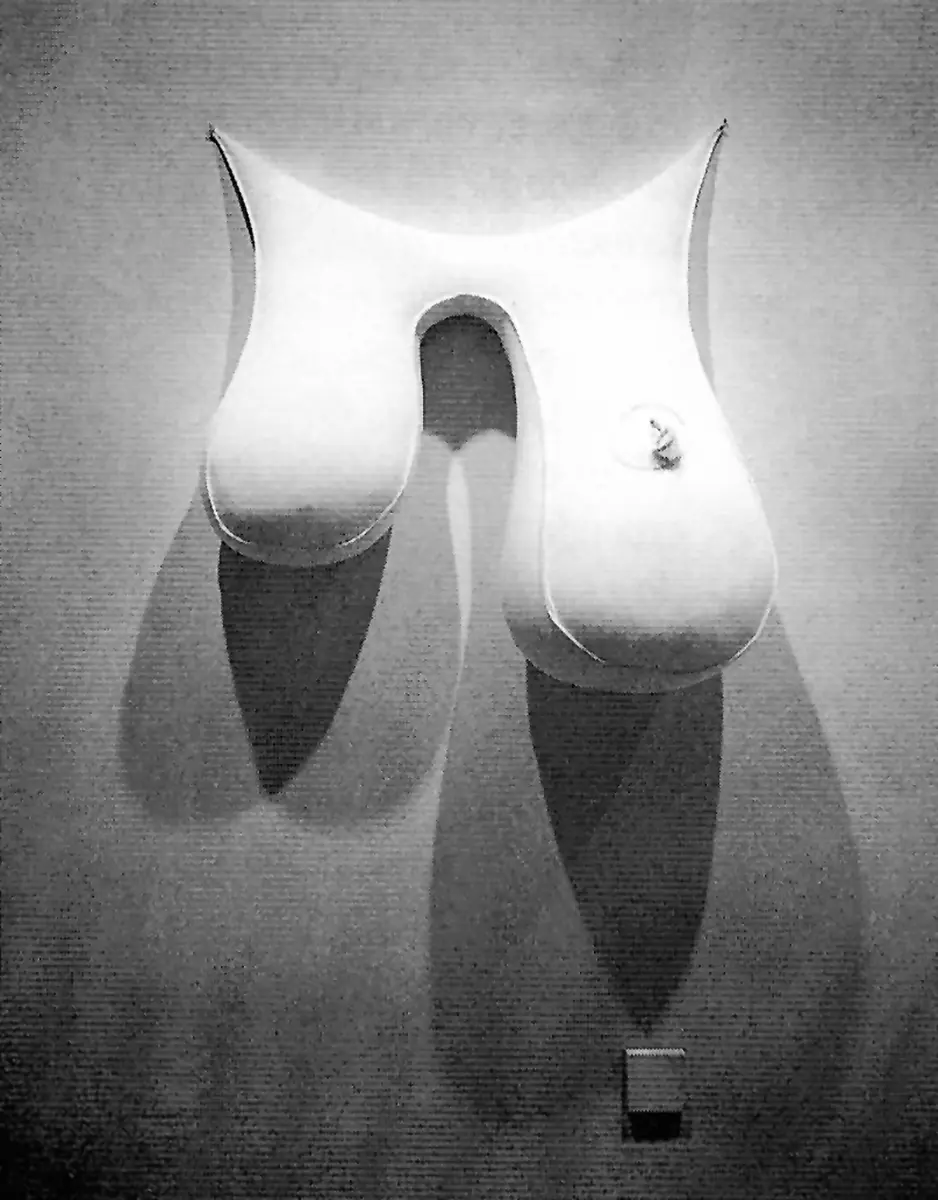
Madrid has enthusiastically welcomed Ernesto Neto’s newest solo show. Neto (b. Rio de Janeiro, 1964) had an exhibition in the same gallery four years ago, and his work has appeared in numerous group shows and art fairs, attracting the same intense attention. Neto’s work is currently on display at the University of California in Berkeley and the Centro Galego de Arte Contemporánea in Santiago de Compostela is planning to display Neto’s oeuvre for next year. The Elba Benítez Gallery possesses beautiful spaces, well-lit by natural light entering from the sun-drenched patio that fronts the gallery—very appropriate for Neto’s installations. Neto’s Pensamientos emocionales (Emotional Thoughts) come to us in the form of well-defined volumes, in sculptures realized in translucent Lycra—typical of the artist’s work—filled this time around with little white Styrofoam balls. The centerpiece of the exhibit is, clearly, Si mi cuerpo no estuviese tan lejos tal vez no estuviese tan cerca (If my Body Weren’t so Far Away Maybe it Wouldn’t Be This Near), a large installation occupying the largest hall in the gallery. A veil covers the entire ceiling, and from it emerges a sort of umbilical cord connecting to the padded body of a large white larva; the larva rests on the floor, inviting our touch, compelling us to insert our hands in its pink orifices. There is an element of transcendence to this piece; in that whitish, protecting, milky sky from which several artificial suns shine, we sense a bodily dimension but also an extra-corporeal level, a beneficial, nutritious presence—feminine, perhaps—spilling its gifts and facilitating the tranquility Neto has referred to elsewhere. Other pieces in the show have equally suggestive titles: Algo existe entre nosotros dos (Something Exists Between You and I); Este tiempo tan lleno de cuerpos (This Time so Full of Bodies); Otras obras que se escurren en el tiempo (Other Works Oozing Away Through Time). They signal, once again, Neto’s conception of the corporeal as something beyond the tactile (even as the sense of touch plays a major role here), something that extends immaterially through space and fades into time. Some of these sculptures, smaller in size, develop ways of relating to space that are new in the artist’s work. For Neto, the most sustained strategy has been to create atmospheres and spaces—often open for our entry—through fabrics and appendages shooting out from them. The new works I’m referring to tend to modify an architectural structure by joining it, as in a piece stuck to a room’s corner or another one hanging from a wall like a double sack. This is a more conventional procedure, saved from cliché and kept fresh by Neto’s sculptural ability, which never loses its communicative faculties. Neto practices soft sculpture. In previous works he has also experimented with olfactory and chromatic sculpture, using spices and pigments. These lines of exploration are rather outside the canon of sculpture, although there are precedents for them. Notable artists such as Claes Oldenburg and Barry Flanagan pushed the envelope considerably in the same direction. Neto’s work also reveals the influence of Neo-concretism, through the work of artists like Clark and Oiticica. But Neto inhabits a more purely poetic space, straddled between the objects’ intensity of the former and the political intentionality of the latter. To sculpt with veils is for him a way of hiding but it also announces the possibility of uncovering what’s behind. Translucence, which is not transparency, spurs our desire to see clearly. Neto’s veiled interiors, hidden from view but open to touch, offer the promise of pleasure in the luminous bosom… of nothingness?
ELENA VOZMEDIANO