
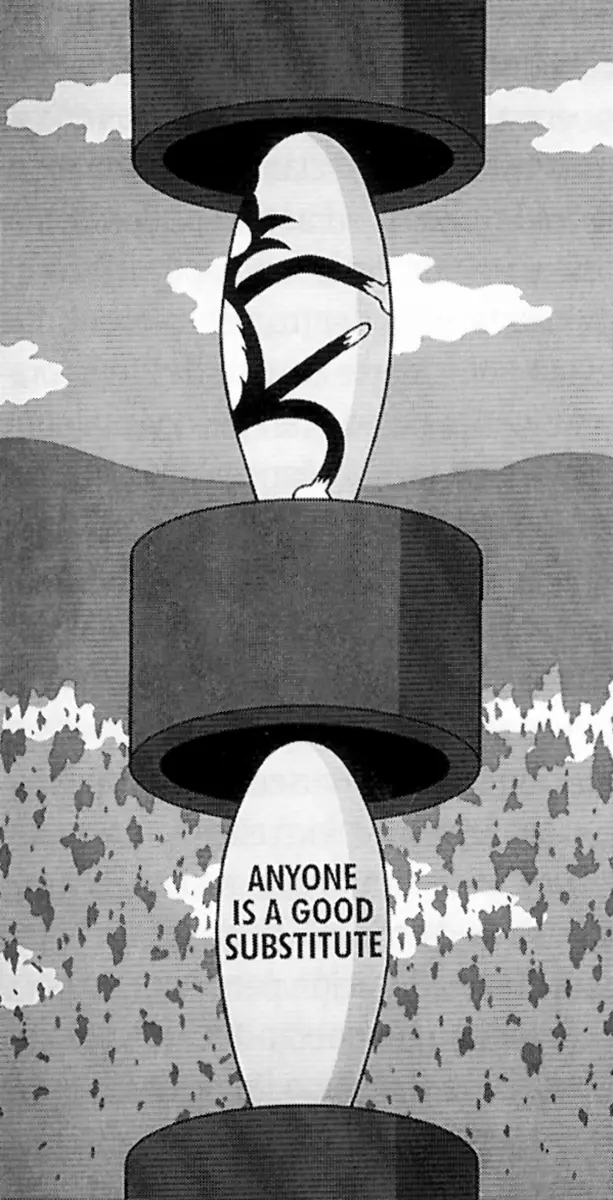
The works by Fabián Ugalde (Queretaro, Mexico, 1967) were shown at the Galería Enrique Guerrero from April 5 to June 15. They are a group of 15 pieces done with polyvinyl on vinyl, on which the artist tackles intelligently the language of comics, making it say, with its peculiar iconography, things that it wouldn’t normally say from its soapbox of humor and wit. The show’s title is Fallas de origen (Source Faults), alluding to the defective transmission that sometimes occurs in commercial and cable TV. But it’s also a word game with Ugalde’s own generation. During an interview,1 Ugalde said the foreign influence in his work is due to the fact that he “was born in a moment where television received loads of American cartoons and all those products were invading us. If you want to see it as a ‘source fault’ in me, then that’s what it is.” By retaking Popeye, Felix the Cat, Woody Woodpecker, and Mickey Mouse, among others, Ugalde not only deconstructs their universe but goes beyond and changes their physiognomy, leaving only those parts that can be identified by association. Daffy Duck is only his beak; Sylvester, his tail in some pieces, his belly and hands in others; Porky Pig exists only as a silhouette. Three of the show’s most visible strands take the way of eroticism and scatology, and the criticism hidden intelligently behind them springs forth in those moments of humor worthy of standing out. If the topics of eroticism and scatology can be subjected to criticism (inasmuch as they exist as two possible expressive languages), they’re so persuasive in their own right that in this case it can be said that they’re inarguably autonomous. One of the pieces best illustrating this point is Prodigios de segunda mano (Second-hand Prodigies). It’s one of the pieces with the most text, in which Ugalde clearly states his position on what surrounds him. In the first panel, we see a stone slab with a sort of foot. Small, stony periscope-like tubes spring from the slab: Boceto para una escultura basado en una extraña formación rocosa (Draft for a Sculpture Based on a Strange Rock Formation.) On the second panel, is that Porky who we see? Do his arms resemble chicken drumsticks? On his face, there’s a hole, from which sausages (worms?) exit towards the hollow of a nearby tree in the same manner that comics illustrate radio waves. The text reads, Transmisión telepática de cuerpos sólidos (parásitos no identificados) (“Telepathic Transmission of Solids (Unidentified Parasites)”). The third part is one of the show’s most unsettling. An organic shape that looks like a body mutilated from the waste and mid-thigh has been placed face down so that the buttocks are pointing upward. A protuberance that turns into a trumpet emerges from between the cheeks and blows a musical note. The text reads, Criatura de origen animal dotada de una peculiar habilidad musical (“A Creature of Animal Origins with a Peculiar Musical Ability”). This apparently candid way to evoke childhood’s most simple moments has as backdrop a brutal engagement with real life. The creator’s vision, his peculiar way of confronting the being —sending the sort of messages that not everyone wants to hear— turns his work like the childhood remedy that was administered through trickery. The bitter pill inside a piece of cheese. "In some sense, my work also tries to give a vision of pain. With hues of black humor, I try to ironize my own situation as well as others. This is part of my proposal that many times has been interpreted as if I were merely telling a joke when in reality the bottom has more bitterness."2 Tumores obscenos (Obscene Tumors) are the evocations of explicit sexuality that has been covered (as in the interferences in TV that prevent us from watching porno scenes) with cow dung —or are they potatoes?— from which grow strands of hair as if they were cacti thorns. In another piece, El faro enemigo (The Enemy’s Lighthouse) (not included in the show), a man that is also a cactus has inside him a light bulb, and, in multiple images, glasses appear over the plant’s thorns. We then read, My enemies were doing it for me. More than a simple inheritor of pop, Fabián Ugalde places himself more on the line of authors who have chosen comics —especially TV comics and their American origin— as a point of departure. Belonging to a generation whose visual fodder has been from the mass media that reaches millions of customers simultaneously, the artist has engaged in a frontal battle, lonely and intimate, against those unquestionable messages that comic book characters once sent and that now, according to Ugalde’s discourse, have become the prolongations of a fault-ridden system that can be perfected any which way we see it.
NOTE
1. “A Proposal with Source Faults,” interview with María Luisa López. Milenio newspaper, April 6, 2001. Culture section, page 47. 2. Ibid.
2. Ibid.
SANTIAGO ESPINOSA DE LOS MONTEROS