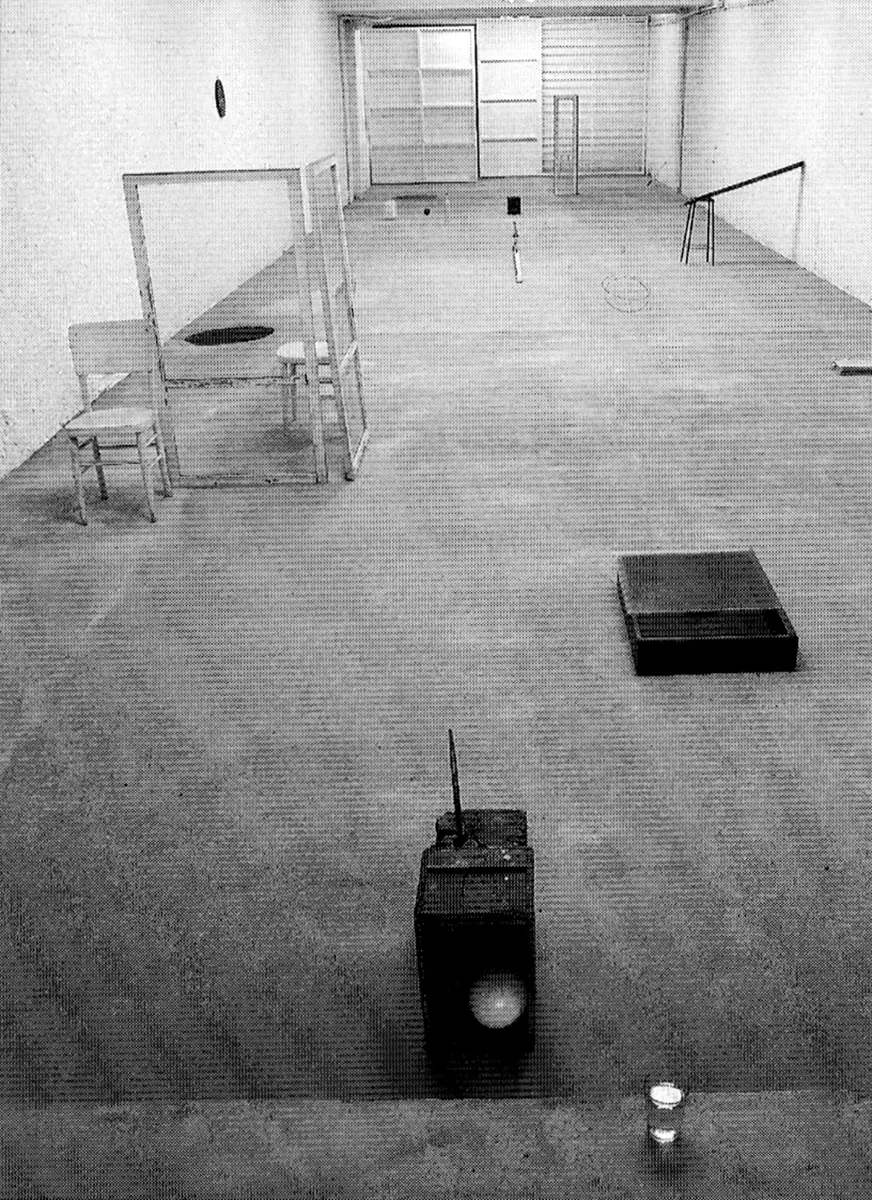
In less than a year, El Espaço Agora/Capacete has become one of the most active exhibition spaces in Rio de Janeiro, a city that’s rich in institutional spaces (for Brazilian and Latin American standards) but poor in programming. By organizing shows, debates, and conferences and producing many artists with little money and good efforts from the space’s directing artists, Agora/Capacete has shown that it’s possible to develop an impactful program and fill an important void in a city such as Rio. Located in a poor area of the city, the exhibit hall itself has something precarious and contemporary, unlike the well-finished look of museums and art galleries. This physical context ends up contaminating a good part of the shows—which have been organized taking into account the specific characteristics of the site where they take place.
Such is the case with the carioca artist Fernanda Gomes’s show. It filled the entire gallery with discrete objects, most of them small, that seemed to have been found on the street or in a basement. There were rusty nails, dirty paper napkins, wire, threads, partial windows, chairs, stools, pieces of wood, bottles, and glasses. From these elements, Gomes makes infinitely delicate constructions. Sometimes all it takes is the precise placement of the pieces or the way they relate to each other in the hall’s white environment. Other times it’s the juxtaposition of different pieces such as the structure of a stool and a piece of wood, or two copper pipes and a table leg, or a chest drawer and guitar strings.
Gomes’s constructions obey a logic that isn’t utilitarian or conventional or rationalistic. As far as the pieces’ composition and the show as a whole say, it’s a logic imbued in a rigorous formalist aesthetic. Element association seems to grow from an almost affective approximation, by an attraction that binds with an articulate tension both similar and disparate objects, the same and the opposing. Thus an almost imperceptible thread runs close to the floor throughout the gallery, tensed by a hanging rock that by human proportions is small but becomes huge when placed in that context. In another piece, several glass window panes rest against chairs, forming an L-shaped partition and determining a spatial division, an inside, and an outside, with a minimum of transparent elements. The fragile balance sustaining this piece is a constant in Gomes’ constructions, from the two circles of wire hanging from the ceiling through a white thread and tangentially touching the floor to the two paper bags suspended by another thread diagonally at the other side of the hall, where they roll in one direction and then on the other, almost touching the floor.
Despite the possibility of interpreting each of these element associations as independent pieces, they all form a unique group, an environment totally structured upon those relationships and possibilities of coexistence. Following the baroque logic of approximate symmetry, elements and forms are repeated under different situations: paper bags and wire circles, the L-shaped window panes on the chairs and another window with a similar shape, two glasses of water at the end of the hall, and two identical glasses, only smaller, hidden behind a door. The diverse hues of white in almost all the objects also contribute to the reading of the whole or unit, something that ends up immersing us in a world where the nature of the sculptures seems to obey a peculiar order of existence.
The relationships that Fernanda Gomes proposes in this show always float in a delicate balance, in a silence that could belong in places where nothing moves for long periods of time. That’s why we can’t deny the profound, albeit particular, aesthetic treatment that the pieces go through in order to achieve that suspension. If, on the one hand, Espaço Agora/Capacete’s precarious gallery space takes away from the sculptures the possibility of the type of contrast they could make with museum spaces, the pieces themselves, on the other hand, seem to rest comfortably in this setting. The objects surprise us because it seems that up until now they’ve been in the wrong place. After watching them occupying their space, the strange thing to do would be to hang a picture with a nail, or strum a guitar’s strings to produce music.
CARLA ZACCAGNINI