Could we say that a photograph by Andres Serrano constitutes political art? It would be very easy to resort to certain crutches of political esthetics from the 1960s and say that these photos express the “loneliness of the human being crushed by capitalism.” But while this might be accurate it isn’t true because the enunciates of political art from the 1940s, 50s, and 60s were supported by a Marxist aesthetic and militancy on the left, and today, after the disintegration of the socialist states and the crumbling of the Berlin Wall, these factors have all but disappeared.
The truth is that the artist is the one who must point out a situation of abuse when the powers-that-be become perversely unjust and crush whatever human they encounter. This is what Gloria Posada has lucidly done in her show No lugar (No Place).
Posada has concretized and legitimized an aesthetic proposal from a concrete series of questions about the world as a symbolic universe and reality as an artifice created and distorted by human hands. Her trails in university campuses or urban parks attempt to show the secret cartography of places carved by passersby, giving meaning to those loafers that open space outside the boundaries of maps that have been subjected to planning by the pragmatic concept of property registration.
Objectifying an old, worn-out school desk in a space is also to make it alien. It is to stress before others the continuous maps of stretch marks, carved markings, and diffuse names that have ended in a convulsed palimpsest corresponding to different times that have nothing to do with so-called memory and a lot to do with the uninterrupted flow of sensations inhabited by the time opposing the document. This hidden document has escaped oblivion and the erosion of days, and today is a reading allowing us to discover the tracks and markings, the stories of those who continue being even from their absence.
To turn the abuse of a community into news is to strip the historical event from the true connotations that it has as an act performed by humans. The limitations of film and photography to tell the intangible story are the same limitations that prevent them from showing the pain and the suffering. The murdered body lies there like a marking stone, signaling a sacred space that no new abuse can erase. In Boltanski, death and the dead are blackmail, the metaphysical terror. Here, death opens a question and gives meaning to a place.
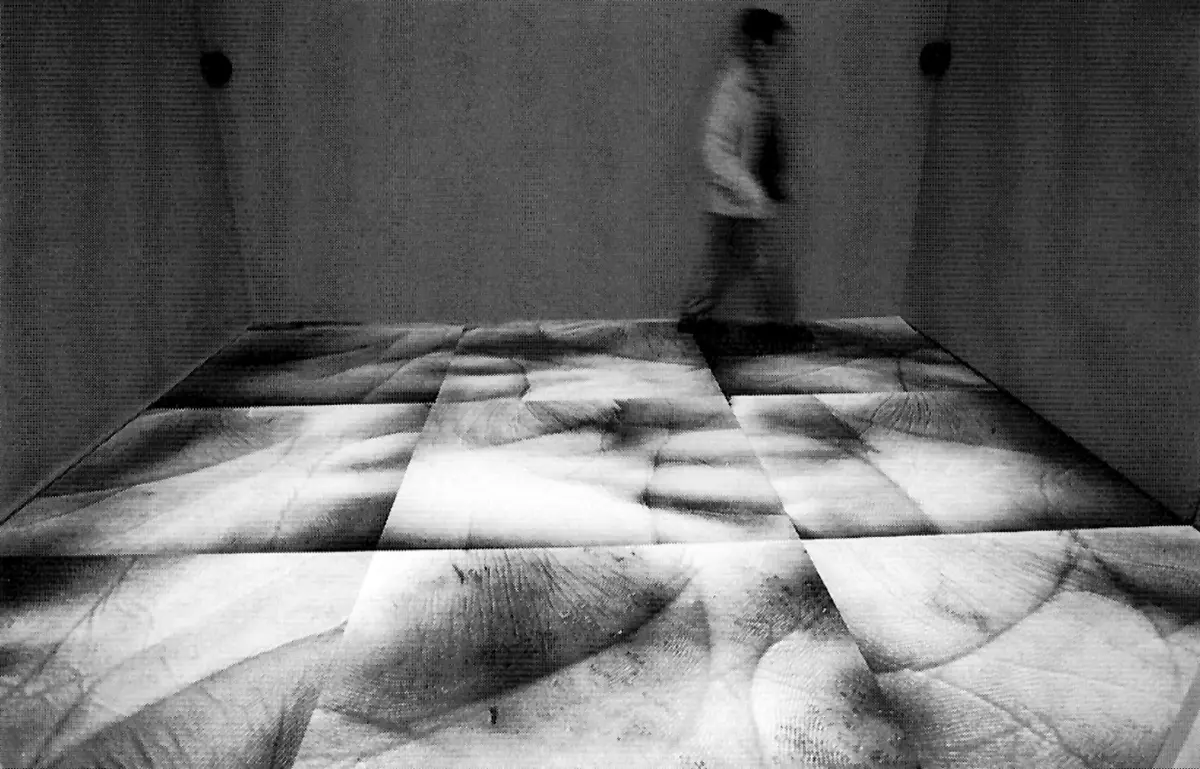
The displaced person takes along his wanderings to the place that inhabits or inhabited him; his body, then, becomes a document to be discovered. But, as one would think, his hand is not a palimpsest but a topography of hatch marks or lines advancing or suddenly breaking off. It isn’t a fingerprint, either, because as something intangible, it has escaped any classification established by the authorities. Like the oracle, in those lines, we read a broken personal destiny. That is why their reading unsettles us so.
Gloria Posada has proposed a mise-en-scene where the presence of this document has united the braggadocio of the Third World testimonial vision. The space created by these photographs of hands, and the color of the walls, make sacred this incipient memory. Posada, one of the most important voices in Latin America’s young poetry, has exhibited in Brazil, Cuba, Germany, the United States, Venezuela, and Austria.
DARÍO RUIZ GÓMEZ