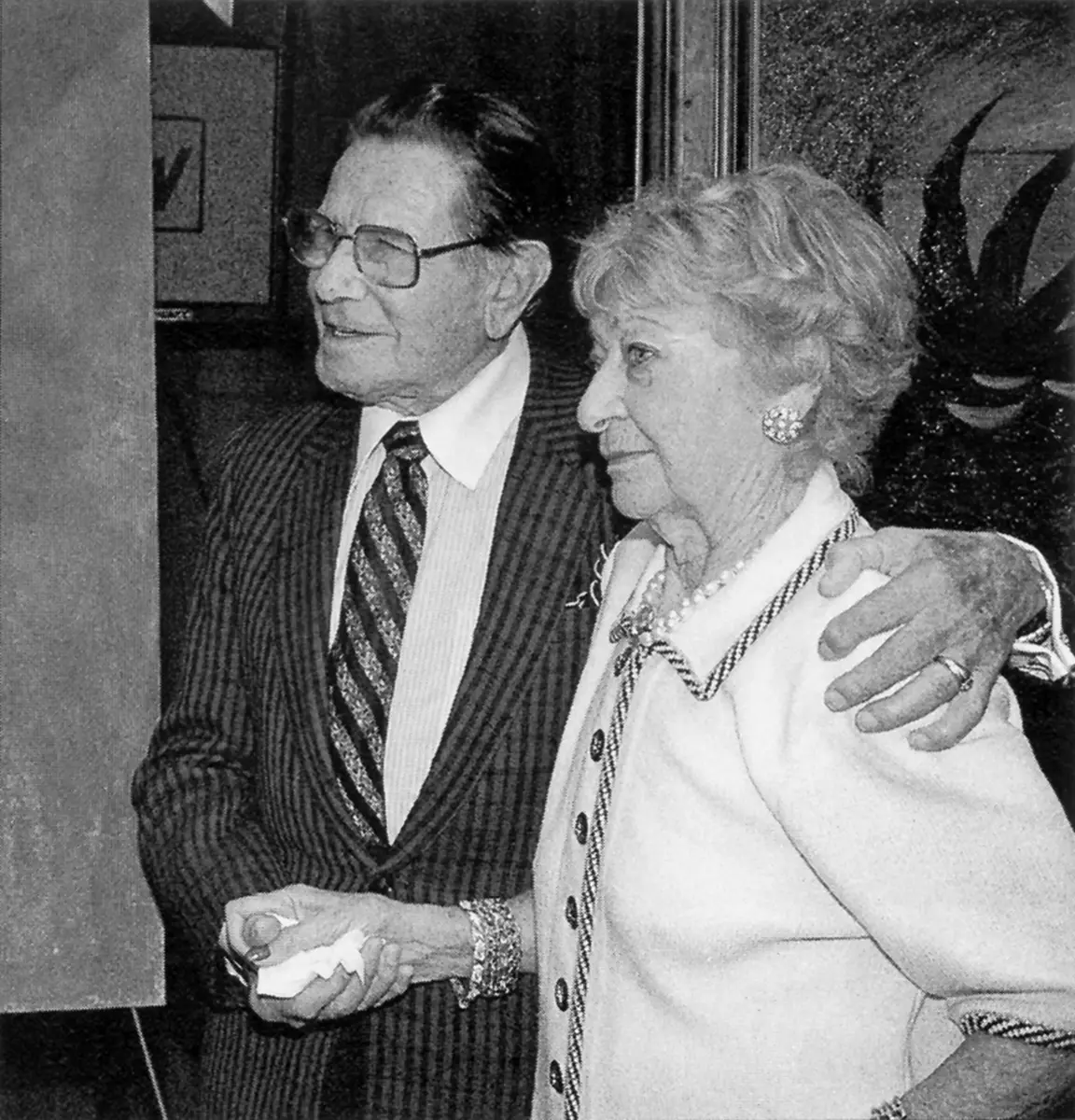
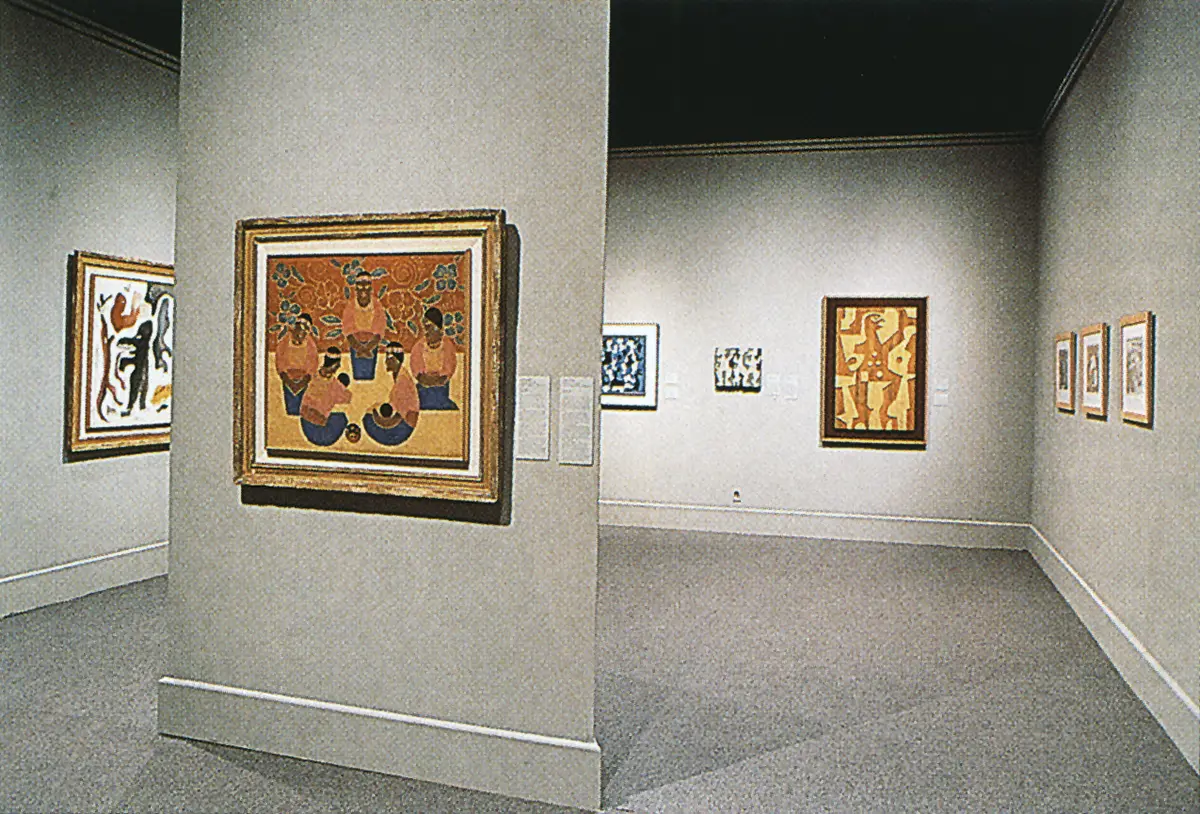
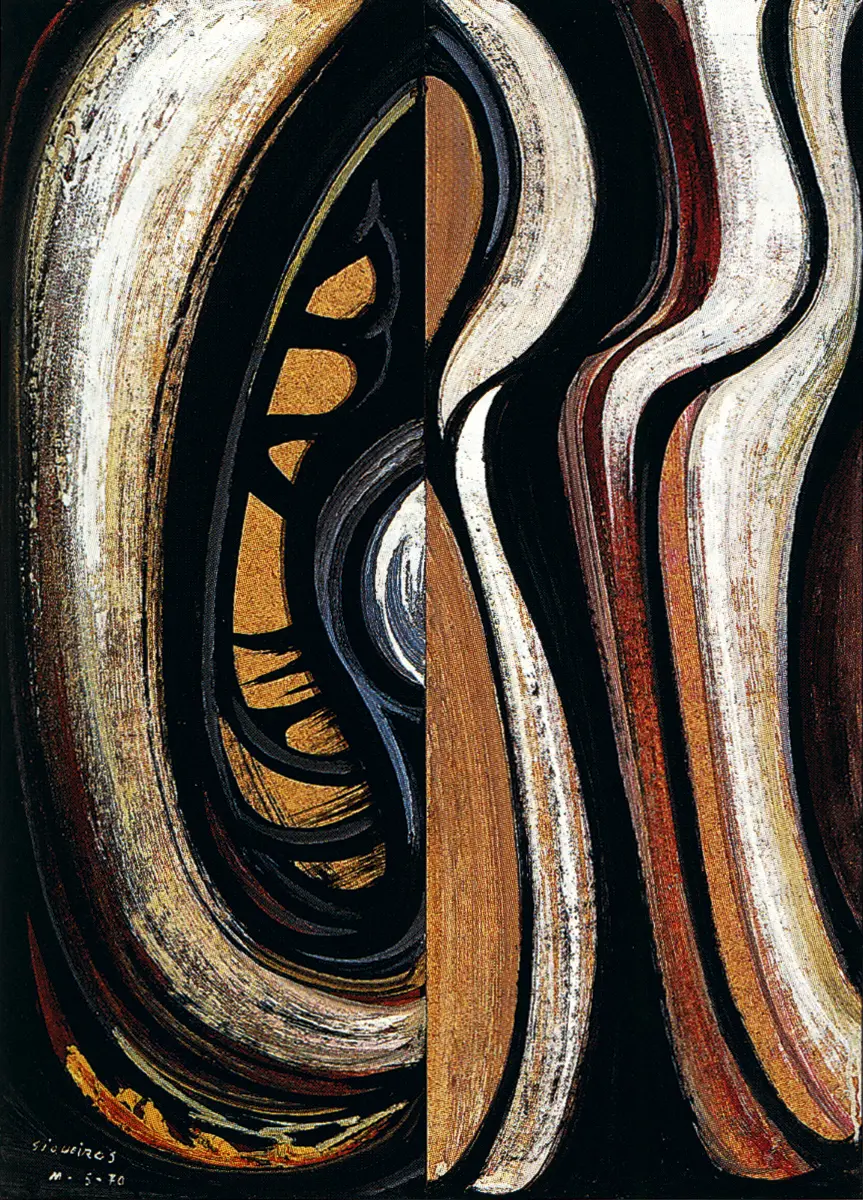
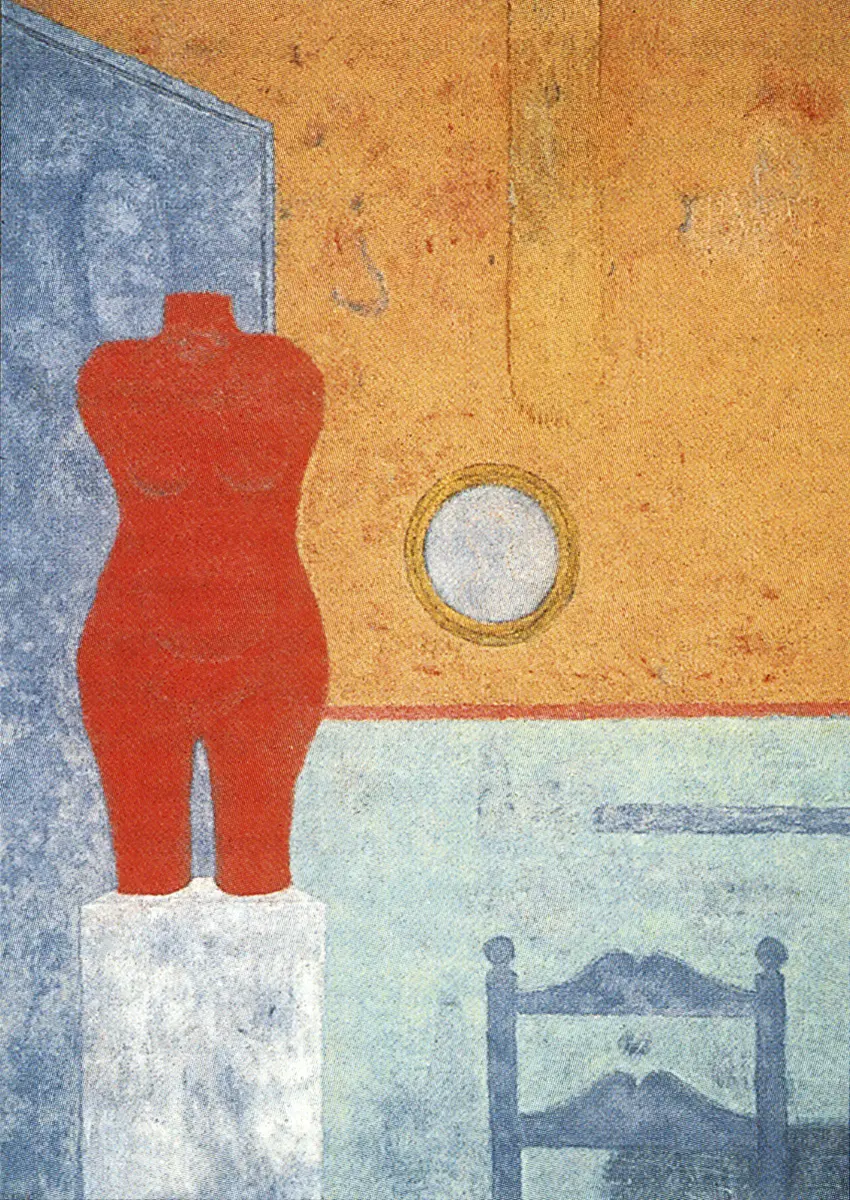
If the opening of the new Latin American Art wing at the Los Angeles County Museum of Art had been filmed, the opening shot could well have been a close-up of Siqueiros’ 1970 Study for a Metallic and Polychrome Door. With its anticipatory energies and sense of impending transition, Siqueiros’ door symbolizes the museum’s current rite of passage. Opening its new Latin American Art galleries to the public on December 14, 2000, Los Angeles’ most encyclopedic art museum took a giant step forward. In a metropolis where Hispanic-American, Asian-American, and African-American communities and arts institutions have often been isolated from a largely Anglo-defined art scene, the establishment of a permanent space for modern Latin American art in one of the city’s most respected museums suggests a shift in the art world’s social infrastructures. At the same time by emerging in the first year of the third Christian millennium, in a city that boasts one of the largest Latino/Latina communities in the United States, these changes carry fortuitous overtones as harbingers of a wider social acceptance of Latin American heritage, culture, and art. The new collections are located on the ground floor of LACMA-West, a recently acquired and renovated building that sits on the western edge of a sprawling six-acre museum complex that boasts five additional exhibition buildings. Augmenting the museum’s collections that extend to 110,000 artworks and roam the civilizations of the world, the new Latin American wing extends to 4,000 square feet. It is accompanied by a newly instituted Latin American Study Center, situated adjacent to the galleries which houses the curatorial offices and a focused research site for students and scholars in the field. The creation of the new museum wing began with the magnanimous bequest of over 2,000, predominately Mexican works of art, donated to the museum in 1997 by the retired Los Angeles art dealers and collectors Bernard and Edith Lewin. Valued at more than $25 million dollars, the gift augmented by over two-thirds of the museum’s extant collection of 1,364 mostly pre-Columbian works. Simultaneously, the new works also compliment the museum’s extensive holdings of American and European modern and contemporary art. The present spatial arrangement of the museum campus and its implied contextualization of the new Latin American galleries, however, have raised eyebrows amongst some of the city’s Latin American specialists. As the new galleries are situated in LACMA-West, any viewer interested in making comparative associations with either the Pre-Columbian or modern European-North American collections—which are both located in the original main buildings of LACMA-East—must walk through a sculpture garden, across a street, and up a steep flight of stairs to arrive at the related galleries. Some in the old guard privately question this separation of the new Latin American galleries from the long-established Pre-Columbian galleries, suggesting that the ancient echoes that sometimes surface in contemporary Latin American works argue in favor of the proximity of these collections. But by far the larger contextual issue here is the new collection’s present separation from the museum’s extensive collections of European and American 20th-century art. Since contemporary Latin American art converses historically and conceptually with these works, it is reasonable to wonder about their current placement in the museum. Queried about these issues in a recent interview, the newly appointed Latin American curator, Ilona Katzew told me that receiving such a large bequest and making room for its presentation within the extant museum layout is something of a mixed blessing. “It’s not our intent by any means to marginalize Latin American art,” she said. “Sometimes museums simply have space issues and bringing an exhibit to the Lewin Galleries of Latin American Art does not mean we want to dislocate Latin American art from the rest of the artworks. Our intention,” she continued, “is to slowly and progressively demonstrate that the art of our hemisphere is very rich and forms part of a very large discourse, which we will try to show through forthcoming exhibitions, symposia, and educational programming.” In the future, she plans to develop thematic and monographic exhibitions that underscore the significance of social context in the interpretation of art. Word on the street is that the museum is also currently discussing options for unifying the present campus. As reported on February 23, 2001, in the Los Angeles Times, while things are still in the molten and conceptual stages, the museum is considering regrouping its collection to create, “established centers for American, Asian, European, Latin American, and modern and contemporary art.” Echoing the organization of many North American University departments, such a scheme would manifest in architectural form extant classification systems. Due to the erosion of traditional cultural frameworks in an ever-increasingly global world, one would hope that in such reorganization, the new Latin American collections would find an eventual home amongst the museum’s other modernist and contemporary works. While questions of classification may seem at first insignificant, their manifestation in spatial terms symbolically reveals the larger frameworks that function to define and interpret culture and art. Thus, the criticality of such discussions cannot be underestimated. The inaugural exhibition of the permanent collection, mounted in five rooms, and featuring drawings, prints, bas-reliefs, and paintings, was organized by curator Katzew and reveals her nuanced response to both individual artistic voices as well as larger collective artistic themes. Presenting just a glimpse of the permanent collection, this eighty-three-piece inaugural display features a select group of Latin American Modernists, with a pronounced focus on Mexican art, due no doubt to the nature of the collection itself. The opening gallery is devoted exclusively to works by Diego Rivera, while the closing room provides a sampling of the museum’s acclaimed collection of Rufino Tamayo paintings. In between are rooms that present thematic groupings of artworks. The Lewin collection itself has been the focus of two previous museum shows. In 1994 the respected art historian Shifra Goldman, who teaches at the University of California, Los Angeles, guest-curated a small historical exhibition from the collection for the local Bower’s Museum in Santa Ana. That tightly focused show, titled Seven Decades: Modern Mexican Art from the Lewin Collection, traced artistic developments from Jose Guadalupe Posada to Francisco Toledo. Apparently, at the time, the Lewins were contemplating placing their collection with the much smaller Bowers Museum, in part because of its rich pre-Columbian art collections. But, for unexplained reasons, those discussions fell apart. The Lewins then initiated conversations with the Los Angeles County Museum, under the advice of Miguel Angel Corzo, who was then Director of the Getty Conservation Institute. Those dialogues resulted eventually in the bequest of their collection to the encyclopedic museum where the exhibition, Mexican Masterpieces from the Bernard and Edith Lewin Collection, was featured in 1997. A small catalog accompanied that show with informative essays by Miguel Angel Corzo and Margarita Nieto, a professor of Latin American art at California State University Northridge. Perhaps because the 1997 exhibition was pointedly criticized by the press for its lack of emphasis on Los Tres Grandes, Diego Rivera, David Alfaro Siqueiros, and Jose Clemente Orozco, the current installation in the new galleries takes special pains to include seventeen works by Rivera, ten works by Siqueiros, and three lithographs by Orozco. The opening room profiles Rivera’s works exclusively, organized around five oil paintings. Because Rivera’s major fresco works do not lend themselves to inclusion in private collections or museum exhibition contexts, the museum collection provides a different vantage point for understanding the artist. While only hinting of the grandeur and political consciousness that fanned Rivera’s oeuvre and renown, the sampling of his works presented here is nonetheless chronologically broad, spanning from 1925 to 1954. Most prominent here are a still life and four portrait paintings. Of these, Flower Day, which grants an ordinary Calla lily seller a majestic presence and dignity, most cogently echoes Rivera’s fresco works. By the same token its placement across from a small and virtually unknown oil portrait of Frida Kahlo, dating to 1939, permits an interesting glimpse of the relationship between the artist’s public and private personas. The Rivera oils are accompanied by five miniature watercolors that at first seem like an odd selection for the opening room of a major exhibit. Yet, on closer examination, the reason for their inclusion becomes clear, for these are small jewels that transport viewers from the bustling streets outside the museum to the tropical plains of Mexico. The exhibit’s largest and most diverse room follows. Its strongest works are a suite of late abstract landscape paintings by Siqueiros dating to the 1960s. While far removed from his commanding and fierce murals, Landscape in Red (1969), Mountains (1964), and Study for a Metallic and Polychrome Door (1970) nonetheless suggest the vigorous certainty of the artist’s vision. It is curious, however, that references to Siqueiros’ charismatic presence in Los Angeles in 1933, where he painted three huge murals and influenced numerous local artists, are wholly absent from the museum’s collection. A small cluster of paintings dating to the ‘30s and ‘40s by Miguel Covarrubias, Pedro Figari, and Jean Charlot converse with one another at the end of this long hall. Focusing on racial ethnicity as a spectacle of the “other,” the works of Covarrubias and Charlot use the conventions of racial stereotypes with derisive or exotic Euro-centric innuendoes, while two paintings by the African-Latin Uruguayan artist Pedro Figari appear to study rather than merely perpetuate such discourses, foreshadowing post-colonial interests. Presenting as it were a miniature exhibit within the exhibit, this grouping of works unblinkingly confronts the issues of race and ethnicity as fundamental paradigms of culture and civilization. One can sense curator Katzew’s hand in this selection of works that explore themes related to those she exposed in an exhibition of colonial casta paintings that she organized for the Americas Society in New York in 1996. The third room of the inaugural exhibit juxtaposes the simultaneous but divergent currents of Social Realism and Internationalism that defined Mexican Modernism from roughly the 1920s through the 1950s. It highlights six social realist prints by artists affiliated with the Taller de Grafica Popular comparing and contrasting these with the more poetic and abstract works of the Internationalists, especially Carlos Merida. Functioning as a conceptual turning point within the exposition, this room provides a transition to the subsequent galleries where the more private worlds of various internationally oriented Latin American artists are shown. As an in-depth study of the Internationalist trend, the fourth gallery focuses on Latin American Surrealism, presenting a small array of diverse Latin American, as opposed to strictly Mexican, examples. Many of the artists profiled here led peripatetic lives that contributed to cultural identities that were more fluid than fixed, such as the Chilean-born Paris-based Roberto Matta, the Cuban-born European-traveled Wifredo Lam, the Guatemalan-born Mexico-based Carlos Merida, and the English-born Mexico-based Leonora Carrington. Two walls hung with prints and drawings by Matta and Lam grant glimpses of their creative works that fueled post-1945 artistic developments in the Western Hemispheres. The collection’s weaknesses, however, are glaringly apparent in the lack of any major paintings by either of these two seminal artists who associated with the European Surrealists and interpreted and transported those concepts to the western hemisphere, where they influenced among other things the artistic development of New York Abstract Expressionism. Also shown are works by the women artists Carrington and Kahlo. Carrington’s mature works, which date subsequent to her emigration to Mexico, project haunting and surreal qualities as is evidenced in the exhibited lithograph, Tuesday. Hanging nearby is a small oil painting by Kahlo titled Weeping Coconuts. It presents a still life that surrealistically doubles as a veiled self-portrait, and was loaned to the museum especially for this exhibit by Bernard Lewin, who still maintains a small, private collection of works. The exhibit’s climax occurs in the final room where a sampling of ten of the reported eighty or so Tamayo paintings bequeathed to the museum by the Lewins are presented. This chamber offers a small survey of Tamayo’s work beginning with an early 1925 abstract painting of an exterior space titled Airplane and culminating with a late 1983 abstract painting of an interior titled Red Chair. Because experts regard this Tamayo collection as one of the largest and best in the world, it should be interesting to see if the museum stages a Tamayo blockbuster show in the coming decade. It is worth noting that Tamayo and Merida, the artists most favored and collected by the Lewins were part of the larger group of poetic and abstract Mexican Internationalist painters, whose explorations turned away from the more politically overt emphases of their contemporaries, Los Tres Grandes. In a recent interview with the author, the now 95-year-old gallerist, whose wife passed away two years ago, declined to speculate on their collecting preferences. Instead, he opted to recount his harrowing escape from Nazi Germany in 1938 which was made possible by the unexpected kindness and assistance of a Nazi S.S. agent. Perhaps the Lewins’ all too personal brush with political absolutism led to a preference for the more private ruminations of Tamayo, Merida, and others who chose to address the anxieties and struggles of contemporary existence in encrypted, existential terms. By the same token, Lewins’ savvy and cogent evaluation of the larger art scene in the late 1950s was crucial to all that followed. Assessing the post-World War II artistic developments in Los Angeles, Mexico City, New York, and Europe, they opted to enter and support the fertile world of modern Mexican art at a time when its international significance was undervalued. Indeed, it was not until roughly 1980 when prices for modern Latin American art began to soar in the Euro-American art auction houses, that the Lewins’ course of action was subsequently vindicated. Describing the nascent Los Angeles gallery scene of the late 1960s to me, he commented, “I had no competitors here. My only rivals were in New York.” While the Lewins’ tale is a classic “rags to riches” story, its destiny was not readily apparent in the beginning. Periodically traveling to Mexico from California, they sought out pre-selected artists, were introduced to others, and eventually formed intense artist-dealer relationships with those they chose to represent. In 1968, when the Los Angeles gallery scene was just getting off the ground, the Lewins decided to establish a gallery in Beverly Hills. “I had the first gallery in Beverly Hills,” Lewin explained and then went on to describe the circumstances surrounding its founding. Speaking slowly, articulately, and with a hint of wit not diminished by age, he said, “The building was at the corner of Cañon Drive and Wilshire Boulevard. It was condemned because the electricity wasn’t correct. So, I straightened it out and had many prominent people come to the gallery.” His patrons were the then luminaries of the Hollywood screen. “Greta Garbo came,” he reminisced, ”but didn’t buy anything.” But those who did buy included such superstars as Edward G. Robinson, Elizabeth Taylor, Ella Fitzgerald, and others. Capitalizing on an untapped art market, the Lewins successfully enhanced the value of the artists they represented, nurturing a broader appreciation for Mexican and Latin American art in Los Angeles and beyond. There are naysayers who criticize the Lewins saying they shortchanged Mexico of its cultural riches by supporting Mexican artists and transporting, collecting, and selling their works in the United States. But without the Lewins’ vision, hard work, and final magnanimous gesture of generosity to the people of Los Angeles, the current international exhibition and celebration of these works would not be unfolding. The critical support they lent to a selected cadre of artists provided in its own time the financial and representational frameworks that permitted artists to create art, rather than being forced to other occupations to meet the basic requirements of living. This is not to say there isn’t a long way to go. Certainly, the current collection at the Los Angeles County Museum of Art is impressive as a start. However, it is predominately Mexican in focus and will require numerous new acquisitions to become exemplary of the vast terrains of modern Latin American art. There are, for instance, no examples of the broad and influential South American Constructivist developments: no works by Joaquin Torres-Garcia and the artists affiliated with the Escuela del Sur in Buenos Aires and Montevideo, nor of Venezuelan Kineticism and Brazilian geometric abstraction. Encouraging rumors promise, however, that future touring and in-house exhibitions will explore these artistic horizons. Thus, despite the collection’s current limitations, the fact of its establishment complimented by the new curator’s savvy approach to the field, promises to raise the North American discourse of Latin American art to a more sophisticated level. In the past, such seriousness has been woefully absent in the public domain of this city’s major museums, although the universities and an array of smaller arts institutions, particularly the dynamic Museum of Latin American Art, have managed to fan such flames. In focusing on the social context of art—be it issues of race relations, the psychological brutality of war, or life’s relentless struggle against mortality—the curator and the museum have wisely selected a path that promises to make Latin American art relevant to the complex multicultural communities of Los Angeles. In making a commitment to permanently exhibit and interpret modern Latin American art, the museum symbolically takes up the mantel of furthering cross-cultural artistic understanding both here and throughout the hemispheres. It is a commendable beginning to what will doubtless be an arduous but rewarding journey.
COLLETTE CHATTOPADHYAY