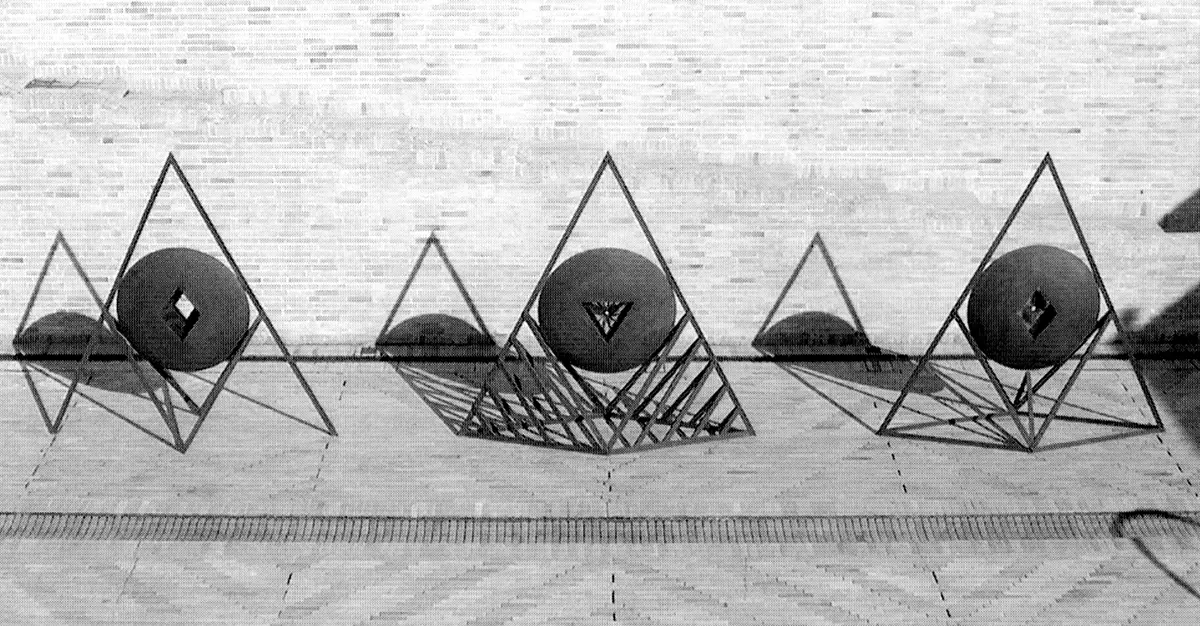
Within the incomparable frame of a Latin American architectural masterpiece—the Postgraduate Studies Building at the Universidad Nacional de Colombia designed by Rogelio Salmona—Lydia Azout has found the best environment for a retrospective exhibit of her sculpture, selected by Piedad Casas. 25 years of work are synthesized here in 18 pieces.
There is a complementary dialog between Salmona and Azout—brick and steel adjusting and conjugating with one another amidst the terraces, patios, ponds, ramps, and hallways, where the fluidity of water and the solid sharpness of steel end up intertwined in a music that is both sensitive and rigorous.
From the onset, the first selected piece creates an affinity with Salmona’s project. It is located at the threshold of initiation. It’s one of the famous pita-fiber rope and wood altars where Azout weaves and interweaves indigenous reminiscences, granting them a spiritual dimension in a translucent game of “controlled spaces,” (as I call these works from 1984).
The ziggurat and the maloca (a ceremonial sacred house or temple used by some Amazonian indigenous populations), the pyramid, and the cabin. With sticks and ropes she builds the cosmos’ home, where light and air flow through its walls. Inside we can see, through the rope door that’s been left ajar, other ropes coiled onto themselves, perhaps a small stone talisman.
She has created a whole world within the established parcel. Within it, she has reproduced the game of the elements, and she’s defined an environment that has risen from the original parcel into a paradoxical and reduced version of the cosmos. She has opened the doors of perception for us, suggesting that we should live in a house we cannot enter. Contemplating it, it offers us the possibility of going from our secret subterranean labyrinths to the sea’s reconciled luminosity, as Azout herself remembers in her childhood memories. A nature turned essential by the respectful use of materials, and the indispensable ritual that makes us bend forward to perceive, inside the house, the luminous halo of sacredness that in reality floats in our insides.
The show continues anthologizing her “rhythmic forces” from 1988, where the visual and musical vibrations of the ropes composing an atmosphere have been substituted with the rotund implantation of the stone that, abruptly carved with a compressor, alludes to Amazonian symbols that in turn were inscribed in a stone of the great river navigated by Orellana and Lope de Aguirre.
If her temples alluded to Augustinian culture in some fashion, where from hollow tree barks we flow into a stone slab suspended in mid-air, these marbles and sandstones allow her to begin plotting her visual alphabet. The flowing waves within which creative writing transcends the support given by the material. From there, she went on to conquer her 1992 “suns.”
These large steel disks whose volume can resonate like a drum or just remain there, exposed to the rust of days as an emblem of the world’s archetypes. The rhythmic forces that undulate over the stone’s surface, are now concentrated on that eye piercing the metal, offering us a great formal synthesis and a vanishing point leading toward a landscape reduced to its most synthetic definition: at the sun’s center, a circle, a spiral, a square, a rhombus, a triangle. They break the spheric mass at the center, giving us ways of accessing new dimensions. From rope to stone, from stone to steel —a peregrination that is also a psychic exploration.
Confronted by these seven rotund suns that rise like guardians, Azout continues her valuable formal concretion by paying attention, with a subtle sense of hearing, to the suns’ vibrations—acoustic or visual. When she drums on this resonance box or when she perceives the world integrating into the surrounding nature, Azout discovers the void linking all living beings and objects. They’re energetic networks spreading themselves freely in the air. They can be born, as an impulse, from the Serifot of the cabalistic tradition or from the signs identifying the feminine gender.
In an even riskier and more courageous exercise, she then builds tubular structures in which space invites us to participate freely, watching them from any angle or entering them as one discovers nakedness as the biggest rich. These irons crisscrossing one another, and those plumbs signaling the exact center of the void where the universe finds its nodal point of balance. But nodal in a figurative sense—that is, lines that remain fixed on vibrating membranes or plates. While everything changes and is altered and we move around these sculptures trying to listen to their secret, they have delimited a ceremonial center, in whose interior hall survives the subtlest sacred chord. That which has a correspondence, as two instruments in a symphony, with the harmonious melody of Salmona’s architecture. The spirals’ great flight deepening into the air, or the artifact that allows us to ascend, in the prophetic vision’s chariot of fire, confirms the tenacious perseverance with which Azout has accessed a fertile maturity.
This show reiterates this with each piece. The book Diario de una creación (Diary of a Creation) from 2001, where the various echoes of her works are registered from an interdisciplinary perspective and beautiful photographic documentation: from anthropology to dance, from American landscapes to the most remote Orient. The universality of whom, with her “feminine forces” from 1997, has achieved her most expressive and complete creation.
JUAN GUSTAVO COBO BORDA