Pablo Vargas-Lugo (Mexico City, 1969) held his first solo show in Mexico City in September 1998, where he held his first at the Museo Carrillo Gil, located in the same city.
In this show, Vargas-Lugo limits the materials to paper and cardboard, and with these, he produces two- and three-dimensional pieces using a schematic language in which he minimizes elements and creates images overflowing into narrative. Determined by the material used—corrugated cardboard, photographic paper, or cut paper—the show can be divided into three nuclei. Each piece is part of a series.
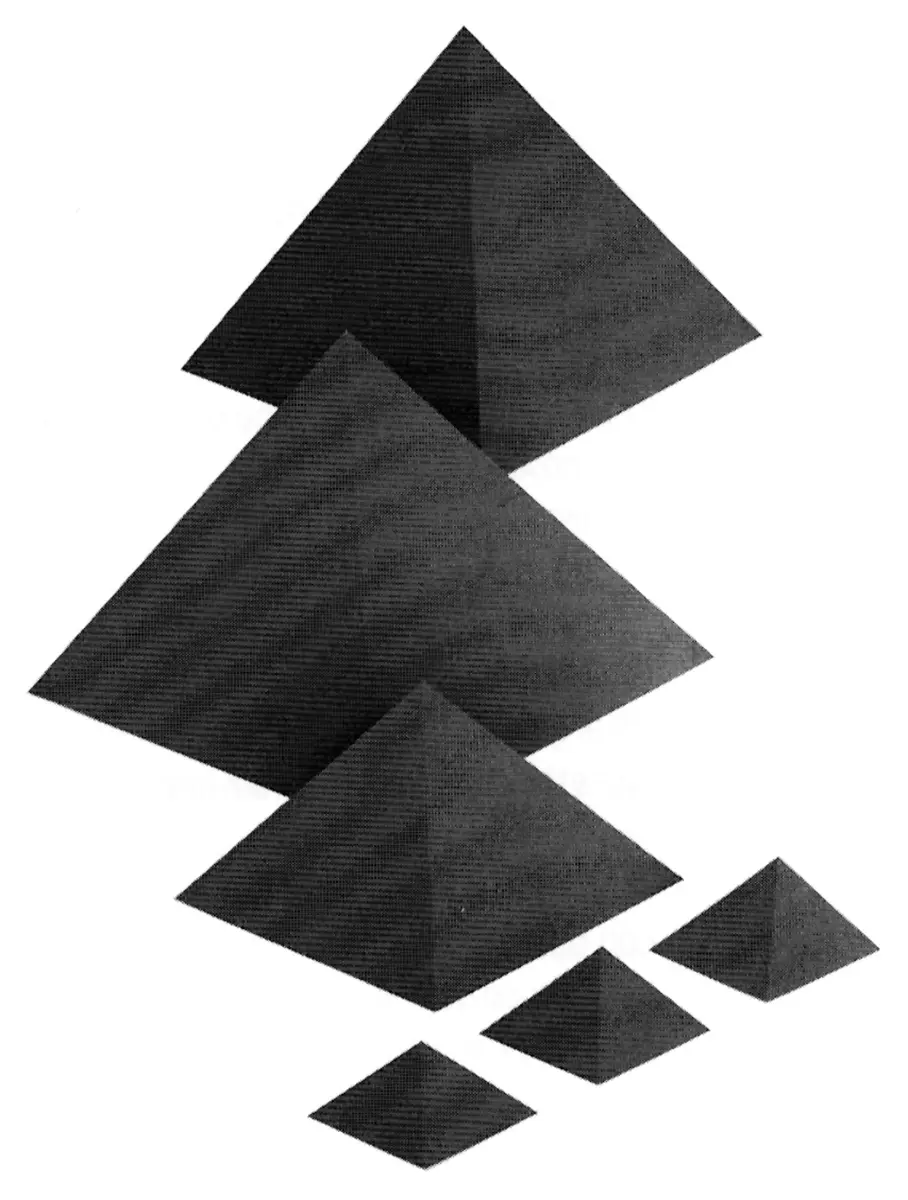
The journey begins with Piramid Panoram (2001), comprised of six pyramidal cardboard structures jutting out from the wall. Behind each element there’s a color reflection created because in the wall’s separated part, which gives volume to the pyramids, is covered by a different bright-colored paper for each one, generating a subtle luminous effect. The volume achieved through the reflection and the lighting is surprising; the color of the cardboard and the grouping of the six pyramids refer us directly to Cairo, the city on which the piece is based. Viajero, Pionero y Marinero (Traveler, Pioneer, and Sailor), produced in 2000, were made out of photographic impressions in which the flat background color is different from that of a drawing of a tree. The tree branches, which are different in each case, extend through several leaves tacked to the wall, creating a pattern with them. Two versions of Visión estrábica (Strabismal Vision) (1999 and 2001), also made out of corrugated cardboard and bright-colored paper, use the same recourse of luminous reflections. Created from common cardboard boxes used for innumerable things, with Vargas-Lugo’s modifications they find new life and interpretation without losing their basic form. Finally, a series of collages—or drawings, as the artist calls them—entitled Golgotha (2000) and Mapa Roto (Torn Map) (2001) in which a delicate line creates images full of implosive and explosive movements over monochromatic backgrounds with similar palettes.
In Congo belga o cómo escudriñar al mundo (Belgian Congo, or How to Scrutinize the World), from the catalog for the Museo Carrillo Gil exhibit titled Congo Bravo (Brave Congo), curator Magali Arriola states that “by changing the appearance of things, and, implicitly and perversely, by making an attempt against our visual expectations, Vargas-Lugos makes us ask ourselves where does the meaning of an image reside. He tries to elucidate on why things are the way they are, even when they seem to be something else.” This statement is central to the artist’s aesthetic search. By producing his pieces from everyday materials and manipulating their shape without radically changing their structure, as in the case of the boxes, or by adding components, as in the case of Visión estrábica (figura G) (Strabismal Vision) (Figure G), it creates the illusion of several boxes joined together. Once more he takes advantage of the luminous reflections, resulting in a more complex set of boxes than the first piece with the same title.
In this show, the collages or drawings he’s been doing since 1994 take shape as torn maps—an idea he’s elaborated on light boxes (which he’s also exhibited). The light boxes represent the relationships that Mexico has with other countries such as Italy and Japan. The torn maps are a graphic game in which the artist takes the plane's geographical contours and exploits them to the smallest natural accident in islands and coastal areas, overlapping and playing with the resulting order of lines, creating new contours that are still recognizable as territories. In the exhibit, the pieces shown don’t refer to specific geographies but keep the appearance of territories.
Melanie Smith, 100% Acrylic
Melanie Smith (United Kingdom, 1965) came to live in Mexico City in the early 1990s. The work she’s produced since then has based its discourse on this huge city, from which she tries to find elements that could be found in other big cities. She’s developed more the concept of a megalopolis than a local discourse centered around Mexican culture. Her constant attraction to modernism, plastic, accumulation, and massive spaces has translated into installations, sculptures, videos, and paintings.
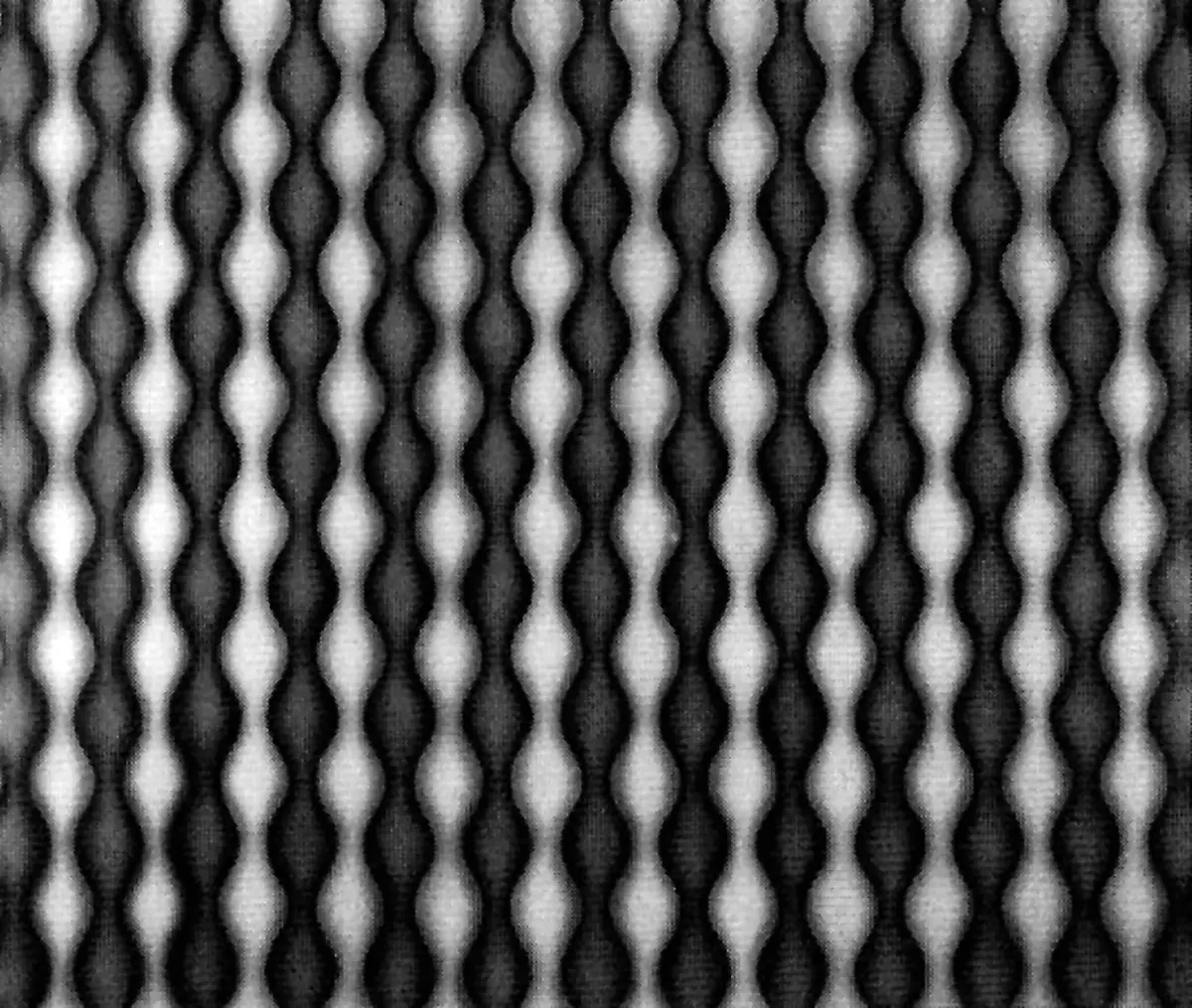
In 100% Acrylic, paintings and photographs (all done in 2000) are presented in juxtapositions, proposing cross readings, and although the paintings are not a literal interpretation of the photos, they’re closely related. With titles that pinpoint geographically the place in which they were taken, such as Comercial Mexicana Mixcoac (a self-service gas station), Telas la Parisina, or View from the ABC (a hospital), the large-format photographs (from 100 x 100 cm to 120 x 170 cm) show urban landscapes that are more generic than specific. In each image, the accumulation, excess, and element repetition are paraphrased in the paintings, which are also large. Titles such as Car-Jam 85º, Suburbia 2.1 (a department store), and Authentic Atzcapotzalco Tardío II (a zone in Mexico City) give room to the interpretation of images, which could be cataloged as Op Art or Hard-Edge paintings—two styles that were stereotyped during the 1960s. The intense colors achieved through acrylic that have been applied with incredible precision over a sort of wood conglomerate grant the hypnotic and repetitive forms an incredible amount of movement and vibration.
Although in appearance Melanie Smith and Pablo Vargas-Lugo have no thematic, conceptual, or artistic kinship, they are artists whose works coexist in harmony. Both are obsessive in the care they give to technique. Their manufacture is impeccable; the quality of the line, the chromatic handling, and the esthetic quality—traits scarcely found in contemporary production—are primordial in both cases. Also, both artists show a wide knowledge of art history, and from it, they take points of departure and references in their pieces. In the case of Vargas-Lugo, his collages and trees have a close relationship with Chinoiserie or European appropriation of popular 19th-century oriental esthetics, or perhaps with the ceilings painted by Tiepolo or Titian. In her paintings, Smith pays constant homage to Victor Vasarely Ellsworth Kelly, and Andreas Gursky in her photos.
While going through each perfectly delimited exhibit, the notion of the popular and the current makes itself evident—but not the folkloric. Thanks to the intellectual and aesthetic process that each artist went through to create these realities, when we leave the show we’re invited to make a second reading to see whether what’s inside and outside the gallery links or separates art from daily life; or that which the common citizen takes for granted from what Pablo Vargas-Lugo and Melanie Smith take as theme for creation and reflection.
FRANCISCA RIVERO-LAKE