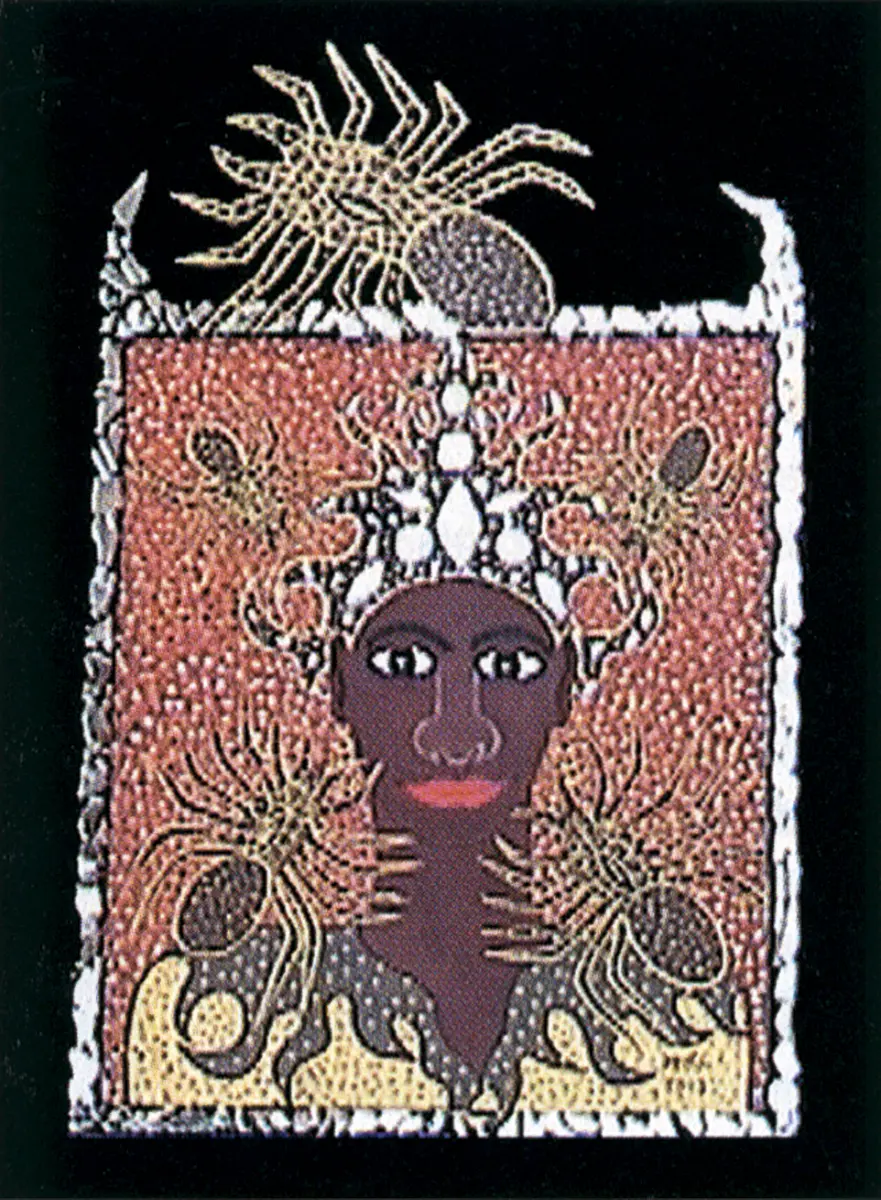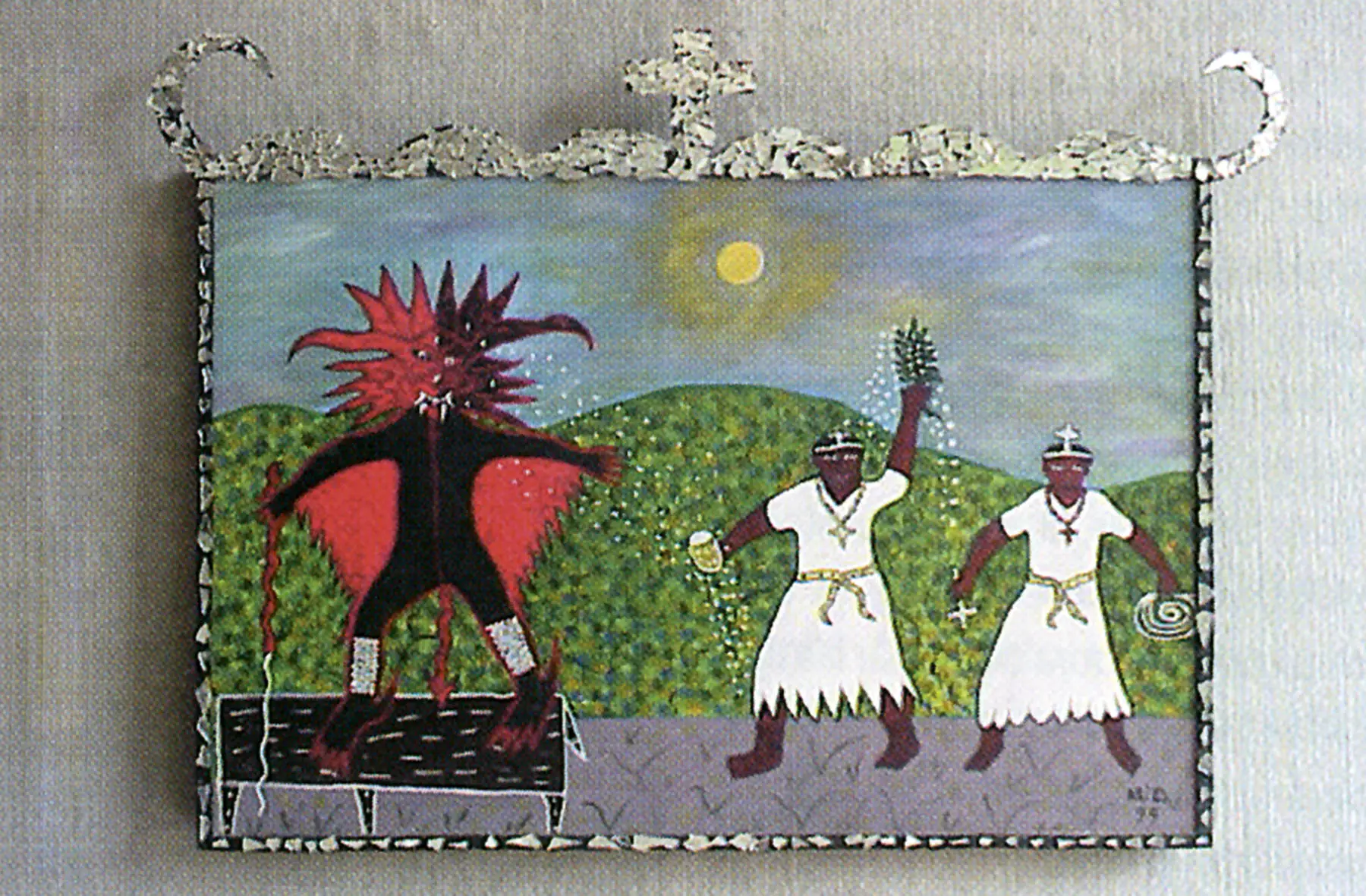
Now that Atlanta has developed an important Latino population—around half a million Latin Americans with increasing economic power—it is not surprising to see local galleries representing Latin American artists. This month a noteworthy exhibition opened at the Modern Primitive Gallery that featured the Taller Portobelo, whose members specialize in congo-based imagery from Panama and work on purposely primitivizing styles. In these paintings, Congo Queens and Kings confront the viewer with iconic intensity. They wear symbolic animal headdresses—spiders, crabs, octopuses—whose forms are sometimes duplicated with emblematic directness in a collage of mirror fragments and shells that crown each canvas. A few of the works represent an ironic fable that has been enacted during every carnival celebration in Portobelo since colonial times: a black and red devil, a symbol for the Spaniards, is captured by Congo angels in order to baptize him and sell him in the market.
Portobelo first came to the attention of the international public through the unforgettable black and white images produced by Panamanian photographer Sandra Eleta, which featured the congo inhabitants of this fishing village on the eastern coast of Panama. Since 1995, Portobelo has become the focus of a transnational workshop co-founded by Eleta, Virgilio “Yaneca” Esquina, and Dr. Arturo Lindsay. The Portobelo-based members include Eleta, the self-taught “Yaneca,” his first student Ariel “Pajarito” Jimenez, and Esquina’s two sons, Virgilio “Tito” Esquina and Gustavo Esquina de la Espada, in addition to Manuel “Tatu” Golden and José “Moraito” Angulo. With the exception of Eleta and Esquina senior, all these artists are workshop-trained. Lindsay, based in Atlanta, is a Panamanian visual artist and art historian who studied in the United States and now teaches at Spelman College. The interaction between Portobelo and Atlanta has acquired a certain routineness. The Taller members visit Spelman every other year and students from this school participate in the Summer Art Colony, directed by Lindsay, that brings them to Portobelo for several weeks.
According to the members of the Taller, an important moment in the development of this workshop took place when Lindsay invited “Yaneca” Esquina to lecture at Spelman College about the art of making bastones or walking sticks. Esquina painted and sculpted canes following a tradition that goes back to colonial times when run-away slaves or cimarrones made walking sticks for defensive purposes. In Atlanta, Esquina became interested in working on canvas and his exploration of this new medium resulted in a purposely primitive style that, to a certain extent, has characterized the production of the Taller as a whole.
All the members of the group have contributed to the definition of a shared but flexible aesthetic. Their approach not only rendered the opposition between self-taught and academically trained artists problematic but also encouraged the exploration of individualized styles and the use of different media. For instance, the show includes Eleta’s large color photographs of members of the Taller dressed in traditional Congo clothes and Lindsay’s small altar-like installations honoring dead slaves.
Jimenez and the elder Esquina believe that the most important aspect of the Taller is not the styles or the media but the process of cultural reclamation that informs their works. As descendants of cimarrones and ex-slaves, these artists are trying to recover and preserve congo traditions that still exist in Portobelo and nearby towns. According to Lindsay, Portobelo did not have a plantation economy but was instead the first Caribbean port after the Middle Passage. Africans from many cultures, in transit to different slave markets, escaped and lived together in palenques or fenced villages. Protected by the rain forest, these cimarrones were successful in fighting the Spaniards and thus remained free until Nueva Granada achieved independence from Spain and slavery was outlawed. Portobelo is now populated by many descendants of cimarrones and ex-slaves who call themselves Congos, a term that is not related to the central African country nor to the Kongo-based religious practices of the African diaspora. In Panama, congo is a generic term used to describe the traditions that people of African ancestry developed in this particular region.
The members of the Taller Portobelo, well aware of the variety of origins of the African population in Panama and their own exposure to the international market, make no claims of authenticity or purity for the hybrid congo identity they are consciously constructing. Although part of their art is inspired by well-known Congo stories, another part of it is based on ethnographic research conducted by talking to the elder members of their communities and those of nearby villages. Thus, the art on exhibit at the Modern Primitive Gallery is a visually poignant way of celebrating surviving Congo traditions and recording others before their memory is lost.
FLORENCIA BAZZANO-NELSON