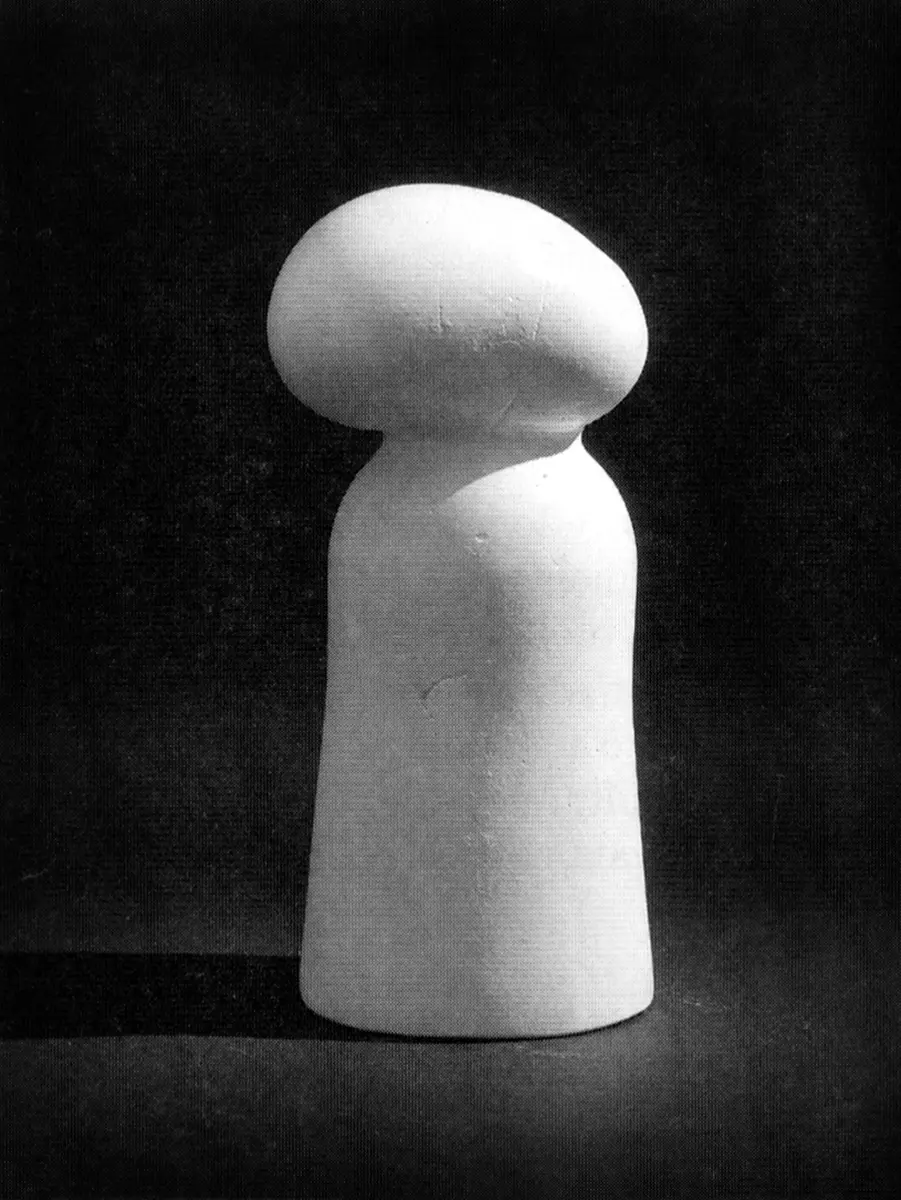
Víctor Grippo (b. Junín, province of Buenos Aires, 1936) is an outstanding representative of Argentine conceptualism. He joined the legendary Grupo de los Trece (The Group of Thirteen) (Buenos Aires, 1971), and then the Grupo CAYC (The CAYC Group), to which Bedel, Benedit, Glusberg, Portillos, and Testa also belonged. Ten years after his last solo show in Buenos Aires, Grippo—an artist who prefers silence and meditation to the furor of an exhibit—presented a group of small white sculptures under the title of Anónimos (Anonymous). There are almost 50 anthropomorphic, sometimes phallic, pieces done in polished gesso and grouped in odd numbers (3, 5, or 7) under bell jar glasses. A poem by the artist included in the catalog reads: "Entranced we see our landscape/Peopled with shapeless beings,/Soulless, dauntless presences/Sustained by neither roots nor soil./Identical nothingness cloned/Air carnations with no flowers or memories." That’s how he describes his ambiguous and vague objects, dated 1999. Molded with an artisan’s passion, each piece is different from the others. But not only their size changes. The gesso surfaces also show small incisions and rough sports indicating, almost imperceptibly, a timid and frustrated try at some sort of identification. The imperfections contrast with the perfection, purity, and immutability of the white color. In the end, Grippo’s creatures have one single element in common: their silence, and their nothingness. In the show, Anónimos is strategically placed in the middle of two stretches that share work and time as common themes, creating tension between them. The first stretch corresponds to the installation La cualidad de la luz (The Quality of Light), a dark, close, and half-empty enclosure. An old table, worn by use, has been placed at the end of the room. On it there are basic tools of the trade. In this case, the quality of the light aimed at the table is to concentrate our gaze, isolating it from the “noises” fragmenting it, allowing our perception to change amidst the surrounding darkness as we get to see more and more. This part of the show plays a capital role: to attune the spectator’s gaze and begin the journey through a knowledge that reflects him. In the third stretch (located in the gallery’s basement), a series of reduced white boxes contain small geometrical objects, plumbs, and mason’s levels. The objects talk of balance and the lack of it, of the rules of the universe, and also about chance. But the protagonist in this stretch is El tiempo del trabajo (Work’s Time), an industrial machine used to mix stones during construction. Each minute the machine drum gives one full turn; inside it, concrete-covered marble pebbles tumble. As a consequence of physics and chance, the pebbles fall when the cycle ends, producing a noise similar to the act of constructing. The allusion to work is constant in Grippo’s oeuvre. In 1976, he presented Algunos oficios (Some Trades), one of his most important pieces. Different sorts of materials and worn-out tools were piled up against a wall being constructed. Everything seemed oriented at abolishing traditional value scales and establishing a nexus, and reciprocity between art and work in general. Going against the myth of the artist’s aura, everyday activities were reevaluated in Construcción de un horno popular (The Construction of a Popular Oven) (1972), a large-scale operation involving craftsmen brought in from the countryside to build a bread oven in a plaza in downtown Buenos Aires. The reflection tables on which Grippo has been working since the 1970s not only talk about work and the demystification of art but also about time. On one of them he wrote: "This tabletop, sister of innumerable others built by man, was a place of union, reflection, and work; when there was bread, it was broken here; it was here that children did their homework, and here tears were shed and books read and joys shared..." Other important works by Grippo were done with potatoes, a comestible tuber that makes reference to South American pre-Hispanic cultures and is a symbol of its energy. Analogía I (Analogy I) (1971), national patrimony housed in the Museo Nacional de Bellas Artes, was shown for the first time in the exhibit Arte de sistemas (The Art of Systems), organized by CAYC in July of 1971. The piece is made up of 40 potatoes, each one encased in a cell and plugged into a voltmeter measuring their energy by zinc and copper electrodes. It shows the artist’s interest to break the limits not only between art and work in general but also between art and science. Grippo enjoys the rare privilege of being known and respected inside his own country as well as abroad. In 1977, he received, along with the rest of the CYAC Group, the Grand Prize of the XIV São Paulo Biennial, for Analogía I. In In1995, Guy Brett curated a great retrospective show held at the Ikon Gallery in Birmingham and the Palais des Beaux-Arts in Brussels. In 1999-2000 he took part in the Cantos paralelos (Parallel Songs) show (Austin, Texas; Phoenix, Arizona; and Bogotá, Colombia), and this year he participated in Eztétyka del sueño (The Aesthetics of Dreams), organized by the Centro de Arte Reina Sofía in Madrid. We have more than enough reasons to recognize Grippo. The spirit of his times emerges brightly in his work. His philosophical dimension is notable but not less than his ethical. Even if his criticism of a hyper-technological world is corrosive, it’s never violent. His protestations aren’t explosive; they’re more reflexive, measured, and accurate. It’s the fruit of a lucid mind linked naturally to the power of imagination —essential conditions for the true work of art.
ELENA OLIVERAS