
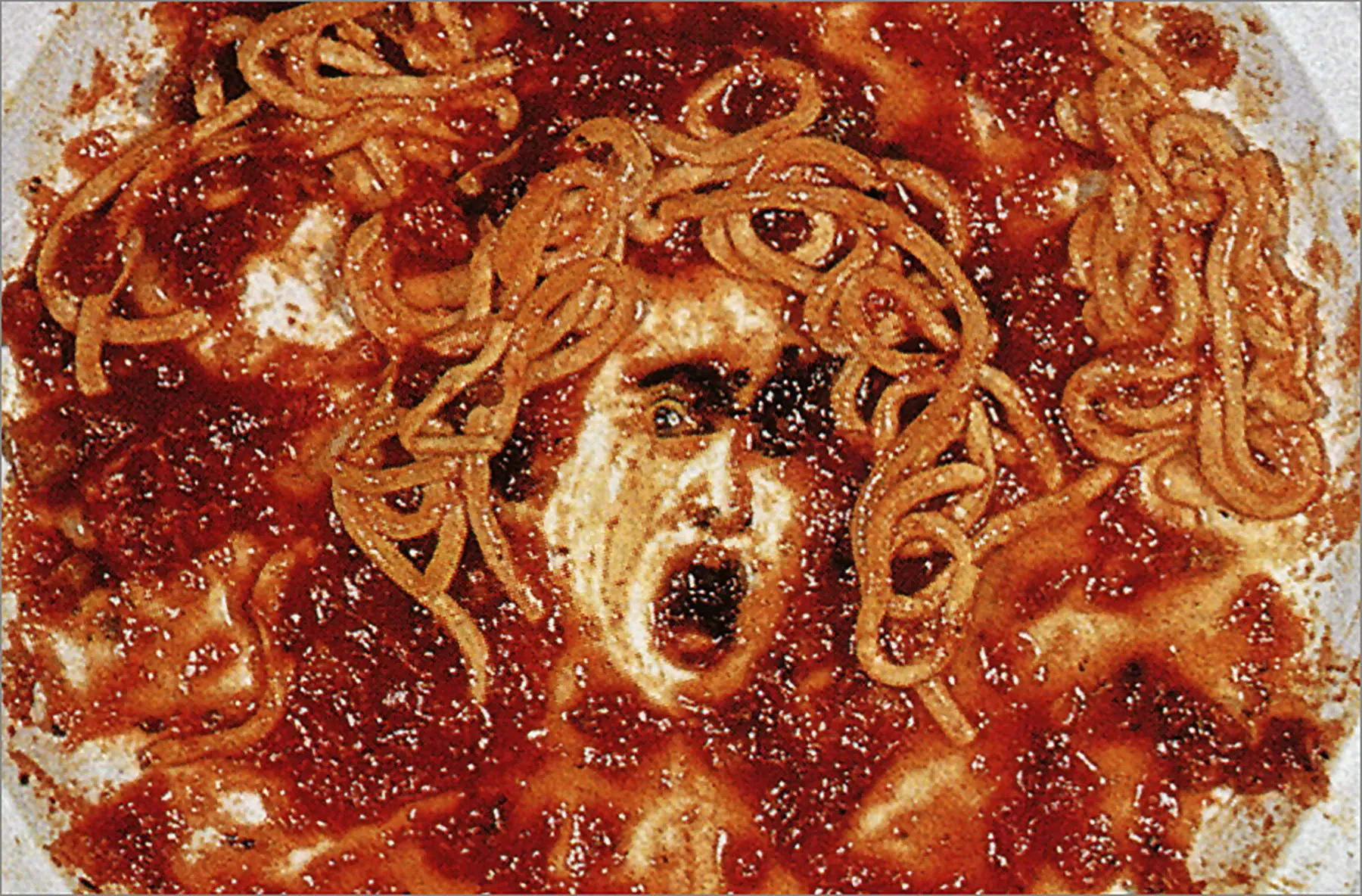
The technique of reproduction detaches the reproduced object from the domain of tradition. By making many reproductions it substitutes a plurality of copies for a unique existence. In permitting the reproduction to meet the beholder or listener in his own particular situation, it reactivates the object reproduced.1 Much has already been written about the work of Brazilian artist Vik Muniz (São Paulo, 1961), often focusing on his use of the photographic medium to explore its illusive qualities in relation to visual perception. As groundbreaking as the pictorial realism of photography, its infinite and fast reproducibility played a decisive role in the way society came to perceive reality, that is, in a two-dimensional, reproduced form. The photographic image has permeated all spheres of visual communication and has progressively multiplied to the point of visual exhaustion. Since moving to New York in 1984 and settling with a studio in Brooklyn, Muniz has developed a body of work that seeks to reawaken the viewer’s visual and critical numbness by drawing his/her attention to the technical and conceptual mechanisms behind image production, construction, and reproduction. In order to do so, the artist has focused on two key elements: recognition, through the use of familiar images that the viewer can identify instantly, and novelty, or surprise, by reconstructing these images with the use of materials and techniques that are not commonly associated with artistic production but with other emotional and sensory perceptions.
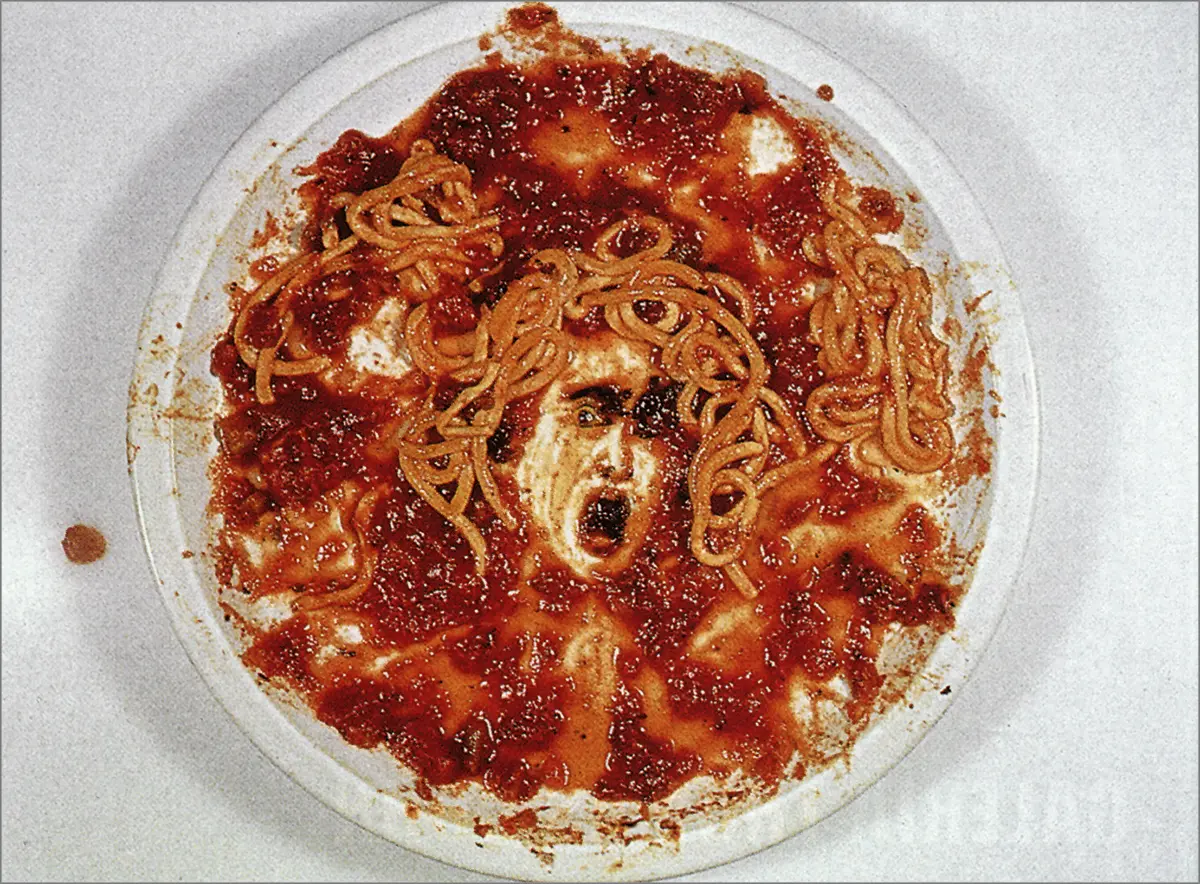
Most of his photographs belong to series and are referred to as “pictures.” A picture can be anything from a painting, a drawing, a photograph, a scenery, or a film. In fact, Muniz’s photographs are pictures more than they are photographic images of scenes and objects caught by the camera alone. This is because his pictures are the final prints of a creative process that is at once painterly, sculptural, and graphic. In his studio, Muniz rummages through a vast array of unconventional materials as well as historical and documentary visual sources to create compositions that conjure up new interpretations of the nature of visual information and artistic expression. Using photography as a means of synthesizing a complex array of interrelated ideas, technical considerations, and intellectual concerns, Muniz has brought together, sometimes in a single image, issues that question the complexity and changing history of visual perception - from art history, creative techniques and documentation to more social and political matters. Through a continuous play with parallel references, Muniz addresses each issue by appropriating its own inherent characteristics. The misconstrued notion of the photograph as a “truth revealing” mechanism is thus addressed through pictorial illusion, while its endless reproduction is articulated in the form of its own paradox by inverting the logic of duplication and transforming the reproduced image, the photograph, into a “unique” work of art.
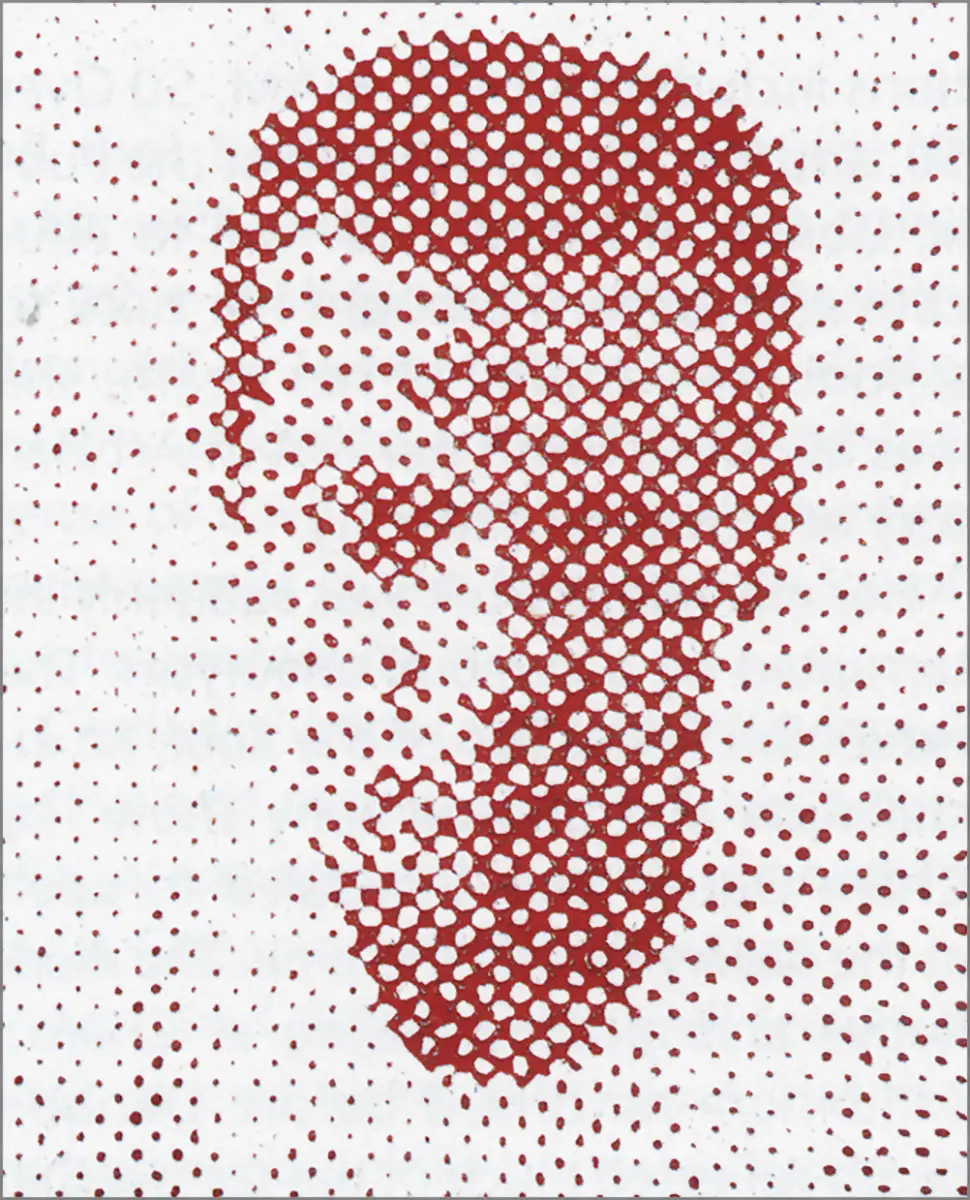
In 1998, Charles Stainback curated Muniz’s first retrospective at the International Center of Photography, New York. The exhibition was titled Vik Muniz: Seeing is Believing and was documented in a book bearing the same title. The heading introduces to the viewer an assumption that is immediately questioned: is seeing, believing? There is an almost didactic nature to both Muniz’s work and his artistic/ideological approach that invites the viewer to study his photographs critically and analytically. He once called his pictures “my little private happenings.”2 Having been involved with the theater in São Paulo before moving to New York, it is not surprising that both acting and ‘60s and ‘70s performance art are constant references in his work. In effect, the artist likened the fact that the creative process employed in the making of his pictures always remains perceptible to the counter illusive effect of “bad acting.” A good actor will disappear into his role and convince you that you are watching his performed character, while the bad actor will shift back and forth between his own self and his character, thereby reminding you that you are seeing a representation of something that is not “real.” In Muniz’s “visual stage,” the photograph is at once the written play and a bare stage, that is, the initial idea as well as the formal support. The bad actors are the materials used to create his figurative compositions, which range from edible substances such as chocolate, sugar, spaghetti, and ketchup to soil, dust, wire, thread, and nails, among many other organic and synthetic snippets. While the chocolate used to create a portrait of Freud (Sigmund, 1997-1998, from the Pictures of Chocolate series) is instantly recognized, the pictorial realism of the photograph challenges the viewer’s visual preconceptions, raising doubts as to whether the image is a painting, a photograph of a painting or the photograph of a chocolate reproduction of another photograph, or of another painting or drawing, for that matter. Muniz’s theatrical analogy brings to mind the alienation effect of Brecht’s plays, in which actors maintained a certain detachment from their characters in order to reveal to the audience the real mechanisms employed in the play’s construction, while simultaneously performing its fiction. Similarly, Muniz’s photographs create pictorial illusions at the same time that they display their illusory “tricks.” In this sense, “seeing is believing” has a dual connotation: it is both an ironic reference to our perceptual delusion (we tend to believe what we see in a photograph because it’s the documentary medium par excellence); and a cue to understanding the artist’s Brechtian approach to pictorial representation (we believe what we see because we know how the re-produced image has been construed). This play with the illusive and delusive properties of visual perception confers an active quality to Muniz’s pictures, stimulating a cognitive dialogue with the viewer through a play of sensory and intellectual association and recognition.
Looking at the effects of visual representation and how mass-produced imagery, for example, can easily influence people’s judgments, in Personal Articles (2000) Muniz chose to address the political field of “social delusion.” In this work, the artist has displayed copies of cutout news articles in which the images and/or texts have been distorted into visual and informational absurdities. One of the headlines reads: “First Head Transplant is a Complete Success – scientific marvel won’t shut up, say specialists—” a witty story about twins who were born stuck to one other. Another article shows a photograph of an astronaut on the moon dispersing oil paint in space – “NASA launches the first painter in Space…” If the viewer does not take time to study these articles carefully, he/she may be fooled into thinking they are newsprints with reports the artist found intriguing. The photographic image is published alongside articles as visual proof verifying the alleged truth of their contents, whether these refer to a social incident, a scientific discovery political corruption, etc. Once again, Muniz reminds us of the deceptive power of photography, and how, in this case, its most relied-upon documentary function is usurped by journalism. In an earlier series titled Principia (1997), Muniz explored this idea in an even more explicit way, through creative mockery aimed both at the “gullible” viewer and “smart” image-maker. Principia is composed of a display cabinet containing several “very silly pseudo-scientific photos,”3 accompanied by equally “pseudo-scientific” captions, which further test the viewer’s response to a material repertoire of false scientific information presented in a convincing and, most importantly, image-proven manner. For example, Principia 5: Goosebump Hormone, looks like the complex structure of some random hormone. However, upon closer inspection, one realizes that the image portrays a potato pricked all round with toothpicks; and Principia 3: Vocal Cords Saying “Buongiorno” is actually an image of a few spaghetti strands. Image manipulation in photography and other vehicles used for documentary purposes, such as film and video, has existed since their invention. If Mussolini had himself photographed on a horse to divulge the image of a virile and commandeering ruler for his political campaigns, a journalistic snapshot would only reveal an arbitrary frame of reality translated onto a flat surface. Muniz highlights the fact that an image is always constructed whether compositionally or technically, and can therefore never be a faithful documentation of reality.
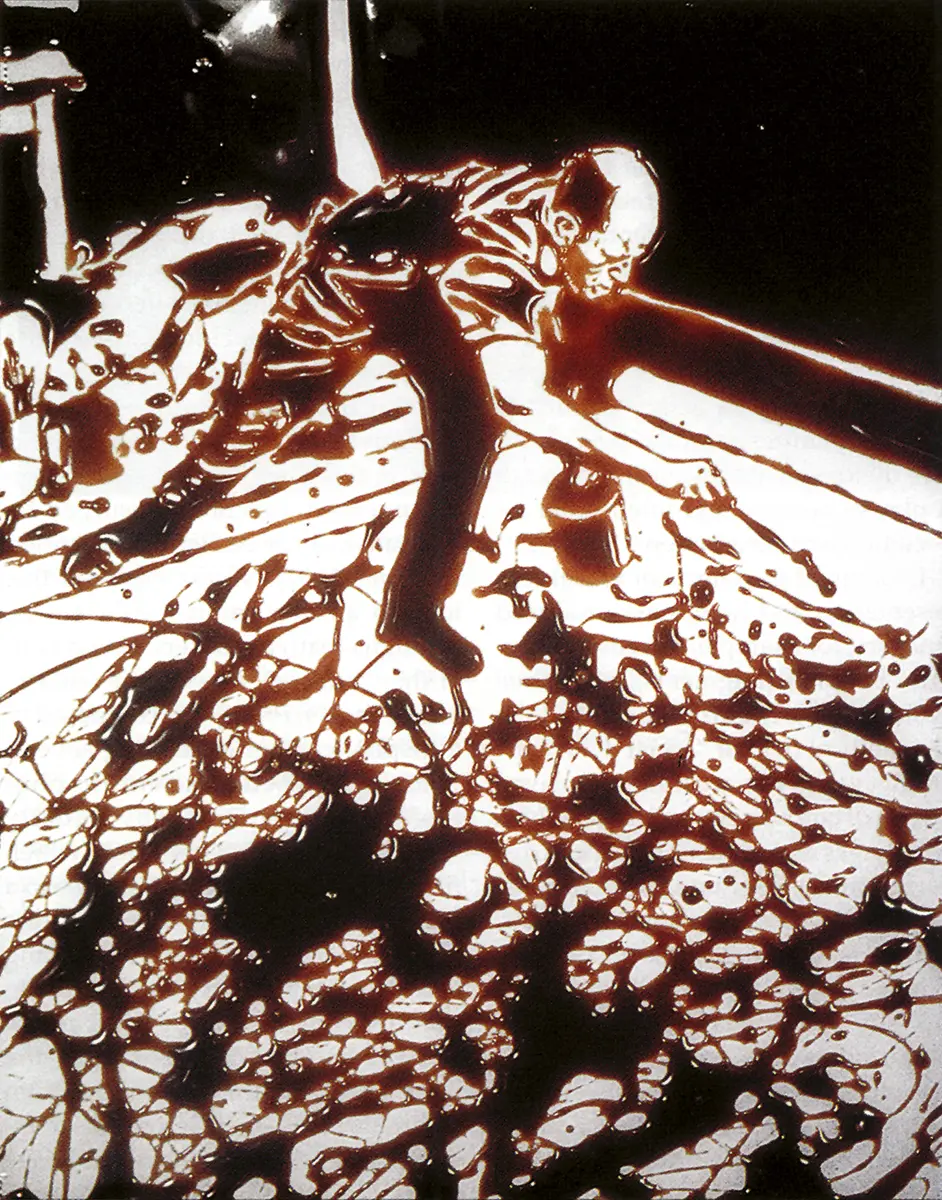
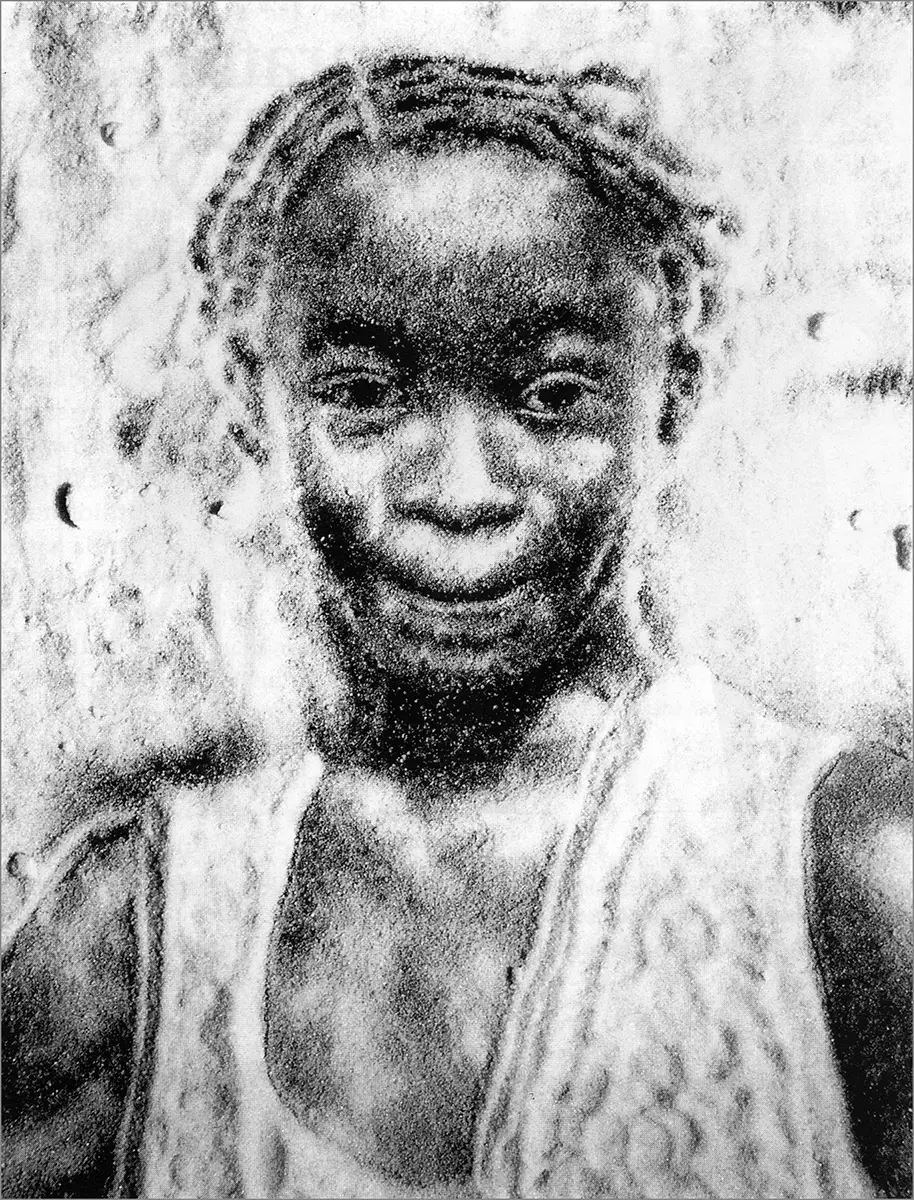
Beyond the field of visual perception, a three-dimensional relationship in Muniz’s pictures is established between the creative process, medium, and content. In The Sugar Children series (1996), the artist made portraits of children whose parents worked in sugar plantations by sprinkling sugar on black cards and then photographing the composition. The sugar used for each portrait was then stored inside glass jars labeled, as a commercial product, with photographs of each respective child. In the series Aftermath (1998), ghostly-looking white portraits of street children emerge from or disappear into a gray background of litter, mildly brightened by celebratory Carnival references. In this case, the children’s lost childhood is emphasized by the contrast between their smiling or oblivious expressions, the colorful confetti, and the waste that surrounds them. The successful use of a particular medium will call for corresponding themes and vice-versa, depending on what came first… Chocolate, for example, has inspired several pictures based on its symbolic connotations, as well as its plastic qualities. A portrait of the father of psychoanalysis would not have been created with ketchup, for example, since chocolate has a series of psychological and emotional associations related to Freud’s theories, such as sensory pleasure, overindulgence, and compulsive tendencies, as well as absence and depression. At the same time, being a viscous and glossy substance akin to oil paint, but one that the artist has to manipulate with speed, chocolate was also used for other pictures such as Action Photo, After Hans Namuth, 1997, in which Muniz echoed Jackson Pollock’s action painting by depicting the artist at work through the use of a similarly fast and drip procedure, with chocolate.
A unique feature of Vik Muniz’s pictures lies in their visual and conceptual irony. They convey meaning and emotion with a visual strength that contradicts their technical form and “reproduced” status. Muniz’s work is conceptual and romanticist at the same time. Formally, they are photographs imbued with the grandeur and uniqueness of a historical oil painting. In The Work of Art in the Age of Mechanical Reproduction, (1935) Walter Benjamin described the element that characterized this uniqueness as the “aura” of a work of art. He drew a clear analogy based on “natural objects” to explain this notion: the aura is defined as “the unique phenomenon of a distance, however close it may be. If, while resting on a summer afternoon, you follow with your eyes a mountain range on the horizon or a branch which casts its shadow over you, you experience the aura of those mountains, of that branch.” Benjamin believed that the aura of a work of art had to be destroyed in order for art to become more politicized and emancipated from tradition, and he believed that this would be produced through mechanical reproduction. Photography was a key instrument for eliminating the “distance” that preserved the unattainable essence of the work of art. However, as image reproduction multiplied excessively and today, with digital and virtual communication, has become accessible and directly manipulative through a simple personal computer, free of charge and copyright restrictions, the distance between duplicate and original can no longer be traced. The aura of an original object and artwork has been lost and so has the logic of its reproduction. Muniz has thus inverted this process by interpreting with spontaneous creativity either a reproduction of an old image or the semblance of a common object, shape, or idea and then reproducing it again in the final photograph. And in so doing, ironically retrieves the aura ascribed only to nature and “Fine Art,” by means of the mechanical instrument and ideology that once eliminated it. A final consideration left for the viewer to reflect upon regards the innate reproducible nature of Vik Muniz’s pictures: other than seeing and unraveling the visual discourse presented in his images, how does their potential reproduction fit into this story?
NOTES
1. Walter Benjamin, The Work of Art in the Age of Mechanical Reproduction, 1935.
2. Interview with Charles Stainback in Vik Muniz: Seeing is Believing, Santa Fe: Arena Editions, 1998, p.15.
3. Interview with Charles Stainback in Vik Muniz: Seeing is Believing, Santa Fe: Arena Editions, 1998, pp.17-18.
VERÓNICA CORDEIRO