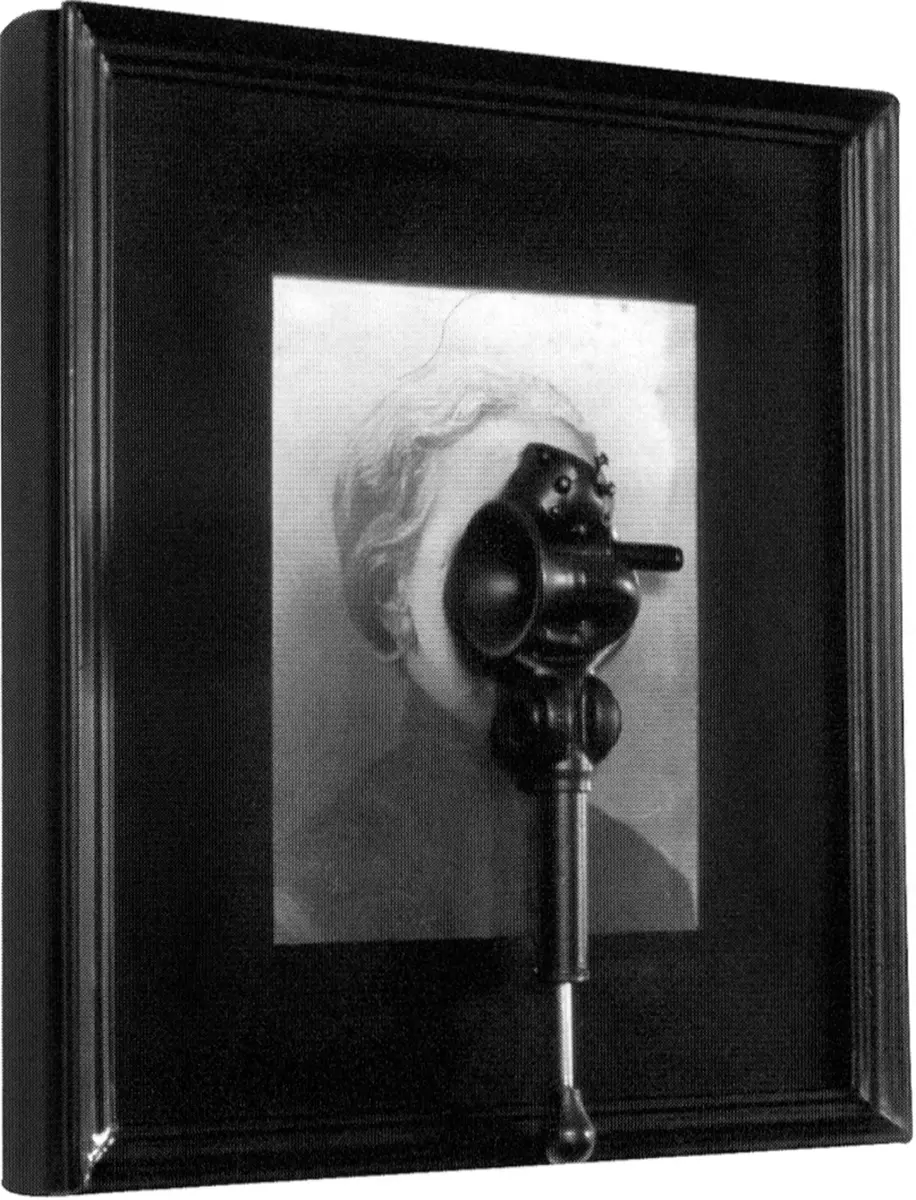
With Bernardo Salcedo learned that an everyday object such as a box is capable of holding body parts, useless institutional phrases, or saw blades as metaphors for the sea. With his works, we could illustrate the importance of art in this incomprehensible world. The trick lies in finding a simple but efficient form—a box, a tripod, a rectangle such as a frame or a photograph, or the precise word—to allow the context’s complexity to burst forward. To enter Bernardo Salcedo’s exhibition is to corroborate the legacy of a period and a sensibility such as that of Neorealism or Pop Art. This legacy insists that the artist is a part of the world and he/she perceives things around without classifying them as banal or transcendental; they’re just used differently. In Salcedo’s case, the merging of disparate things generates in the spectator’s mind an idea that ends up eroding education and tradition, perhaps culture in general, underlining it as static, repetitive, or inoperative. In the final analysis, Salcedo’s show proves that there isn’t such a thing as a useless object; to the contrary, the useless ones are some of our concepts. Through that operation, his work is a lesson on the history of culture with all its contradictions, said as only an artist could whose thought evades the powers that be and is in constant movement. Bernardo Salcedo was born in Bogota in 1939. He studied architecture and sociology. He taught at the university level, and his influence on his students is known as decisive in breaking away from what was learned in high school. He has taken part in numerous international events and his works display a whole world’s worth of references. (María Iovino, the show’s curator, confirms their variety and multiplicity, starting from the spaces of his childhood —his father’s baggage depot, the theatre, and the construction of Nativity set at the Bojacá church.) Salcedo later became interested in architecture and piano but also took a job as the creative director in an advertising agency. Through all of this, we see the series of references to art history that Salcedo has used at will. We see a crossroads between Surrealism and Dadaism, with Neorealism and Pop, but we always encounter a self-taught mind navigating through a space of fragments that the artist has arranged as he has seen fit. Iovino highlights cinema as a main influence, which she sees reflected in the “emotional order” found in many of Salcedo’s pieces. The exhibit held in the Biblioteca Luis Ángel Arango’s halls opened with Las cajas blancas (The White Boxes) (1966-1979), assemblages of objects on open boxes, or frame-boxes on the wall. Their contents are not alien to the melodrama serving as the narrative base for cinema and television—the cultural boxes par excellence— and newspaper news as well. The bundles of mannequins are as sinister as a suspense film. Beatriz amaba el control de la natalidad (Beatrice Loved Birth Control) is an assemblage of eggs and the hands of children. La valija de Lola (Lola’s Valise) features a poison atomizer protruding out of a suitcase filled with the hands of seemingly shipwrecked children. Melodrama en un acto (One-Act Melodrama) surprises with a delicate, feminine hand holding a funnel with a child’s leg growing out of it. Instantáneas de la creación (A Snapshot of Creation) is a sketch of the dialogue between the hands in the Sistine Chapel. Virgen de Bojacá (Virgin of Bojacá) is built from fragments of mannequins with fixed, unsettling eyes like those found in colonial sculptures. In Huída de Egipto (Flight from Egypt) are small feet running away. El viaje (el enmaletado) [The Trip (The One Inside the Suitcase)], based on a news item from the newspaper, is a travel suitcase in which a human body has been neatly tucked in—an assemblage anticipating what lay ahead in the country’s history. In a circular hall was exhibited La hectárea de heno (The Hectare of Hay), from 1970. Made out of 500 tagged and numbered plastic bags filled with hay, they amount, bundled together, to one arable hectare. On the walls surrounding it we found the Cajas elementales (Elemental Boxes), whose contents can be seen through opaque glass panes. This sensation of diffusion makes us think that the uninspired reality they hold—rice, beans, shoes, and a blond wig that reminds us of Sharon Tate—can be easily forgotten. That is if someone’s actually interested. This perception becomes even more incisive in La Caja Agraria y su sucursal (The Bureau of Agriculture and its branch), since here we find only paja (a Spanish word that stands for both “hay” and “empty talk”). And Minifundio (Small Farmstead), is made of a box containing soil as if it were the remains of erosion. In the country’s recent history, the country folk seem distant and unresolved; the violence intensified and thousands were displaced. An artist’s simple and accurate materialization ends up reminding us of the true story. At the end of this hall were Frases de cajón (Stock Phrases), from 1975, guava paste boxes showing phrases such as "Colombia’s Total Victory," "The Cost of Living is Down," "The Strike was a Failure," and many others. Originally, there were around 150 boxes. The phrases continue being uttered today; they have the same syntax as phrases distanced from reality. At first, this lack of correspondence between a static language and real events is what makes us laugh. But 30 years later, they lead us to think that what we’ve lived through in Colombia is really just a piece of fiction—or a lousy movie. On the back wall of this same hall, the spectator was able to see, once more, Los bodegones (Still Lifes), from 1972. Originally there had been wire fences holding three huge signs: “A cabbage (there’s nothing more)”; “On a table there’s a pineapple, two onions, and we can see two bowls”; and “Two oranges (by themselves).” Words take shape in the spectator’s mind, and Salcedo’s work is refined within the spirit of the 1970s when he proposed that we are imagined by the culture into which we are born and the language we learn. This gives more importance to these history lessons. La primera lección (First Lesson) from1970, is made up of five fences; the artist erases the symbols no longer present in the Colombian coat-of-arms, and he underlines it with language: “There are no condors, There’s no horn of plenty, There’s no liberty, There’s no canal, There are no coat-of-arms. There’s no country.” Before climbing to the second floor, the spectator could see the drawings done on school-type paper. Los castigos escolares (School Punishments), from 1970, for example, repeats over and over the phrase “time is gold.” The method persists and produces another one that repeats the phrase, “I shouldn’t stay up all night,” somewhat impatiently. Then come the drawings with the innumerable “Operations,” “Calculations,” and “Multiplications” (some shaped as calculators) that the news subjects us to, and then the Listas de mercado (Market Lists), the protagonists of daily life. But this does not prevent Salcedo from making Las notas sobre el cielo (The Notes on the Sky), Hojas sobre el mar (Leaves on the Ocean), and Acuarelas a la lata (Watercolors a la Tin Can), from 1976, which emphasize the support on which they’re constructed. These travails through official culturedom and its endless lists seemed to have bored Salcedo with their repeated stereotypes. He became interested in more serious themes such as the sea and the sky and their metaphors. In order to expand meaning, he combines with the other signs the static signs he finds. Thus, on the second floor, we saw the boxes containing saw blades as metaphors for the sea, and pieces of glass as rain (1983-1985). And then we reached the photographs from 1989, mostly antique photographs of people whose history we tend to ignore. Salcedo tells their history in his own way, gluing onto the photographs different objects and relating the image, saved in a deposit, with a wider world of ideas. A fox tail over a woman’s face turns her into a zorra (vixen); a pair of shears become Mirada cortante (Cutting Gaze). There are photos of institutions or military groups that Salcedo makes more uniform by placing, over each head, beans or seeds, or screws. In his incursions into metaphor, wood, and buckshot become Cielos de plomo (Leaden Skies, 1986). In Música doblada (Dubbed Music), 1983, an acetate disc cut in half and perched on a tripod could have a better existence in language and memory than in an antique shop. Salcedo’s minimalist iron houses (1995) could become, in a dialogue with a real object, Casa por cárcel (House Arrest). The show ended with some of the public sculpture projects that Salcedo has done in Medellín and Bogotá.
NATALIA GUTIÉRREZ