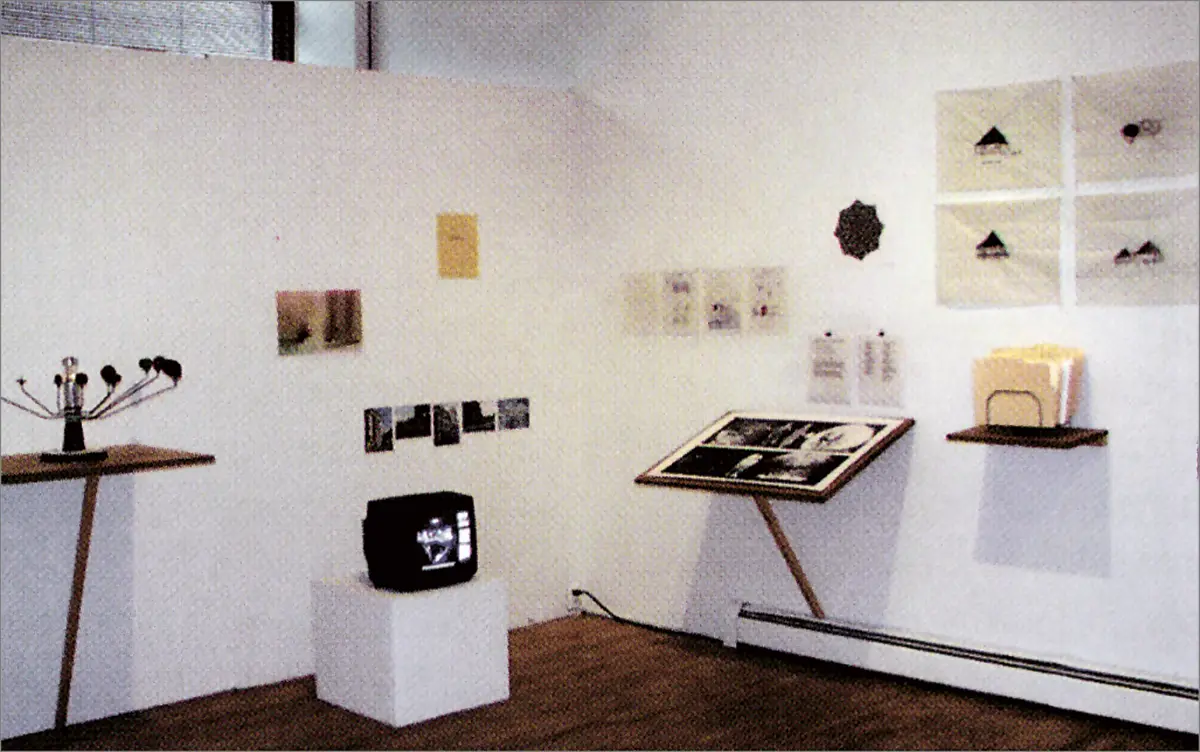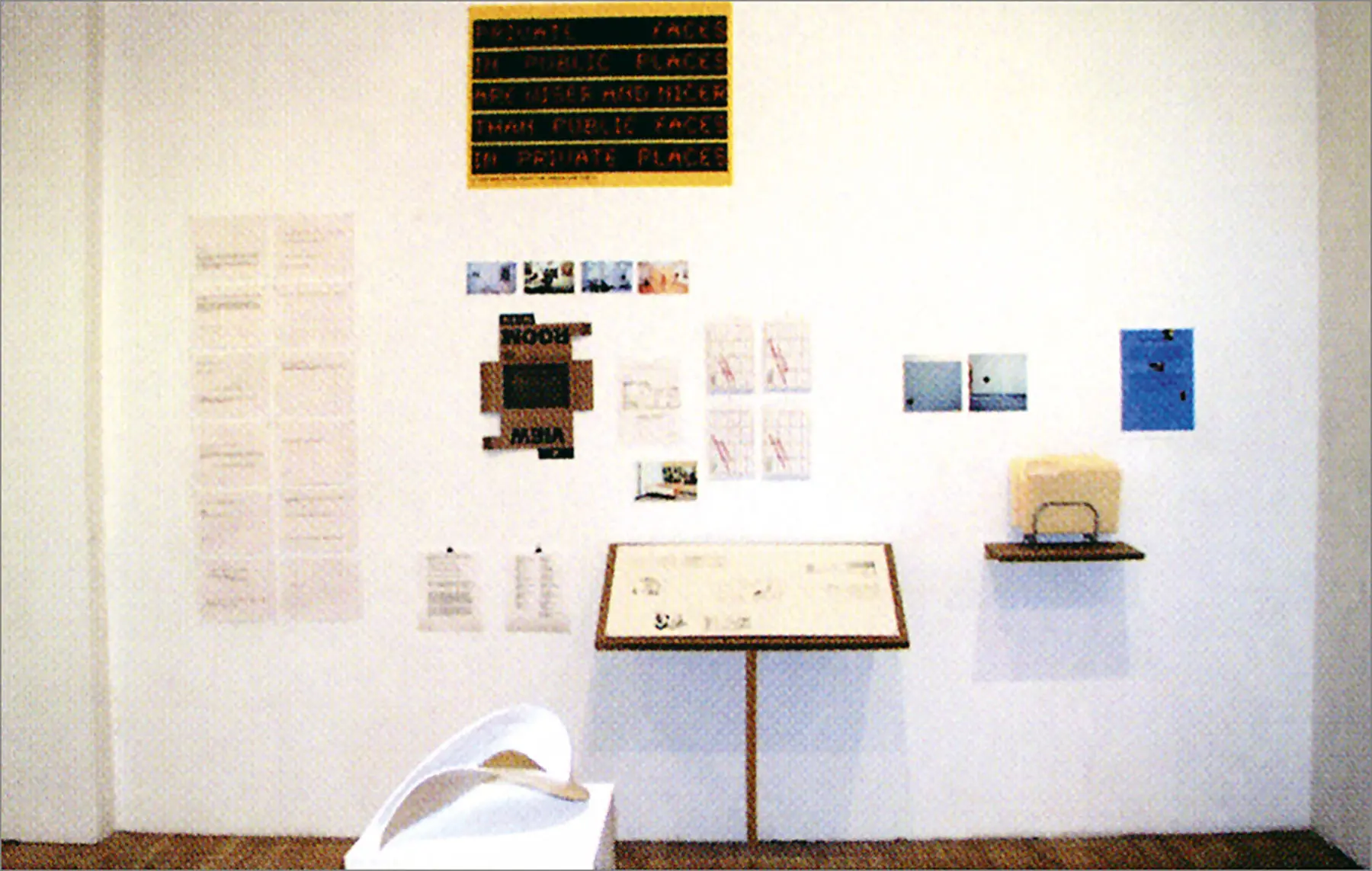
After leaving its first venue, the Museo Alejandro Orozco in Caracas, the show Demonstration Room: Ideal House had its second stopover at Apex Art in New York, from February 7 to March 10. The Venezuelan curators Jesús Fuenmayor and Julieta González called upon 25 artists to tackle the general problem of the house as utopic space. The show intended to use architecture as a discipline or border, observing the topic of the habitation unit from the artist’s distanced perspective. In this sense, Demonstration Room can be understood as another attempt to position the artist as a figure capable of activating, in the fictional realm of the work of art, architecture’s potential, not so much as a symbol of the statu quo—in other words, as a discipline inevitably linked to the crossroads of power—but as a critical language.
The project’s title, Demonstration Room, makes reference to the exhibit spaces for modern art that El Lissitzky designed in Dresden and Hannover at the end of the 1920s. Through these two curatorial projects, Lissitzky’s aim was to effectively activate the relationship between the spectator and the works shown. In general, the halls proposed an aesthetic that was coherent with the work, and this coherence of language opened the possibility of optimum contemplation and participation. Instead of being white planes, the walls changed colors according to the position of the spectator, adding an optic and phenomenological dimension to the gallery’s architecture. The paintings shown could be revealed or hidden through a system of sliding panels that could be manipulated by the visitors. As the title suggests, this type of project was inspired by scientific models, particularly in the notion of the hypothetical postulate as a privileged way of knowing reality.
The title and topic of the González and Fuenmayor project worked in such a fashion, that the concept of house appeared as a model and metaphor for the individual and the society at large. Thus, each proposal included in the show promised to define itself as a theorem, as a perfect (or critical) unit for a person or a society—real or imagined. On the other hand, once again at the level of the curatorial proposal, the experimental cry for “demonstration space” could be applied either to the works or the show itself: the concept referred both to the house’s thematic unit as the space where a utopian thought could be projected, and the show as a laboratory of ideas.
In the Caracas version, the exhibit space was designed as a studio of architecture, in which the works were installed in a sequence of autonomous modules or work units. Since the Apex Art Gallery is small, the idea of a work unit became less explicit. The works were divided into thematic nuclei signaled by a series of platforms with folders containing information on the artists and their work. The thematic nuclei were: the cushicle, which included works referencing, in a more or less abstract fashion, mobile homes; the shanty or ranch, which included works that literally elaborated questions surrounding some precarious types of Latin American dwellings; and Gesamtkunstwerk, which grouped projects of domestic utopias emphasizing the totality of the experience.
The artists were extremely open and diverse in their interpretation and development of the ideal house. At the gallery’s entrance, Liam Gillick painted a geometrical, labyrinth-like mural acting as the décor of an office lobby. Karin Schneider worked on the theme of International Style and its relationship with the internationalization of icons of consumption. Her Coca-Cola House is a domestic system of refrigeration whose freezer is a model of Philip Johnson’s Glass House. Inside it, there’s a can of Coca-Cola that the visitor can drink and replace with another can, which can found in what is the bathroom in Johnson’s project. José Antonio Hernández-Díez published a series of classified ads in the local press in which he requested dwellings specifying characteristics that made direct reference to the other works shown (the classified ads were distributed throughout the gallery). As a domestic utopia, Meyer Vaisman presented a sequence of photo stills from Scarface, the movie starring Al Pacino and Michelle Pfeiffer. To finish, and to give an idea of the variety of the proposals, Diana López equaled the notion of the ideal house with a moveable property: her work was a phrase that read, “A pair of blue jeans and $25,000 in your pocket.”
If the project’s concept was solid, the experience of the exhibit in itself was somehow problematic due to the contrast between the strong presence of some of the works (be it an object, photograph, or video) and the comparative weakness of the works that were presented as projects or drafts. I don’t wish to undermine the exhibit’s notion of project—which is central to it, given its “utopian” or “architectural” character—but to highlight the problems visitors face with this show that has a faceted and complex texture. For example, the Brazilian Ernesto Neto participated with a drawing, Study for Nude Plasmic, located inside one of the spaces that could be entered. In this case, the drawing’s “project” status didn’t seem like an appropriate representation of a clearly material work, in which the sensuality of the experience of space and the materialness of the piece is more important than the idea that can be reflected in a drawing.
INÉS KATZENSTEIN