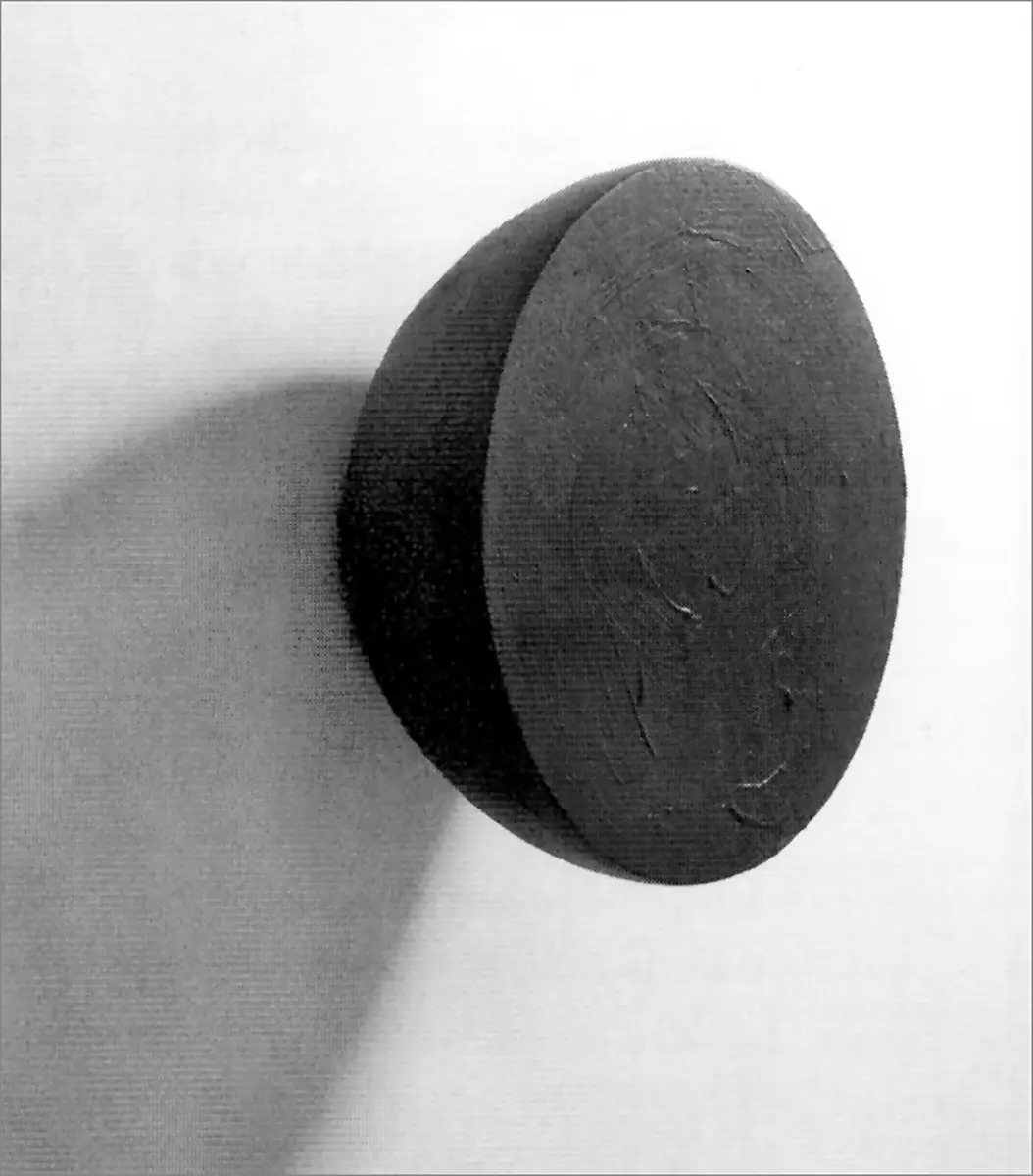
Without a doubt, many painters have confronted a can of acrylic paint that has solidified with time and has turned into a sort of cylinder —brilliant, sculptural, mysterious, a partial replica of emptiness. Surely, many of them rescued that volume and stashed it away knowing that the object contained an as yet undeciphered secret. By persisting on this question, Eduardo Costa discovered a profile that he improved in purity until he was able to squeeze out all the perversion locked in that small accident. His show at the Cecilia Gallery is all about that. Costa, accustomed to a conceptual approach to art since the beginning of his career in the late 1960s, sees in this chunk of pigment a sort of archetype of painting, a painting of paintings, a painting made out of paint. For this reason, his action is paradoxical, since it proposes rescuing the painting by opening a new path perceived from a linguistic point of view while at the same time it remains as matter. The path that Costa treads is complex. First, he deconstructed the still life, a classic mode of pictorial representation. This led him to paint lemons, vegetables, flowers, napkins, tools, and containers starting from nothing until they reached their real volume, accumulating infinite coats of acrylic paint. One series was white, but his other trials meticulously respected the color variations inherent in the fruits. His current exhibit shows another step forward in this process. By disarticulating the discourse of painting, he re-articulates the discourse of contemporary art. Costa exhibits geometrical volumes painted in primary colors, created from scratch until they achieve considerable dimension and weight. Spheres and prisms subjected to vertical planes serving as walls, seem to defy the force of gravity. Truly they demand to be seen not as sculptures but as pertinent to painting’s virtual space. Although the immediate references border on modernism, Mondrian, Malevich, and the Bauhaus, and go into reductionist minimalism, all relate to a legacy that Costa recognizes, incorporates, and subverts —and not without a hint of nostalgia. His operation is meta-pictorial. He thus uses representation, though the mediator of this representation is an abstract figure. The works’ character, far from being cold and concrete, is enigmatic, discreet. Made entirely from paint, these works show vaguely their condition through their titles. Among them, we find White Sphere with Black Invisible Core, which is a good example of the poetic reach that these “volumetric paintings” are able to achieve. The piece’s title reflects an unprovable truth, without which the body of work would lose all its meaning. A carefully done catalog was published to accompany the show. In it, an essay written by Alexander Alberro and the reprinting of an interview by John Perreault trace a chronology of Costa’s work and the circumstances under which his ideas have spawned. The catalog is gladly received as it helps visualize this new body of works inside the context of a trajectory of work and reflection.
ANA TISCORNIA