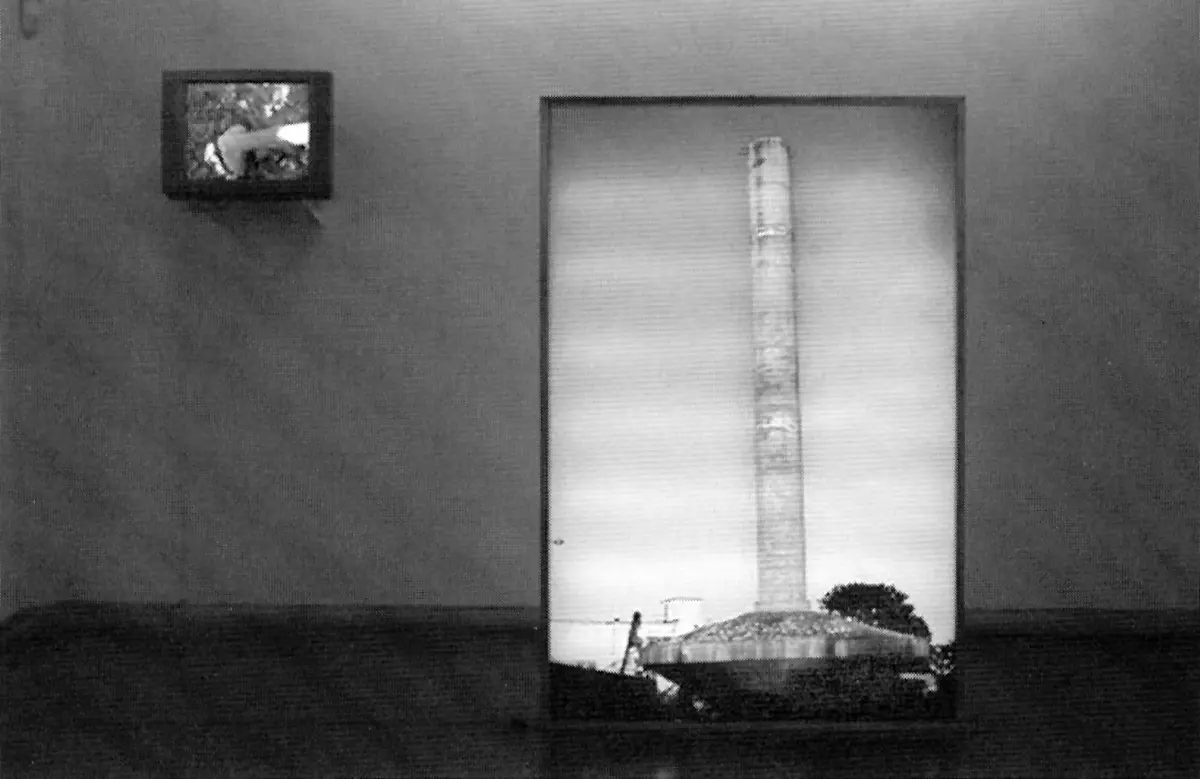
Manuel Piña’s last show was a four-hand piece with Ernesto Leal. They couldn’t have joined two better candidates to create, through photography, topologies surrounding a topic that one way or another obsesses both of them: utopia, in this case, understood as synonymous with a society with true social justice. It would be interesting to see what those who pigeonhole art, characterizing it by periods or moments, and who have established the 1980s as a period of social criticism in Cuban art, think of this show presented in 2001. Despite its cryptic style, this commentary on today’s Cuban society still asks many questions about it.
If we apply the synonyms employed in Sainz Robles’ dictionary, we can observe that, during the 80s and today as well, the viewer can choose to place himself in one of two perspectives in order to decide what kind of “criticism” any given artist uses. If only two synonyms are used, critique can only be an analysis or an appreciation. If negative synonyms are used, then the artist could be reproving, reproaching, mocking, or hurling diatribes. The hues of the language are interesting, especially in Spanish. But let’s not be confused by them.
When dealing with Piña and Leal, we must slow down and take one step at a time. Let’s observe the show’s title: Civiles en shock (Civilians in Shock). To start with, what’s a civilian? Who are here the civilians—the viewers or the artists? Why are they in shock? Why are the artists using a term in English? The hermetic show—and its even more hermetic creators, who aren’t saying much about it—raises many questions. It seems that the artists are having fun at the public’s expense as they find themselves questioned and embarrassed, trying to unravel the mysterious pieces loaded with concepts whose meanings are hidden from the uninformed visitor.
Going back to the dictionary, a civilian is a citizen. In Cuba, where things have different connotations than in other parts of the world, this apparently banal truth stands out like a sore thumb. Contextually, it should be “compañeros in shock.” On the other hand, English would not be the best language with which to address a compañero. Perhaps we should have said, compañeros choqueados (a Spanish word derived from shock) or “scandalized compañeros.” And since this is not the case, perhaps Piña’s and Leal’s show denotes another time, another stage of Cuban society where “civil” was synonymous with “civic” or “civility.”
I’m talking about a moment when the press is using terms such as “individual responsibility,” and “paternalistic state.” Perhaps the moment has come when there’s a need for more civic citizens instead of compañeros. It wouldn’t be only an issue of terminology, but with attitude also. We have seen that at certain times, behind some compañeros there are qualities that aren’t in accordance with the mentality of someone who dreams of a more just society.
When Piña and Leal —using digital technology, video, and the light box, along with more conventional photographic resources mixed with something more “crafty,” like asphaltite on printing paper— “criticize” today’s Cuban society, they launch a diatribe against what for them prevents utopia from happening. They make it stop from within itself: paralyzing self-censorship, paranoia (I’m referring to the sparring sessions between Cuba and the U.S., and what our country does in terms of defending itself, justifying certain control—not civilian—and, by extension, allowing a somewhat paranoid behavior on the people’s part). The game the bureaucrat plays by being invested in power consists of situating himself in a position that allows him to castrate the illusions of those who build or yearn to build the utopia. More or less that’s where Piña’s and Leal’s questions seem to go.
As proof of these subjective interpretations (can there be any other kind when one is standing before a work of art?), we would have to refer to the pieces’ individual titles: Instituto superior de dobleagentes (Double Agent University), De monumentos (Of Monuments). Here Piña talks about history and its protagonists, but their image is nowhere to be found. Another example is Sobre la historia (Regarding History): a photo of a recent political rally, where we can overhear a recording of people Piña interviewed regarding the 1960s and the beginning of the revolutionary process, when utopia was the majority’s goal because, among other things, no one could imagine that the Soviet Union would cease to exist and help to Cuba would be severed.
What I couldn’t figure out, and the artists didn’t give me any answers to: was who were the ones scandalized or choqueados —the artists, or the show’s intended audience?
AMALINA BOMNIN