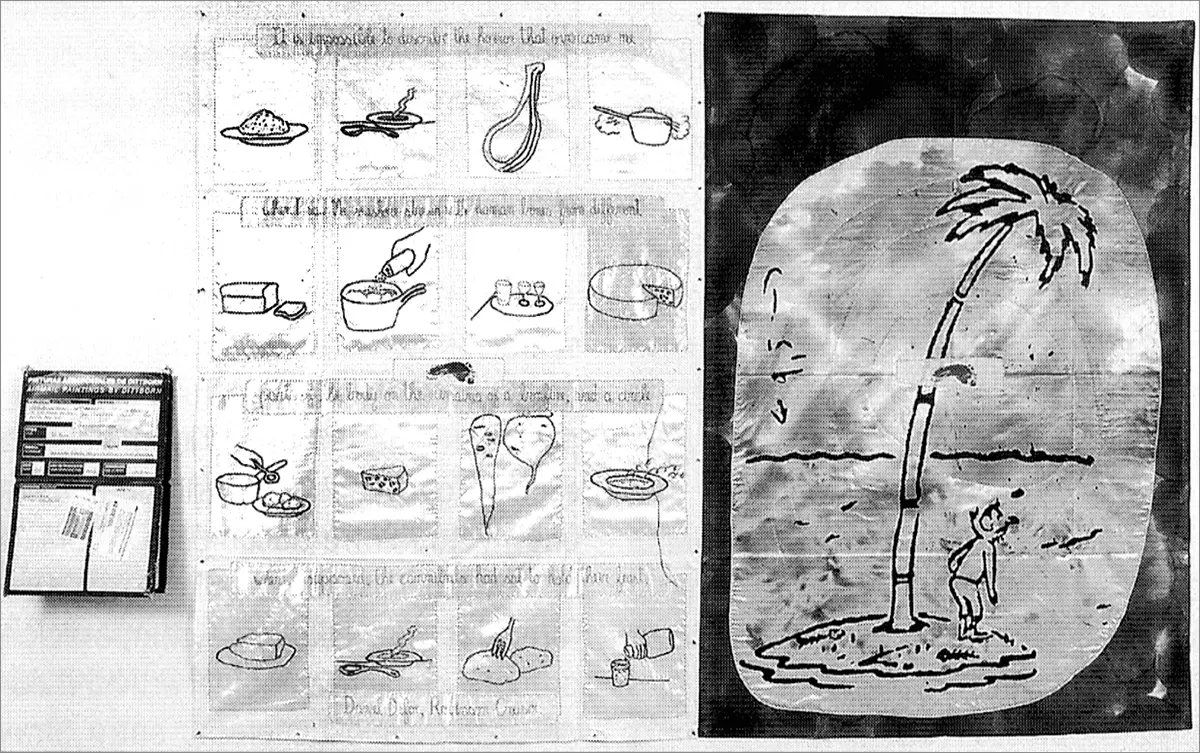
Mysterious, elegant, and a set of open arms, Eugenio Dittborn’s work goes beyond the concept of perception used for paintings, objects, or installations. Simply strong, made to resist the thrust of humanity, with the years it also becomes purer, more pristine—as it had been characterized by Ted Bonin, the gallerist. The aforementioned traits—mysterious, elegant, open, reaching beyond the work of art’s context of perception, pristine, strong, and resilient—belong to the work of someone who was born (in 1943) and has lived in Chile. To live in a faraway region creates an "elephant skin equivalent to a canvas—nothing escapes through its pores." Knowing how to live on the periphery is equivalent to producing something different from city walls, though the resulting object must be able to wage defense and self-defense. Dittborn has been producing precisely that since his first pieces in Arte Correo (Airmail Art). He used to paint in huge sections of kraft paper folded to a sixteenth of its original size. It’s on that brown paper—produced industrially even today for packages and envelopes—that the artist has been resolving his art since 1984. He placed each piece inside envelopes that were larger than normal. Then he sent (and continues sending) them via airmail to their exhibition/salvage destination. Salvage in the sense that they want to call attention to the animal kingdom’s human species. The envelopes had (and have) their peculiarities. They have been designed by Dittborn himself so as to receive on its surface the usual postal-office treatment but extended to the use given by the artist: "various deliveries and round trip accumulating references from the different stopovers." Before Airmail Art claimed its own space, artists like Käthe Kollwitz, besieged by the Nazis, searched for ways of salvaging their work and the messages their art could have in a time of genocide. We know of drawings quickly tucked in the pockets of anonymous travelers and/or inside letters carried by acquaintances. History repeats itself inexorably: Nazi Germany and Pinochet’s Chile are two historical and geographical poles in which nothing was respected. Due to the despicable appetite for extermination that humanity has developed, the artist finds ways to set in motion words, gestures, and salvage attempts. In the preface to the catalog, La cuisine et la guerre, Terrie Sultan says in reference to the exhibition, Siete Pinturas Postales (Seven Postal Paintings), held at the University of Houston Art Museum in May 2001: "In the same fashion as the Russian artists did during the 1960s and 70s, Chilean artists substituted body art, performance, photo-documentation, and street interventions for the production of art-oriented toward the object." We may add that those changes are substitutions in the chess of life: don’t expose yourself directly to death and get the work out of the “mined” territory. Dittborn maintains his deep relationship with paper, but he has also introduced changes in his work—the attitude of one who is active and permeable. He modifies materials, but the envelopes and each piece’s traveling remain a permanent framework. The conceptual structure is solidly embodied in the author in terms of format, medium, presentation, and the arrangement presented to the spectator. We could infer that Dittborn is saying: I’m a painter but not only a painter. These works of art aren’t subjected to the habitual canons of academic painting—nor of the well-known packaging, mailing, reception, and setup. In the recent show held at Alexander and Bonin, the pieces are worked on pristine cotton duck. The artist still uses his accustomed processes, but he’s also made changes and new contributions. The myriad elements chosen by the artist include images taken from comic strips, newspapers, drawings his daughter made as a child or years later through the computer, drawings made by a neighbor who doesn’t know how to draw, and sections of coloring books and drawings made by the patients of a psychiatric facility in Santiago. Mostly these are the sources the artist uses and reuses without ever being worn out in their reiteration. Photo-silkscreen is one of the media he uses most frequently to transfer the appropriated images onto the canvas. In some pieces, and in some shows as well, the same figure appears in different sizes and even on different opaque or glossy canvases of the same diptych or polyptych. This is proven by La pintura colgando aquí (The Painting Hanging Here). By presenting a theme more than once in the same piece, the artist alludes to, among other things, the seer’s diversity of vision—developed so during recent years, when the world has been fractured by social explosions, despite the fact that globalization politics seem to say the opposite. In this New York exhibit, the dittbornian envelopes accompanied the pieces. The changes became more noticeable after the contents were pulled out of the envelope. The cotton-duck support and the use of satin, on the one hand; the use of tincture on the support on the other, the configuration with seam, basting thread, and stitches acting as embroideries of differing intensities and different threads. Drawing with embroidery in black thread to create a figure on the satin level; stitching with white thread that gesticulates like something abstract as part of the working process associated also with celestial circuits... Once again, Dittborn proposes that there is more than one way to understand his work. He often works with vectors indicating opposite situations: through these, the spectator’s doubt is aroused -with the exception of birth, death, and uncertainty, nothing can be taken for granted in this world. The artist also maintains iconic-religious or sidereal allusions, highlighting the importance of the astral in primitive cultures. 127, 130, 131, 133, and 134 are the numbers identifying the five ArteCorreo/Airmail Painting envelopes. They were delivered on different dates to Tenth Avenue (where the Alexander and Bonin Gallery is located). Coinciding with the fact that an artist must not repeat himself, above all because the artist himself won’t tolerate it, the show’s five pieces had different amounts of parts, modules, and sizes. The Unborn Dittborn is a set of four sections on canvas, with pictorical gestures of violet tint, embroidered and seamed. It has irregular fragments stitched on the canvas, putting up with an air of innocence. When we see the use of thread and needle on these pieces, we’re reminded of Leonilson—the Brazilian artist who died quite young and left a consistent personal language in the use of thread and stitches to seriously implicate society during the advent of AIDS. Leonilson’s and Dittborn’s versions differ greatly. Still, they establish the change of roles that this society is witnessing. This alludes to the title of this exhibition, The Foreseen and Unforeseen Position of their Bodies.
GRACIELA KARTOFEL