
In an increasingly evident way, Gego’s work appears as one of the most creative, original, and moving oeuvres created in Venezuela. Although produced concurrently with the development of the kinetic movement, from today’s perspective it is seen as something totally different from any other Venezuelan art, and indeed, any of the international art of the last thirty or forty years. The way in which Gego expresses directly and indistinctly her themes in diverse media—drawing, etching, or sculpture—allows us to see that in her work the traditional limits between the different artistic techniques or modalities are dissolved or amalgamated from early on.
Born in Hamburg, Germany, in 1912, Gego (Gertrud Goldschmidt)1 arrived in Venezuela in 1939. She was the sixth of seven children born to a reputable Jewish family, bankers by tradition, and she graduated in 1938 as an architect-engineer from the School of Architecture at the Stuttgart Technical College (today the University of Stuttgart). Finding herself in the process of receiving her diploma on the eve of the Nazi escalation, Gego was the last member of the family to leave her country of origin. Therefore, it was her job to liquidate the family’s last belongings and to throw the key to their home into the river before emigrating, at twenty-seven years of age, to wherever the wind might take her.
We have always taken pleasure in thinking that the wind wanted to bring her to Venezuela. And there may be some truth in that, for the way in which she was given a visa and a work contract in Caracas seems marked by destiny. The lack of a resident visa had made it impossible for her to stay in London, where her family had taken refuge. Gego, who spoke no Spanish and had never thought of Latin America as an option, had tried to get a visa in London for some English-speaking country. But, still in Germany, and thinking about her eventual emigration, she had also sent her papers to some friends and, when she was no longer thinking about it, she received this concise message: “Visa OK. Contract to follow. Signed: Salomon, Caracas, Venezuela.” We should note that she did not have the slightest idea where Caracas was, nor Venezuela. But, faced with the need to keep her word to leave England, she made up her mind to accept that option. Here she soon met the German businessman Ernst Gunz, with whom she married in 1940, and with whom she had two children.
It is clear that Gego, from a very early age, had the rare wisdom of knowing how to accept what life gave her: places, people, and things. And here it gave her a suitable environment for her to unfurl her creative talent in a personal and independent fashion. We cannot imagine what or how her work might have been elsewhere, but we know that here, years later, after her divorce from Gunz, she met the publicist, drawer, painter, and sculptor Gerd Leufert, of Lithuanian-German origin. Having become her companion and guide, Leufert powerfully stimulated her innate abilities: “He taught me to see and to discover, something that is not learned in engineering or architecture.”
Perhaps due to her somewhat shy and reserved character, Gego began to work in a secluded, private way, and apparently with no pretensions of acquiring fame or notoriety. It is obvious that she was well informed of what was going on in the world, and at the beginning of her career she assumed some of the principles of constructivism. However, when Gego began to develop her work, in the middle of the ‘50s, constructivism was no longer in its initial stages, with its desire to have an effect on society. Nor was Gego in the right place, though at that time Venezuela was by no means isolated. In fact, the country was experiencing a decisive economic and social transformation based on oil production, which responded to the eagerness for modernity to awake in the country after the fall of the gomecista dictatorship.2
Through her relationship with the abstract-geometric artists of Venezuela, many of them recently returned from their Parisian adventure in order to collaborate with the works of the Ciudad Universitaria, by invitation of architect Carlos Raúl Villanueva, Gego and Leufert became interested in pure abstraction and they began to work in accord with the possibilities that geometry offered. Around 1955, Gego began to create drawings of parallel lines in pencil and ink, with no reference whatsoever to the real world. This would be the point of departure for her mature work, fundamentally dedicated to creating spatial configurations of wire that were transparent, aerial, and weightless.
Gego’s spirit was extremely free and her searches responded to her own need to investigate new creative possibilities on her own. Thus, she never totally integrated herself into the group of Venezuelan geometric abstract artists, rather she worked alone, step by step, somewhat in the margin of the country’s trends and trusting only herself and her own abilities.
Unlike a good part of our geometric abstract artists whose work was hatched in Paris while in contact with abstract artists who could be considered third generation,3 Gego’s work was born in Caracas from contact with the most progressive ideas of the period and in a climate of creative effervescence based on the study and knowledge of the great creators of the century. On the other hand, her visits to museums and galleries in New York, which she had the opportunity to enjoy in the ‘60s, were doubtless very important for the conciseness of some of her resources. It is very probable, for example, that in 1959-1960 she saw the Buckminster Fuller show at the Museum of Modern Art, as well as the room that that museum had dedicated to Richard Lippold, an influential sculptor of the period.4
Given its open, embroidered, and transparent character, and its propensity for curves, Gego’s work tends toward the dynamic. It seems to respond to a postwar context which could include the works of Naum Gabo and Antoine Pevsner,5 who, interested in the theories of nuclear physics, leaned toward a lively, undulating, and dynamic conception of abstract forms: a conception born of a thought that, instead of static forms, handles relations and functions. Around the middle of the ‘50s, this dynamic concept of forms would extend its search toward the optical processes, which in some cases would lead to kineticism.
However, since Gego never formulated in her work an intentional search for vibration or real or virtual movement in art (although some of her pieces from the early years come to produce such effects), it is hard to consider her a kinetic artist. Gego does not assume technology as a foundation for her investigations. Although her most frequent work material was wire or, during certain periods, strips of sheet metal, pegs, and even nylon cords, all industrial materials, probably due to the way in which the artist conceives, considers, and structures them, they find their industrial nature eroded in order to acquire an aesthetic nature.
But Gego’s goal was not aesthetic. Her work never hides or conceals the technical resources of construction. So, although her initial work could be placed in the general context of constructivist postwar tendencies, it is well known that it did not take her long to destabilize them, introducing multiple challenges into the orthodox conception of constructivism.
Line and Structure in Gego
We know that the sketch of a single line on a blank sheet of paper is enough to perceive the existence of space. And this is how Gego’s work emerges, moving from one line to many and from paper to real space. In real space, the line has a physical body (subtle though it may be), and spreading out into it and relating to other lines according to the desired structure requires points of support and articulations. In accordance with the way Gego conceived of the spatial unfolding of the lines, they must have been her points of support and connection, and modifying or changing her spatial proposals required other systems or modes of connection.
The changes from one structural system to another manifest changes in feeling, concept, and comprehension of the nature of space in itself and they underscore the objective and subjective relationship that the artist was established with it. They seem to respond to an increasingly large, profound, and vital vision of her qualities. Therefore, Gego’s work cannot be qualified outside of this process of structural change that indicates changes in vision. Having observed the differences that these structural changes produce, we perceive in them the existence of at least three major stages, a product of three ways of approaching their expressive elements.
Parallel Lines
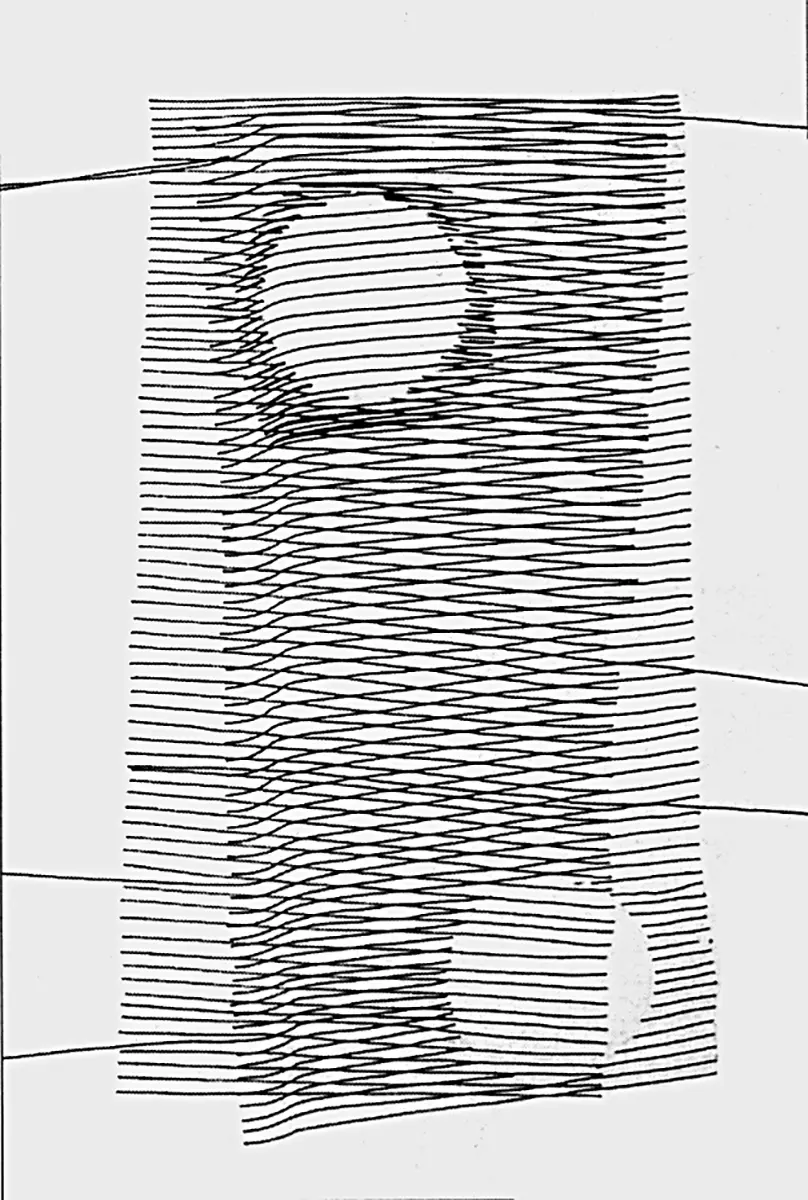
We could consider as a first stage the parallel lines began in 1957 and prolonged, although with important variations in materials, until approximately 1971. Possibly induced by kinetic developments, which in Venezuela were frequently expressed through parallel lines, Gego initiated her work by inscribing parallel lines on paper as a way of finding her own path in this process. The works seem to emerge in a spontaneous and natural way from a sort of internal, practically organic need among the lines, which does not hinder Gego from producing breaks and tensions in that field of typically parallel lines.
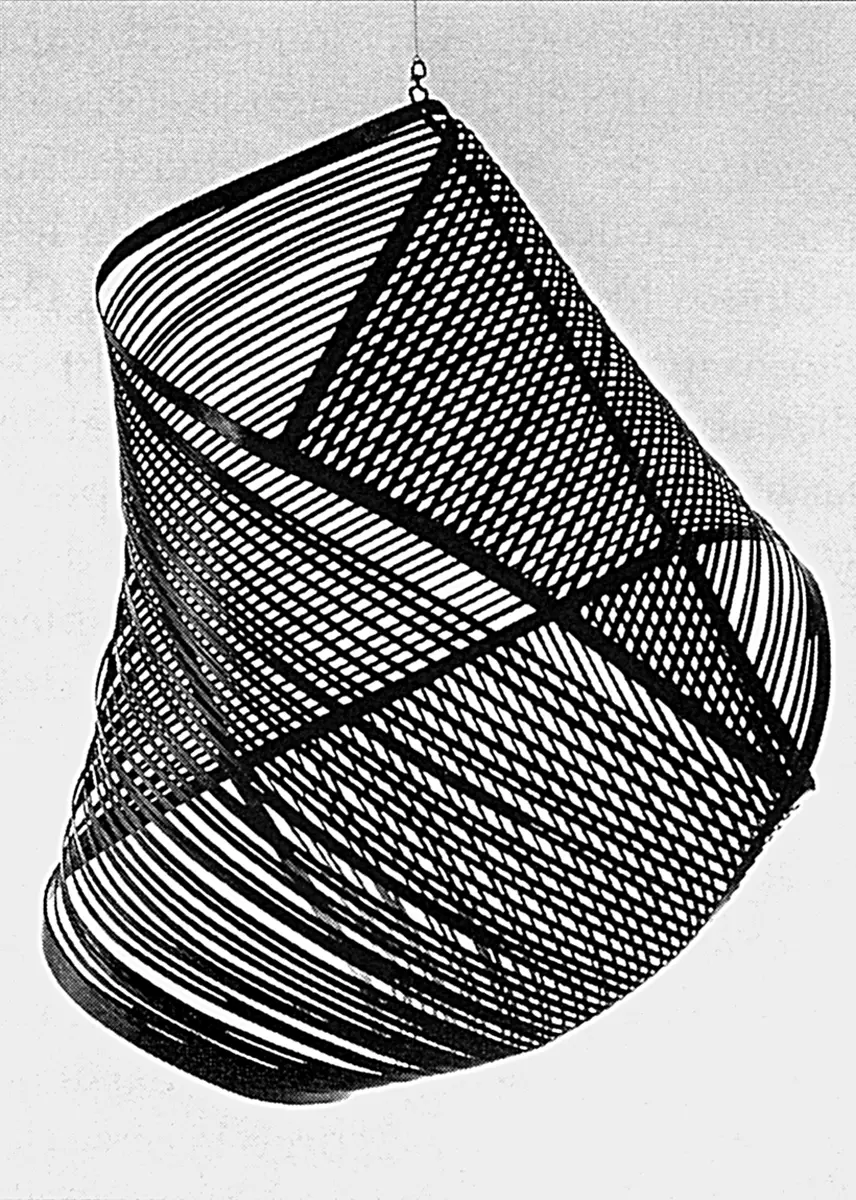
Gego’s sculptural work also emerges in her beginnings from experimentation with parallel lines, both in their concrete appearance (that is, in their material) as well as in their conceptual one. Since 1957, the artist tried diverse ways of configuring parallels as volumes in space: pieces conceived as planes of parallel lines in metal that curve and turn in space in order to close themselves off and produce volumes. In an exercise that seems grounded in the principles of topological mathematics, Gego investigates the different ways in which a sheet of metal (theoretically, a surface) can bend in order to achieve curved volumes.
It cannot be denied that some of these pieces, especially those that are presented hanging from the ceiling and, therefore, moving and turning, have a certain relationship with kinetic works, since motion, be it the viewer’s or the work’s, produces the virtual dematerialization of metallic lines.
In these early works, the artist has also possibly considered the space between the lines as a material. By showing the different metals painted black, she clearly highlights the filling of the void which, at times, also behaves like a form, that is, like a substance, but a negative, immaterial one. This makes us think that perhaps Gego considered the void, or space in general, as something active, not inert, just like, as we know today, matter composed of protons and electrons that spin at high speeds is active. This would illuminate her vision of space as a substantive part of sculpture.
She later conceives of another possibility of constructing three-dimensional forms in space, but no longer as curved, closed forms, but rather as planes intersected in different types of successions which, just like in drawings, expand in space, now in a vertical fashion, through repetition and a summation of equal or dissimilar elements.
All of these early works point out, above all, diverse attempts to construct volume starting from the plane, and the interest in taking into three-dimensional space forms that are theoretically two-dimensional. This indicates that in Gego’s work the lines on the plane are the foundation of her forms, even the volumetric ones.
Gego would also investigate the possible relationships between different pure volumetric bodies, especially the sphere and the cube, without abandoning the idea of the parallels. A good part of her sculptures, until around 1967, consists of planes—of parallel pegs—inside of which, through straight semi-circular cuts of diagonal planes that indicate internal planes or edges, cubes or spheres are revealed. Other works from the period also deal with empty spherical forms; in this case, they are inserted into volumes with a prismatic appearance. The rods that make up the planes of the prism, cut out in a circle in the center, allow us to see empty disks in which we may imagine a sphere.
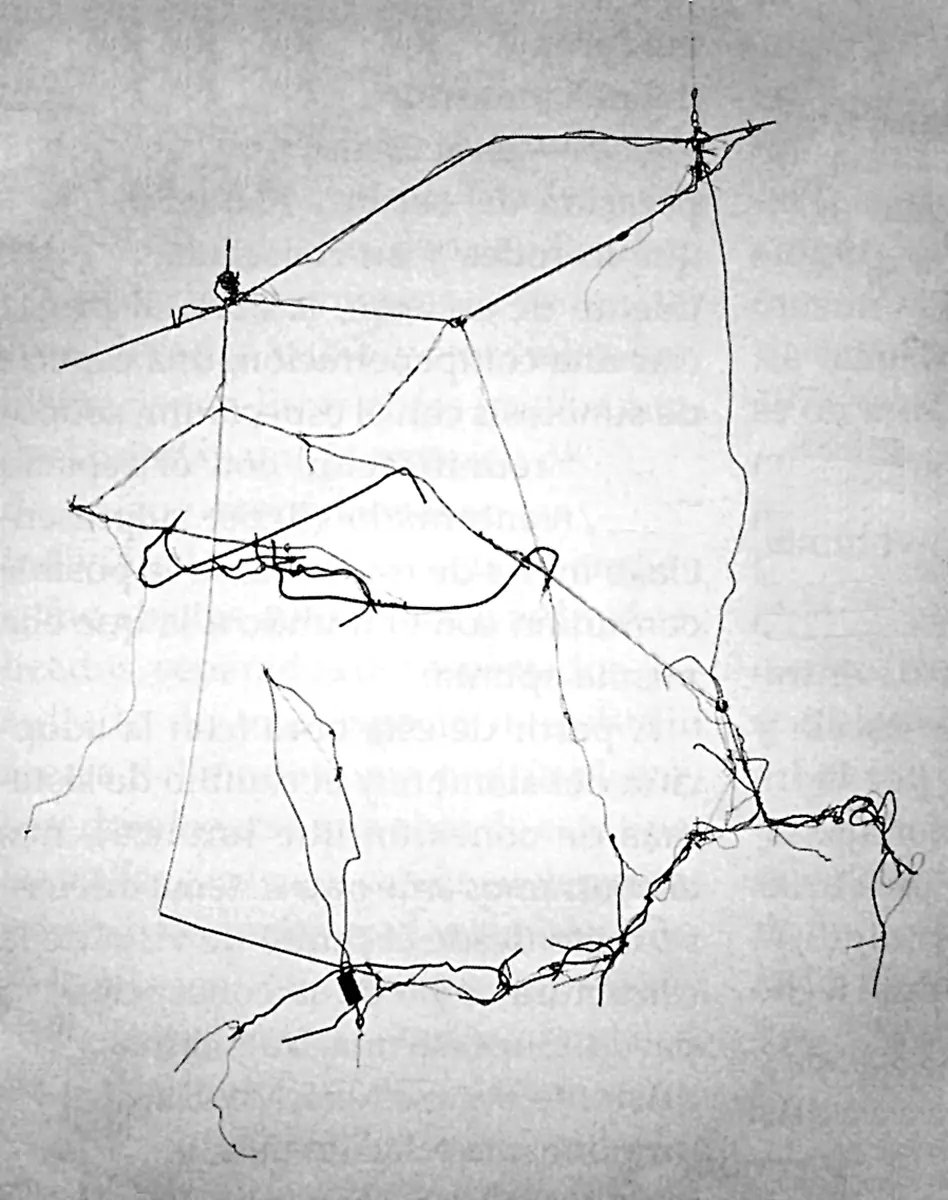
At the same time, around 1965, Gego experimented with smaller works in order to introduce deformations and ruptures (in structure, size, and materials) of the regular forms that she herself had created. These were small works that respond to a libertarian and experimentalist spirit, even one of transgression and mockery. These pieces, which Gego at times calls bichos (bugs), have all the freshness of spontaneous, uncalculated works, born directly from her own hand. Gego decides to use a series of heterodox and unconventional elements, previously not considered (such as wire, plastic or metal bobbins, and springs), in order to create her pieces manually, without welding. It seems to be a matter not only of trying to make her works without the need for outside help but also of experimenting with other materials that are easier to handle, with diverse colors and textures, which allows new and stimulating formal configurations.
After these works, Gego decided to substitute iron for wire, allowing her to decisively free herself of blacksmiths and welders. That would empower her to act as an artisan of her own work and it would allow her “to follow her immediate intention.” Thus, around 1969, the idea of parallels, now preferably vertical, became flexible to the point of nearly losing its character. Gego carried out a series of small works with fine stainless steel wires that protrude from a base or plinth, freely shifting upward in space like nearly parallel verticals, whether in gramineous growths or as curly lines. Frequently placed on a transparent Perspex base that accentuates its subtlety and weightlessness, these works have an almost immaterial look and they appear, depending on their illumination, as spurts of water or light projecting upward.
At the same time, and like many other artists of the period, Gego, occasionally with Leufert, had the opportunity to unfurl her works in the urban setting. Among the architectural activities that Gego carried out under the idea of parallel lines are Torre (Tower) and Mural (Mural) for the Cedíaz building in 1967, in collaboration with Leufert; the murals for the INCE building in 1969, in collaboration once more with Leufert (for one of them); Cuerdas (Strings, 1972) for the architectural work of Parque Central, and the free-standing piece Cinco pantallas (Five Screens, 1968-1971), located in the garden of the IVIC.
Reticulárea: Nets and Mesh
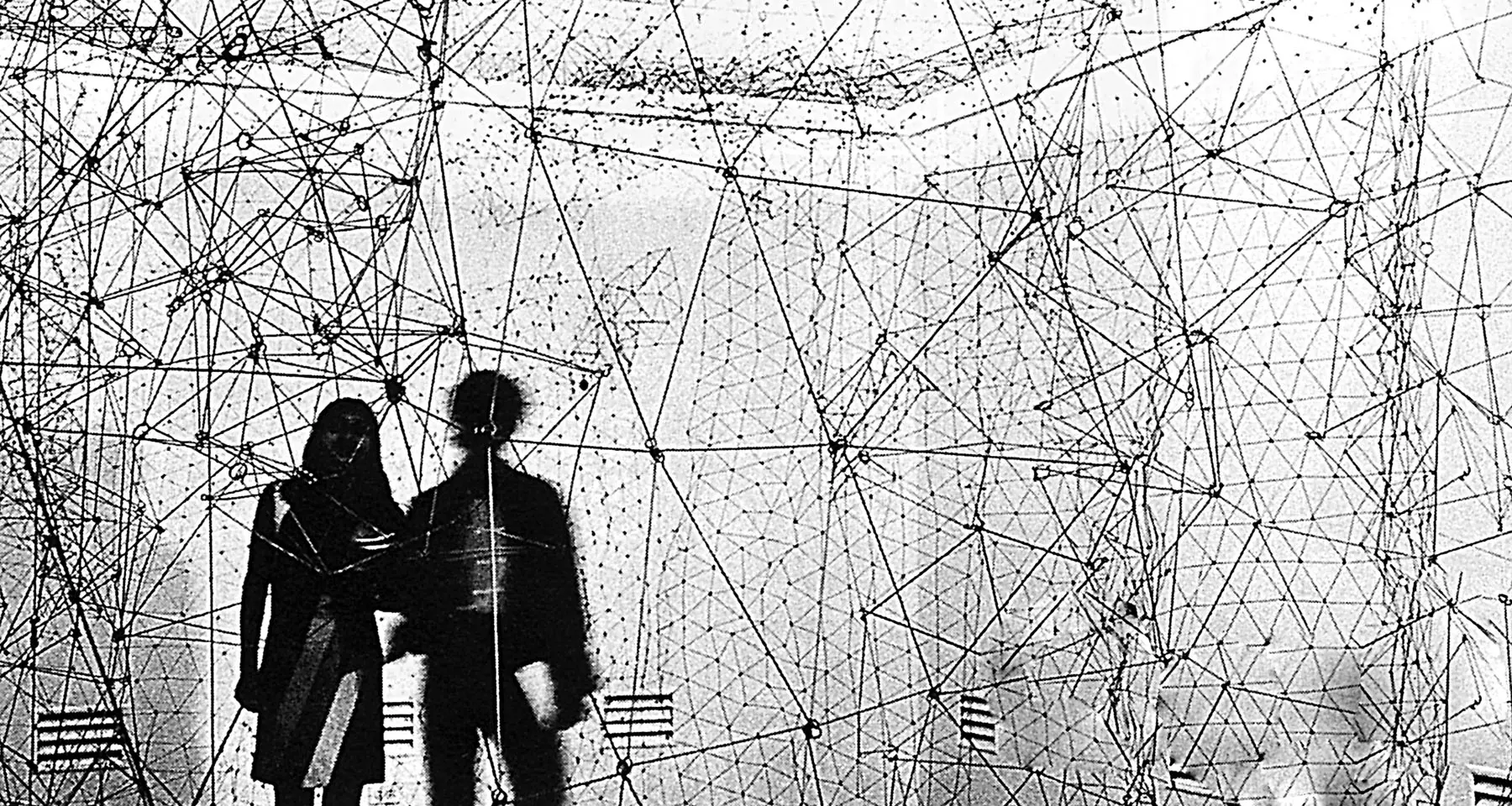
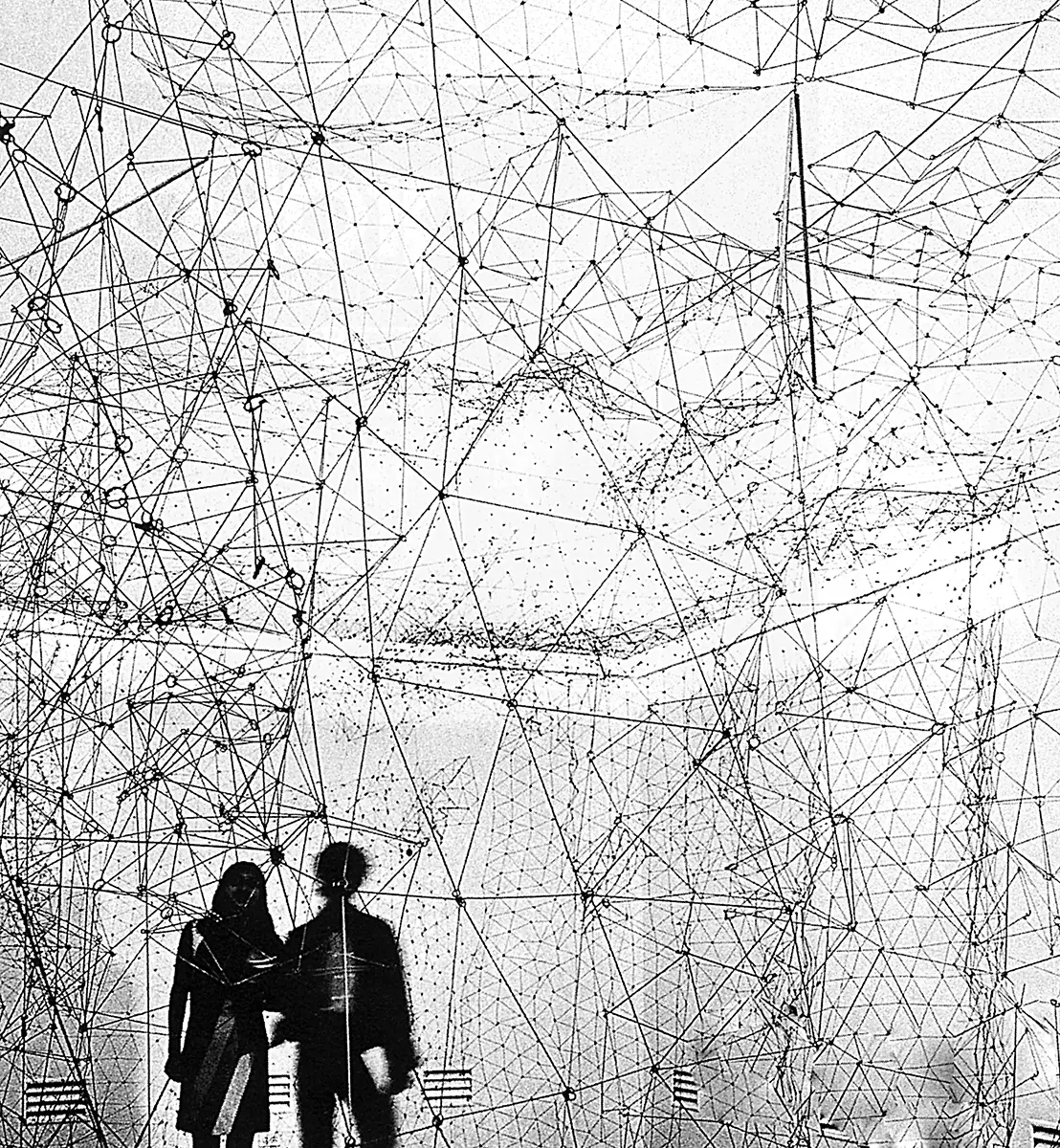
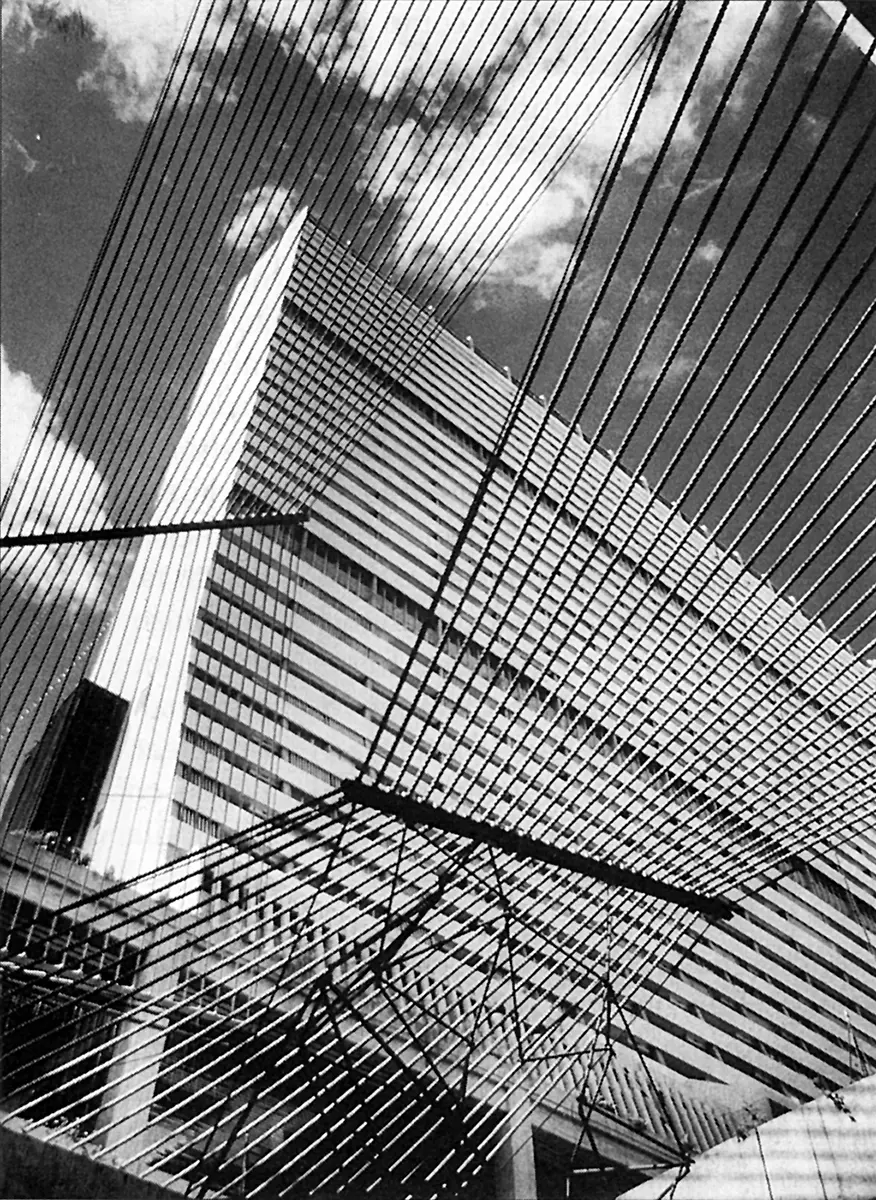
In June of 1969, Gego installed her in the Museum of Fine Arts of Caracas her piece Reticulárea, which represents a radical turn with respect to her previous work and which materialized, as a setting, in the very process of mounting the show in the museum. We believe that the artist could have obtained this idea of the geodesic domes from R. Buckminster Fuller or, perhaps, from architectural mesh in general, but her aspiration seems to have been to avoid, as she in effect does, all sense of effort and calculation.
The Reticulárea is such an astonishing work that from the very moment of its creation it has not stopped from provoking comments from the viewers and the critics who frequently even consider that Gego’s work is summed up in this one piece. Titillating and elusive, like the distant stars,6 it does not only disconcert and provoke admiration but also the sensation of being in a space (and a time) of another quality and contexture. Installed in a small quadrangular room, but capable of growing limitlessly inward through the addition of intervening nets, and outward, through the addition of new modules or the continual growth of the same, and thus taking on any space, Reticulárea is not an isolated structure that is shown to the viewer like a volume that is differentiated and separate from him, but rather it surrounds the viewer. It appears next to him like a group of nets and mesh made of a triangular framework with variable scale and regularity that curve by the insertion of different-sized triangles, and they appear alone or in various superimposed layers that in some places simply hang from the ceiling horizontally or vertically and, in others, they descend randomly to the floor, forming a sort of spider web that surrounds him on all sides.7 Constructed by hand, through artisanship, with wires (and some tubes) of diverse types, lengths, and thicknesses, which at times appear bent and even tangled up in an apparent disorder, Reticulárea is not a technological work: it reveals the trace of the hand. Unlike other, even penetrable, works, Gego’s Reticulárea has no beginning or end. Creating an abstraction in the room where it is contained, we can imagine it growing limitlessly, multiplying its nets toward a cosmic space, beyond the contingent space of reality.
The work is obviously not passive. It proposes passages, rhythms, and tensions that are perceived in accordance with each visitor’s own attitude, and it demonstrates that space is not static; it can be modulated, led, and created by its nets. Nor is the viewer, placed like an actor in its interior, a passive being who simply receives from outside what the work proposes, remaining alone and distant. With just his presence and the movements of his body, he forms part of it and completes it, activating, by invitation of the work itself, a space and a time at once contemplative and experiential. Therefore, considering that one of the problems of our modern culture—due to the establishment of rationalism and its technological after-effects—is distancing, the separation of the human being from the world that surrounds him and his consequent feeling of being cut off, the work, by paving the way for a mutual understanding, a sort of symbiosis with the viewer, proposes a reunification with the living space, “re-enchanted”8 by his presence, and thus invites him to the possible communion with the world to which the work itself points.
From this work on (with the adoption of wire and the implied change of systems of connection), we find ourselves before another different system, both from the point of view of structure and spatial conception. It supposes a fragmentation and different organization of lines and proposes a freer, more open, and more versatile relationship with space.
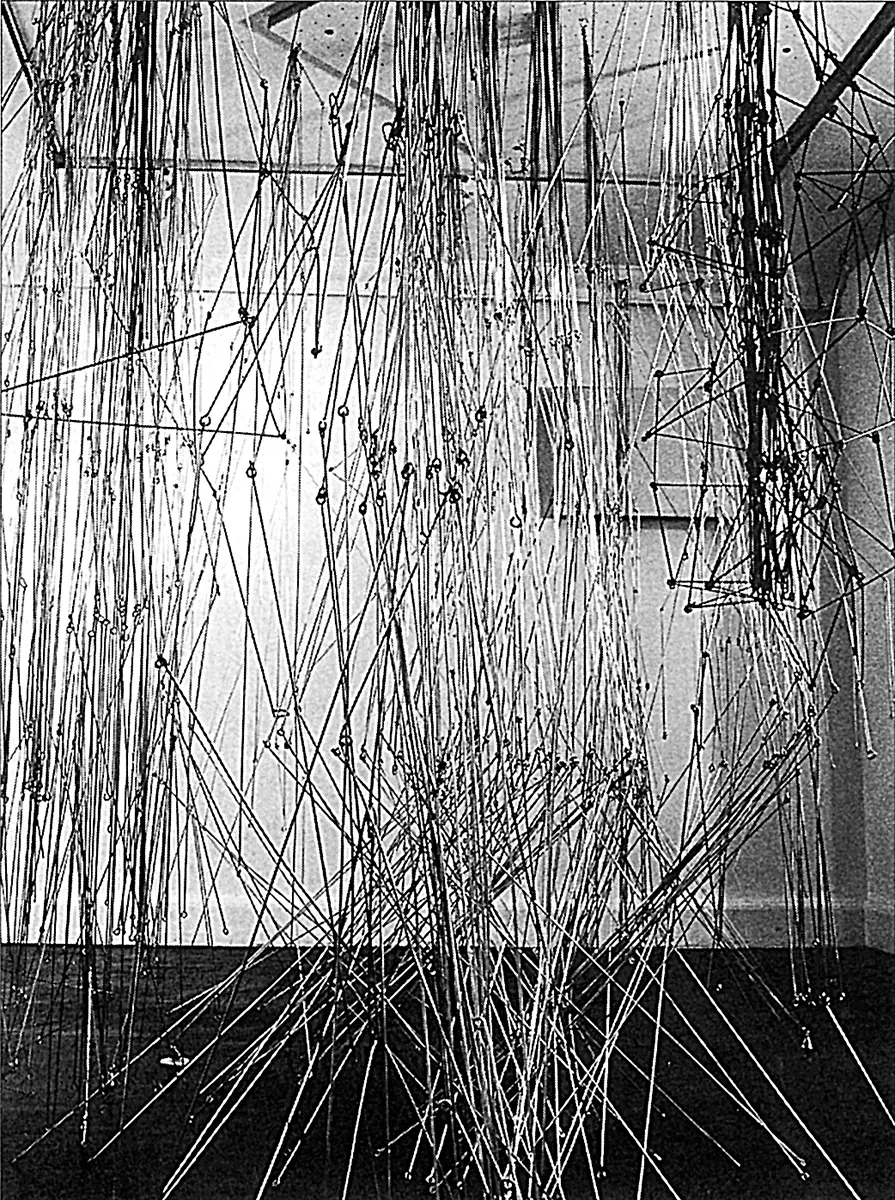
Los chorros (The Spurts) are works of lines, no longer parallel, but presented as vertical shafts, frequently poured out in a chance and disordered fashion in an apparent chaos. The fact that the artist prepared, based on the idea of the Reticuláreas, a system of articulation, which consists of winding the end of each wire so that they may be hooked together, has had a decisive effect on the lines. This system of connection, infinitely flexible, makes these works of lines show ease and fluidity even greater than those of the Reticuláreas. Individually or in groups, they sprout from above like bunches or cascades, like spurts. There are elements in them that break both the possible parallelism and the single direction of the lines, and they generally behave in a random manner. Almost always conceived as large vertical pieces, Gego considers and installs the spurts in an environment, or as masses of random lines that may cover a wall and practically behave like a large tapestry.
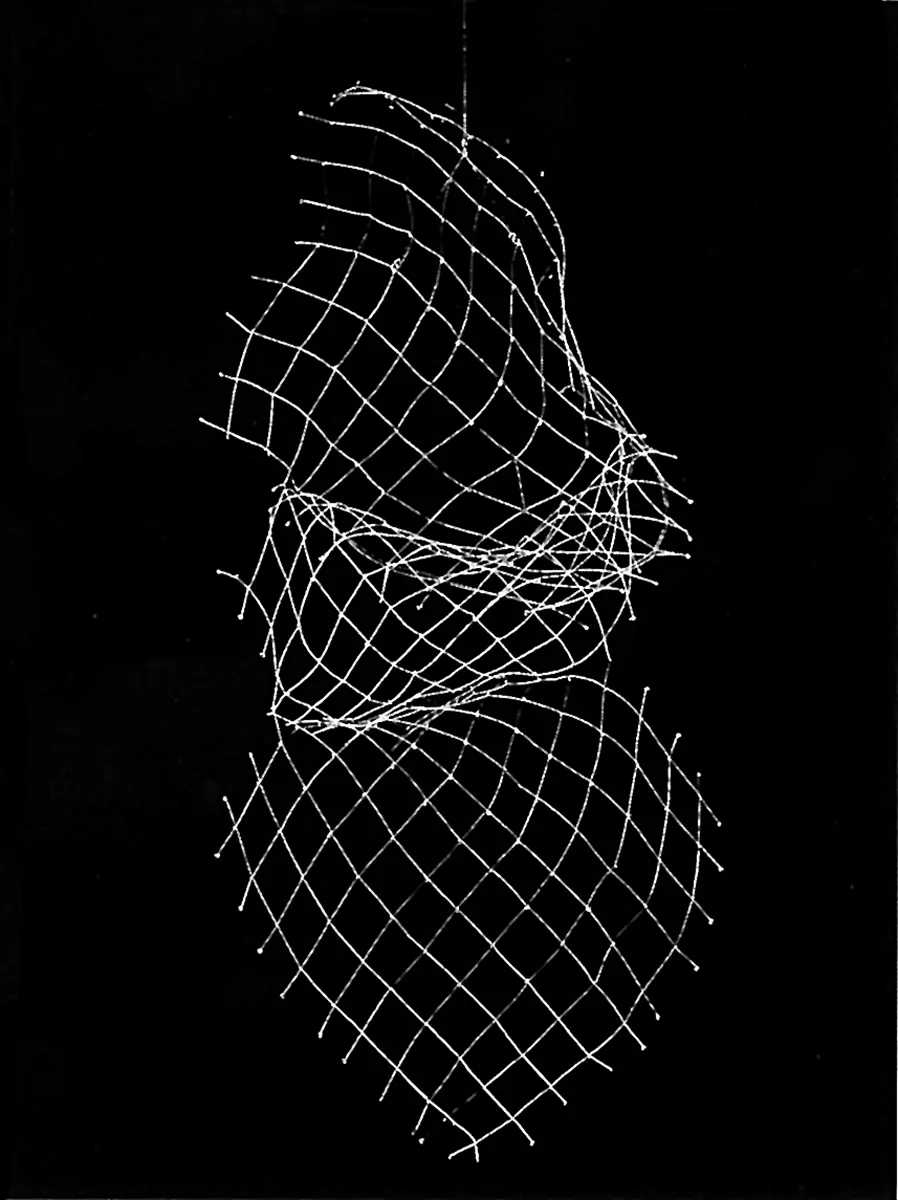
In spite of the fact that Gego did not decide to make more environmental Reticuláreas, she gave this name to all the pieces grounded in the idea of mesh or net, even though they were individual, and not environmental, and even though their modules were not triangular, but square. And even when they return to the condition of individual pieces, given their faculty to grow and combine, they may be considered as potentially environmental. These works (meshes or nets) offer a perception different from that supplied by the previous individual pieces, which looked like autonomous and individualized objects, separated from the viewer. The result of a sort of study on the way in which a work of this type could fold and unfold, that curved square meshes are usually made up of several simple meshes. Due to the tension or compression of their modules, they appear rhomboidal, and in accordance with the way in which the meshing is connected among itself—depending on whether the rods remain open or closed at their ends, and whether those of the upper body appear fastened to those of the lower body—they produce different types of curvature, making them look like flexible fabrics.
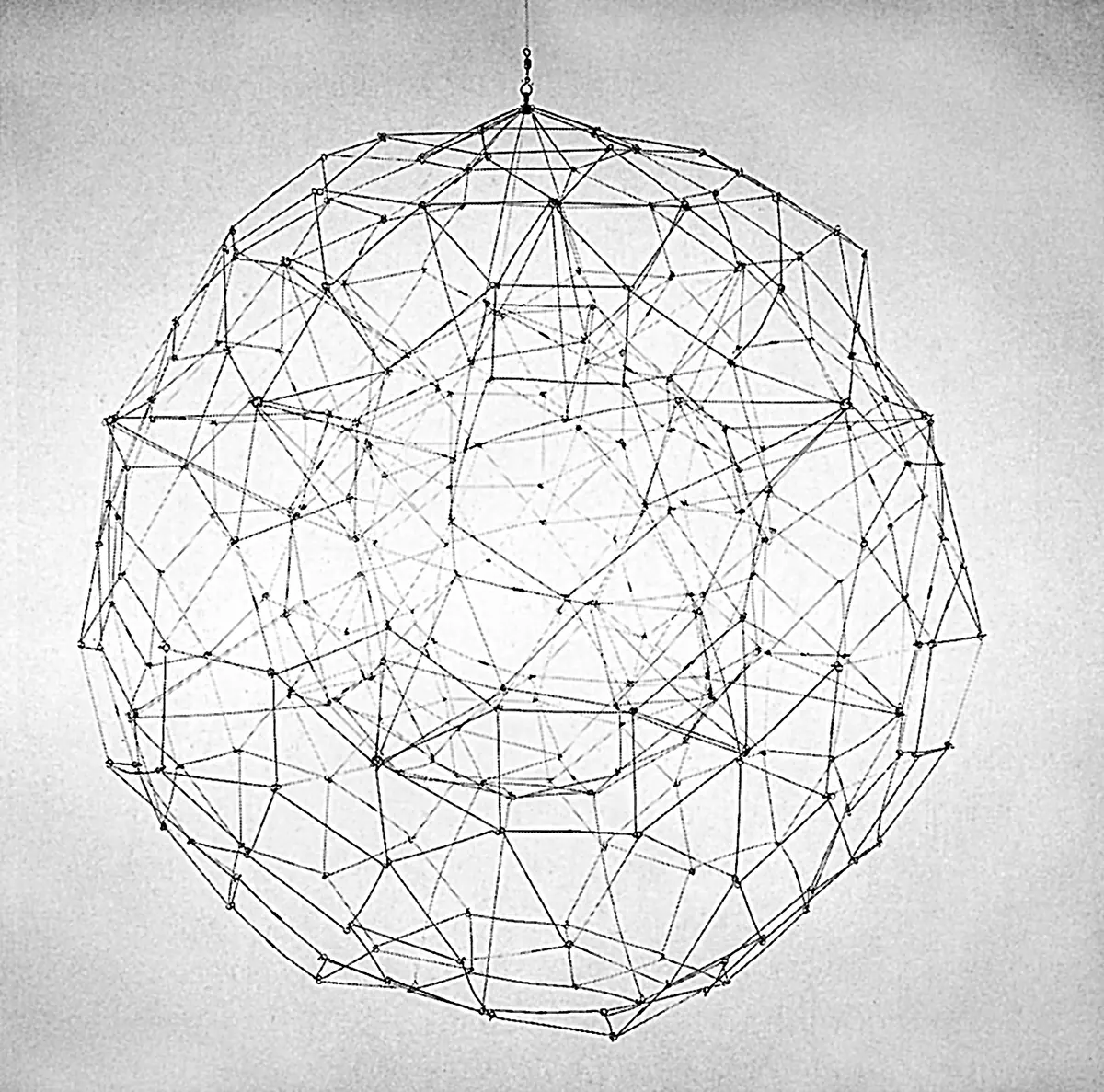
The system of modules (triangular or square) allowed Gego to create other three-dimensional proposals, such as Troncos (trunks) and Esferas (spheres). The so-called Troncos (large, cylindrical, vertical forms) produced around 1974, and Esferas (1976), which usually appear hanging from the ceiling, are separate, individual pieces, but they are transparent, penetrable by the gaze. The viewer can visit the space where they are exhibited as if they were a forest.
The Troncos and Esferas, as well as the towers made of squared reticles that have the ability to grow vertically and horizontally in a limitless fashion, lead us to imagine a space full of wire forms that are not physically penetrable. And, in fact, this would differentiate these pieces from the environmental Reticulárea, which welcomes the body of the viewer (not only the gaze) as part of itself. But Gego never developed—nor, perhaps, did she even imagine—this inexhaustible possibility of growth for her works. And the titanic undertaking of filling large spaces was totally foreign to her attitude. Referring specifically to the environmental Reticulárea, Gego denied in an interview this aim: “It isn’t necessary for it to grow physically... That would be the negation of its ethical concept. The net is life.”9
However, a space occupied (full) in that way by triangular or square Reticuláreas, by Troncos or Esferas, could have been a true spectacle. Obviously, the growth that is glimpsed in these nets and meshes is not a physical one, but rather an imaginative one, and therefore it is spiritual. Through that exercise of the imagination, they propose a possible link with the world in its totality: the fact that the cosmos can be conceived as an infinite net of relations to which we are united by multiple ties, both physical and psychic, is underscored in an ideal fashion.
Drawings Without Paper
Since the end of the ‘70s, and more noticeably in the ‘80s, the majority of Gego’s works are so unconventional, so independent of trends and styles, so free, varied, heterogeneous, and to a certain extent random, that it is not possible to stop thinking that at that time the artist had arrived at a moment in her life when she had decided to do what truly interested her, and what truly interested her was simply doing. And, perhaps, surprising herself, astonishing herself, and marveling about what emerged from her hands.
We know that Gego, after a work that had great consequence for the creation of abstract forms grounded in mathematical principles, or for the investigation of pure geometric volumes, was able to abandon, at times in a surprising way, that rigorous attitude and discard, with no anxiety or sorrow, a work sustained in parameters of extreme rationality, in order to take on the creation of structures free of any conditioning.
After 1976, she began to produce other types of smaller pieces that seem to respond to the desire not only to work with the greatest freedom of invention and manipulation, not only to follow her immediate intuition but to gather herself in her interior and evade the notoriety that the large works gave her. And this occurred precisely when—and perhaps because—her work became increasingly better known.
It is clear that at this point in her life, Gego preferred to do away with her unquestionable and well-established abilities as an architect and to devote herself passionately, alone in her studio, to working with her own hands and in accordance with her physical capabilities. That introspective solitude is perhaps what makes it possible to arrive at the present works, the drawings without paper, which are pure invention and imply a considerable dose of fun, enjoyment, and humor.
It might be thought that with these works Gego broke off from squares. But, considering what comes out of her hands at this time, we can see that it is not simply a matter of rejecting the fundamental ordered structure of the universe according to the rationalist vision, but rather that of a suggestive and creative change of attitude toward it, a change that had been announcing its arrival for a long time. Perhaps it signifies an amusing alliance, a search for other options in the game, which responds to the personal expansion of her experimental and creative attitude, very typical in an artist who, like Gego, cannot cease to manipulate materials and invent, and who, in addition, detests the idea of repeating herself and stagnating.
Prepared to force the limits, even those of her own work, she hopes to find in this play of breaking and reintegration, of rejection and recuperation, new expressive possibilities. Now, when her prestige as an artist is already consolidated and her work appears as a coherent and successful totality, why not play too, and openly, with the square, proposing approaches (squares that slide slowly and almost unnoticed toward the irregular, the broken, the undone, toward the parodic)? Why not stop seeing the square as a structure or form of knowledge, not as a law, but rather simply as a form? A form that, having lost the prestige that the great stories of modernity and the great productions of Western culture have given it, lends itself now docilely to manipulation, to play. With it, Gego, without proposing it openly, would come to produce a true and very suggestive subversion of traditional values (past and present) of the sculptural form, and she would manifest the precariousness of reality in our Latin American countries.
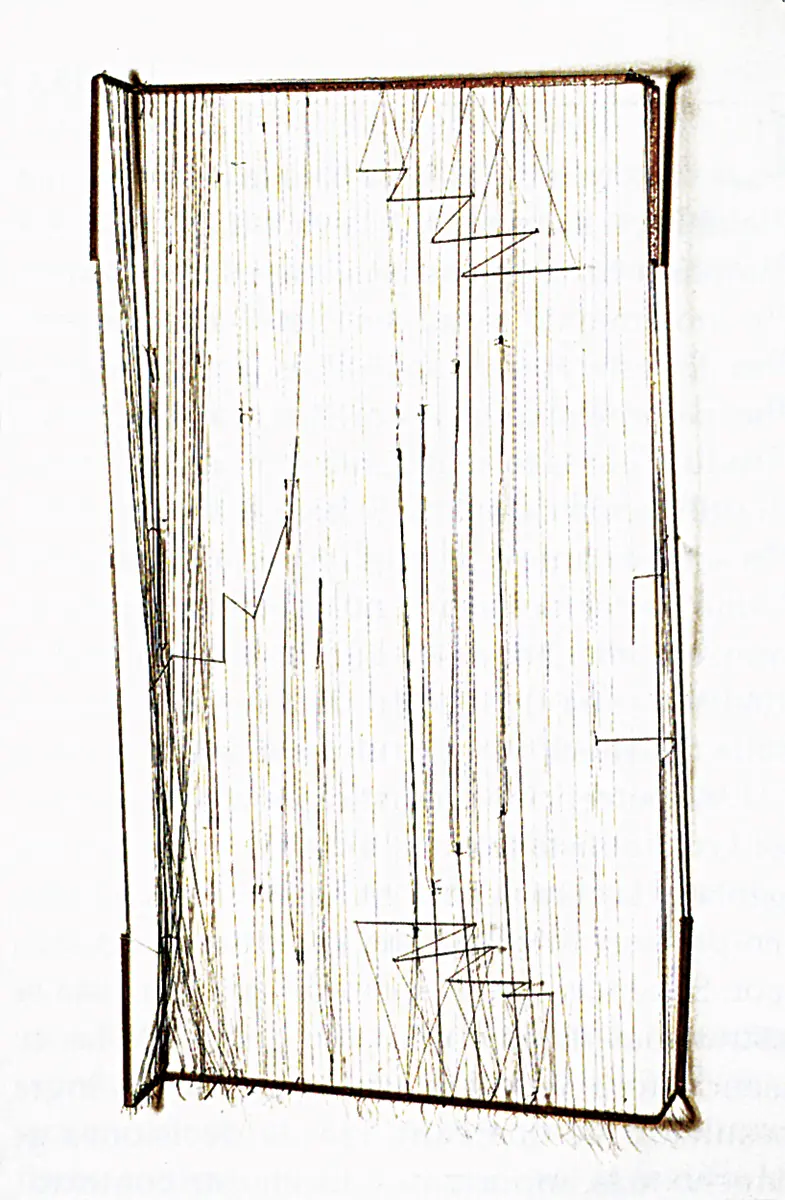
That non-conformist attitude before the established models (including those that she herself had established) possibly came from her past and began to settle in Gego with ever greater force. There are those who think that it was already present when, in 1969, the artist began to construct the nets that would comprise Reticulárea, and that this is what drove the entire work deep down. It underscores a very personal way of being, of seeing things, and of judging them, very typical of and contrary to conventions, the establishment, and institutions. This makes us think that, from very early on, a somewhat argumentative spirit stood out in Gego, extremely free with respect to her surroundings, a spirit that echoes that way of assuming the world referred to by Deleuze and Guattari in the introduction to their book A Thousand Plateaus: a way that they call rhizomatic. After the critics speculated with the idea (accepted by Gego) that with the Reticuláreas she had been producing drawings in space, Gego decided, in effect, to propose drawings in the air with wire and other varied elements, and to present these drawings as such, that is, as flat works before the wall.
Although, because of their common characteristics, all of these pieces enter that category of Drawings without paper, we must note that they display important differences between them and that they are inscribed into a process that seems to shift from the most formalized, rational, and meditated to the most subjective, random, and libertarian. In general, their formalization increasingly refuses the complacency of history, style, and good Gestalt in order to manifest an intimate and somewhat underground development that allows passages and openings that originate within (and toward) the interior, which opens up to the possibility of unexpected ruptures, of random growths. The game is formulated in a zone that is interstitial, perhaps even marginal.
If it was always very difficult to situate Gego’s work in determinate tendencies or styles, both national and international; when we speak of the Drawings without paper, this task becomes even more arduous. To be sure, equally arduous is the task of characterizing these pieces which do not agree on a coinciding verbal discourse with parameters of art history, nor do they present common denominators beyond that given to them by the artist: drawings without paper.
Weaves
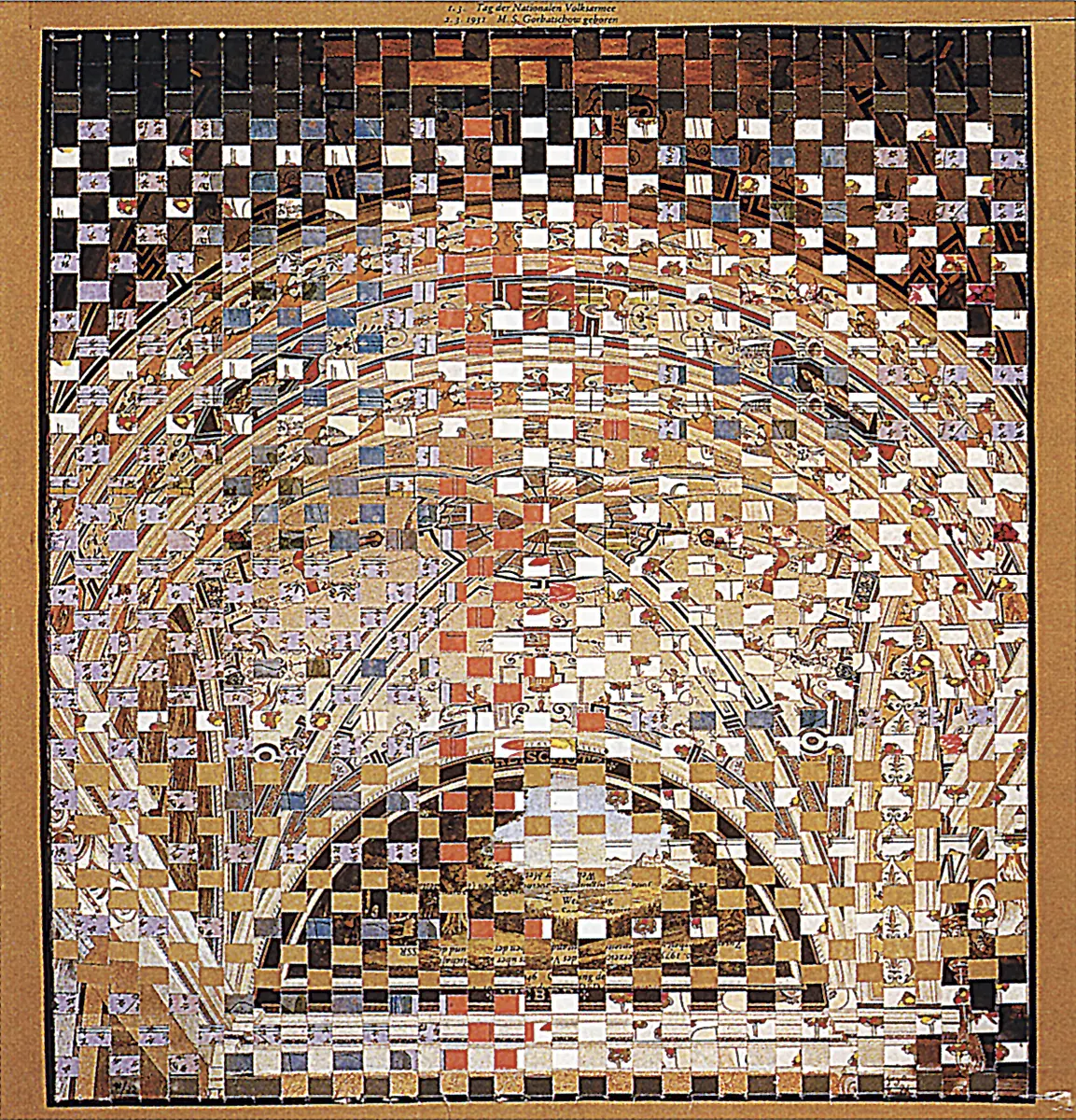
At the end of her life, Gego truly began to weave, that is, through the work of weft and warp. She did not do it with thread nor with wires, but rather with paper, cutting fine strips of her own engravings and illustrated magazines, and frequently using the golden strips from cigarette packages, with which she created stimulating compositions. In these works, two different types of codes are interwoven with no hierarchy whatsoever, appearing fractioned and only partially legible: that of her own engraved work and that of prints found at random in magazines and advertising brochures. In this way, Gego’s work (and life) are inserted and fused with the most daily context.
Like the artist herself, a symbiosis of the scientific spirit, imagination, and fantasy, “of calculation and spontaneity,” an amalgam of rigor and creative flight, Gego’s work, equally distanced from technology and from artisanship in their traditional aspects, incessantly refers to life and places itself at the very center of human life. Tireless like few others, open, fragile, and precarious, she relentlessly evades being pressured by words and, truer than any discourse that can be put together about her, she will continue to provoke the interest and awaken the imagination of generations to come.
NOTES
1. Her professional name stems from the first two letters of her first name and the first two letters of her surname, “very complicated for the Venezuelans,” Gego used to explain. fine arts
2. We must point out, however, that this was a modernity whose circle was “dominated by misery, chaos, and irrationality even in the urban centers that attempt to enter development mimetically.” Marta Traba, “Gego: Caracas tres mil,” Mirar en Caracas (Caracas: Monte Avila Editores, 1974) p. 38.
3. These artists include Magnelli, Demasne, Bill, Bloc, Vasarely, Degand, and Pillet. In Contrastes de Forma: Abstracción Geométrica 1910-1980 (Museo de Arte Contemporáneo de Caracas, 1986) the different stages of development of geometric abstraction are established chronologically.
4. I owe the information on these shows to Lourdes Blanco.
5. In 1954, a work by Pevsnet, Dinamismo en 30 grados, was incorporated into our Ciudad Universitaria. Moreover, Gego, who had several books on Gabo in her library, had a great interest in Pevsner’s work and met with him when she was in New York.
6. Lourdes Blanco, “Gego: Reticulárea,” in the catalog Gego: Reticulárea (Caracas: Ediciones de la Galería Conckright, 1969).
7. Ibid.
8. In his book Reenchantment of the World (1981), Morris Berman exposes his theories on the need to recover the feeling of enchantment in the face of the world that European culture had until around the sixteenth century, and the possibility of doing so, demonstrated by some recent scientific discoveries and by some artists.
9. Roberto Montero Castro, “Gego o la provocación para un mundo nuevo,” El Universal, Caracas, 18 Sept. 1977.
IRIS PERUGA
Fine Arts graduate, and researcher at the Museo de Bellas Artes de Caracas. She has organized several exhibitions and publications.